Málaga rediscovers Emilia Llanos, friend and confidante of Federico García Lorca
The MVA Cultural Centre brings together letters, photographs, dedicated books and personal objects to explore the life of Emilia Llanos and her links with Lorca, Manuel de Falla and other leading cultural figures of the early 20th century.
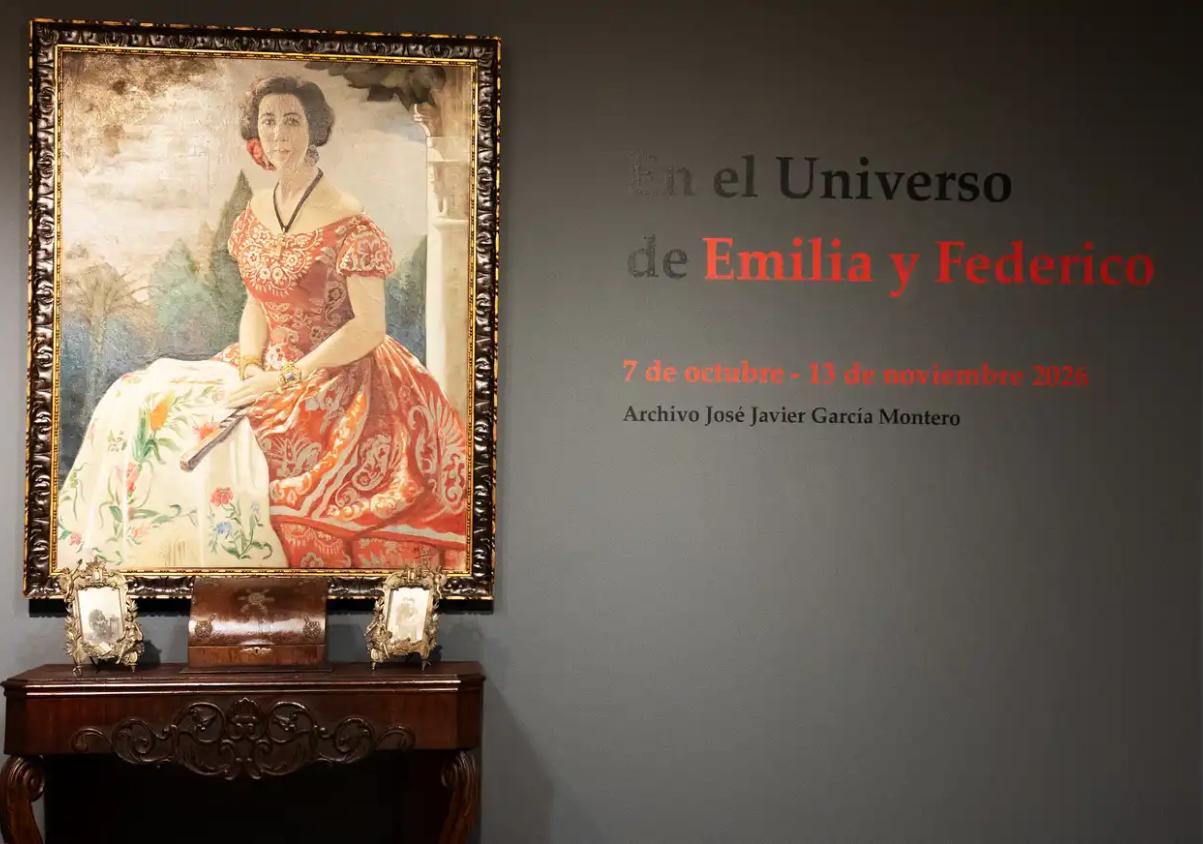

Málaga is opening a window onto one of the most fascinating cultural circles of early 20th-century Spain. The MVA Cultural Centre is hosting “En el universo de Emilia y Federico” until 13 November 2026, an exhibition that brings renewed attention to Emilia Llanos Medina and her close relationship with Federico García Lorca.
Letters, photographs, dedicated books, artworks and personal objects help reconstruct not only the friendship between the two, but also the intellectual world surrounding Lorca, Manuel de Falla, Juan Ramón Jiménez, Zenobia Camprubí, Andrés Segovia and other major names of the period.
Admission is free, and the exhibition can be visited from Monday to Friday at Málaga’s MVA Cultural Centre.
A woman who remained in the background
Emilia Llanos Medina was born in Villanueva del Arzobispo, Jaén, in 1885, although much of her life was closely linked to Granada.
She died there in 1967.
For decades, her name was overshadowed by the famous figures around her.
However, research carried out in recent years has helped restore her role as a cultured, independent woman deeply involved in Granada’s artistic and literary life.
She was a friend, confidante and witness to a generation that would leave a profound mark on 20th-century Spanish culture.
Her friendship with Federico García Lorca
The main focus of the exhibition is her relationship with Federico García Lorca.
They met in August 1918.
From that moment on, they developed a friendship based on trust, mutual admiration and a strong intellectual connection that lasted until the poet’s death in 1936.
The surviving correspondence offers a particularly personal view of that relationship.
These are not only literary documents, but also traces of an everyday friendship.
A book dedicated by Lorca
Among the highlights of the exhibition is a copy of “Impresiones y paisajes” dedicated by Lorca himself to Emilia Llanos.
In that dedication, the poet expressed his admiration for her in especially affectionate terms.
The book therefore becomes one of the clearest surviving testimonies to the bond between them.
It is displayed alongside letters, photographs and other documents that help reconstruct part of their friendship.
Emilia Llanos as a keeper of memories
One reason this cultural circle can be understood more clearly today is that Emilia Llanos preserved many of her memories for decades.
Letters, books, photographs and personal objects were carefully kept throughout her life.
That material later became an important source for researchers interested in Federico García Lorca and Granada’s cultural life.
The exhibition invites visitors not only to look at the famous artists, but also at the person who preserved so many of these records.
A network that went far beyond Lorca
The exhibition is not limited to the relationship between Emilia and Federico.
The route reveals a much wider network of friendships, collaborations and encounters.
Names include Manuel de Falla, Juan Ramón Jiménez, Zenobia Camprubí, Ismael González de la Serna and Andrés Segovia.
It also documents links with other writers, musicians and artists connected to Granada and to the future Generation of ’27.
The exhibition helps explain how those cultural circles worked, with literature, music and visual art constantly interacting.
The 1922 Cante Jondo Competition
One of the historical events included in this cultural universe is the 1922 Cante Jondo Competition.
The event in Granada was promoted by figures including Federico García Lorca and Manuel de Falla.
Its aim was to defend and preserve traditional forms of flamenco that were seen as being at risk of disappearing or being reduced to a more superficial interpretation.
The competition provides important context for understanding the artistic environment in which Emilia Llanos moved.
Manuel de Falla and Granada’s cultural circle
Llanos’s relationship with Manuel de Falla also features in the exhibition.
The composer formed part of the intellectual circle in Granada where writers, musicians and artists regularly crossed paths.
His presence broadens the perspective on a particularly creative period in Spanish cultural history.
The exhibition seeks precisely to reconstruct these personal connections, which are often missing from more conventional historical narratives.
Painting, music and literature
The exhibition includes references to the painting of Ismael González de la Serna and the music of Andrés Segovia.
Juan Ramón Jiménez and Zenobia Camprubí also appear.
The result is a cultural map that goes far beyond the Generation of ’27 understood purely as a literary movement.
The documents show how different artistic disciplines coexisted and influenced one another.
The young writers of Gallo magazine
Emilia Llanos was also connected to young writers linked to the Granada-based magazine “Gallo”.
Among them were Joaquín Amigo, Luis Rosales and Manuel López Banús.
The publication was closely associated with Federico García Lorca and with the cultural renewal taking place in Granada.
Llanos’s position close to these circles helps explain her place within that intellectual environment.
The connection with Agustín Penón
The exhibition also focuses on Agustín Penón, the writer and researcher who arrived in Granada in 1955 to investigate Lorca’s life and the circumstances surrounding his death.
During his research, Penón spoke with people who had personally known the poet.
One of them was Emilia Llanos.
Her testimony was particularly valuable because she had been close to Lorca and retained direct memories of those years.
A key source for research into García Lorca
Emilia Llanos’s collaboration with Agustín Penón helped reconstruct several episodes connected to Federico García Lorca.
The researcher gathered testimonies, documents and memories at a time when it was still extremely difficult to speak publicly about the poet’s death.
Llanos’s involvement once again demonstrates her role as a keeper of cultural memory that remains historically valuable decades later.
An exhibition linked to a wider research project
“En el universo de Emilia y Federico” is not an isolated project.
Curators José Javier García Montero and Elena Santomé have been working for some time to recover the figure of Emilia Llanos.
The exhibition forms part of a broader line of research that has included other exhibitions, publications and cultural activities.
A large proportion of the material on display comes from the José Javier García Montero Archive.
Málaga and the Generation of ’27
Bringing the exhibition to Málaga also has a direct connection with the city’s own cultural history.
The event is organised by the Generation of ’27 Cultural Centre of the Málaga Provincial Council.
It also forms part of celebrations connected with the centenary of Imprenta Sur and the magazine Litoral, two key references in understanding Málaga’s relationship with the Generation of ’27.
All of this forms part of the lead-up to the centenary of the literary group.
Letters, photographs and personal objects
The exhibition uses a wide variety of materials to build its story.
Visitors will find letters, photographs, dedicated books, works of art and personal objects.
Each item helps reconstruct a particular relationship or moment.
The aim is not simply to display historical documents, but to use them to bring visitors closer to the people behind them.
Practical information
Exhibition: “En el universo de Emilia y Federico”.
Venue: Centro Cultural Provincial María Victoria Atencia (MVA), Calle Ollerías 34-36, Málaga.
Dates: 7 October to 13 November 2026.
Opening hours: Monday to Friday, 10:00 am to 8:00 pm.
Public holidays: closed.
Admission: free, subject to capacity.
Four free guided tours
The programme also includes four free guided tours.
They will take place on:
21 October 2026
28 October 2026
4 November 2026
11 November 2026
All tours begin at 6:00 pm.
Each group is limited to 20 participants, so advance booking is required.
How to book a guided tour
Anyone interested should request a place by emailing:
The application must include full name, preferred date, number of participants, email address and contact telephone number.
Places are limited according to the capacity set for each tour.
Rediscovering Emilia to better understand Lorca
One of the most interesting aspects of the exhibition is the change of perspective it proposes.
Instead of focusing exclusively on Federico García Lorca, it invites visitors to discover one of the people who formed part of his closest circle.
Emilia Llanos was a friend, confidante, hostess and keeper of memories connected to some of the most important cultural figures of the period.
Recovering her story adds new layers to a cultural history that for decades was told mainly through its most famous names.
A cultural memory now arriving in Málaga
Until 13 November, Málaga offers the chance to explore that history through original documents and personal memories.
The exhibition introduces visitors to a woman who lived close to some of the great creators of 20th-century Spain, but whose own story remained on the margins for a long time.
“En el universo de Emilia y Federico” seeks precisely to correct that imbalance and place Emilia Llanos within the extraordinary cultural network to which she belonged.

Latest news


Similar News
Málaga through 45 paintings: from Casa de Socorro to the interior of the Cathedral
Málaga
Munch and Picasso meet for the first time in Málaga: a major exhibition opens this October
Málaga
La Malagueta explores the world of Morante de la Puebla through the photography of Maurice Berho
Málaga