Gran Hotel Miramar turns 100: from luxury hotel to hospital, courthouse and back to five-star hospitality
The landmark building overlooking the Mediterranean celebrates a century of history after serving as a hotel, a wartime hospital, a public institution and Málaga’s courthouse before returning to its original purpose.
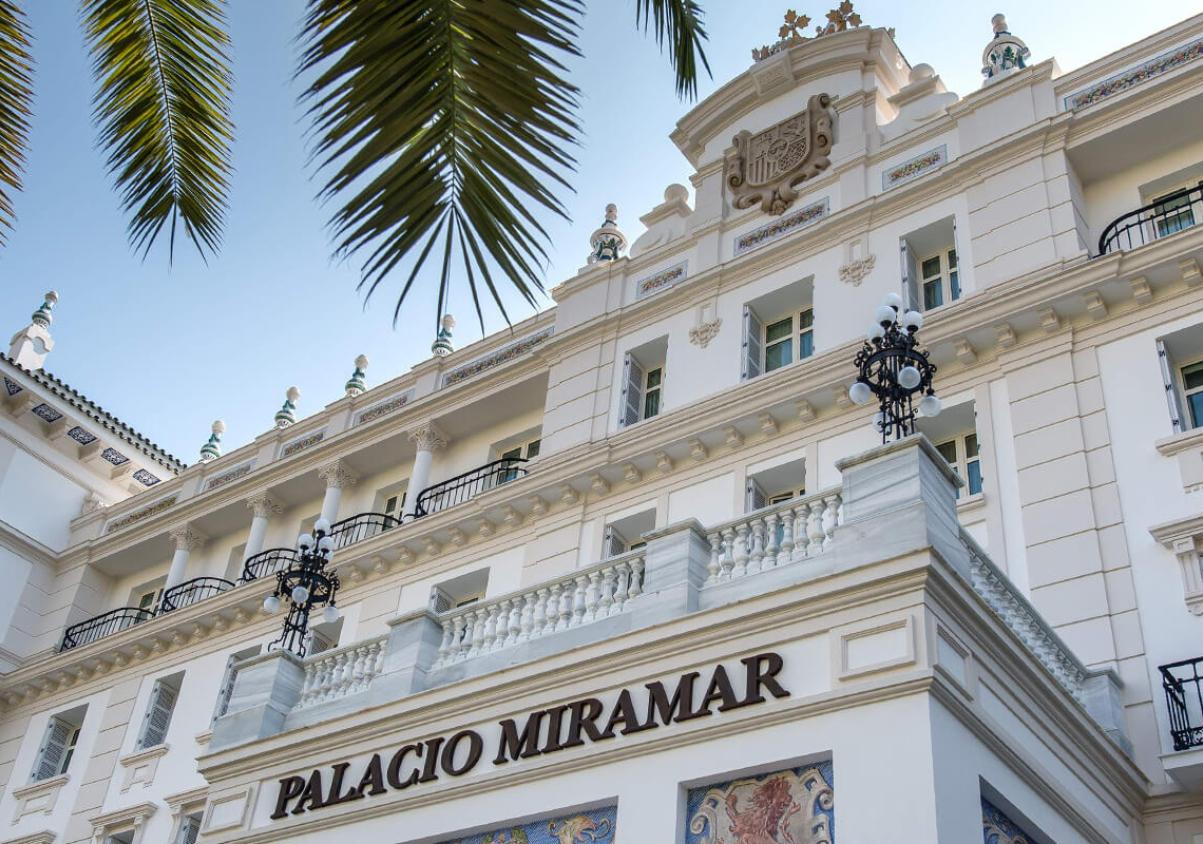

Few buildings in Málaga can tell the story of a full century of change quite like the Gran Hotel Miramar. Opened in 1926 facing the Mediterranean, the building reaches its 100th anniversary in 2026 after changing names, owners and uses several times.
It began life as a luxury hotel designed to strengthen Málaga’s tourism appeal, was converted into a hospital during the Spanish Civil War, later housed public institutions and then spent two decades as the city’s Palace of Justice.
After a complex restoration, it finally returned to its original role and today operates once again as one of Málaga’s most recognisable five-star hotels.
A hotel designed to put Málaga on the tourism map
The story begins in the early 1920s.
The building was designed by Málaga architect Fernando Guerrero Strachan, who was responsible for several other notable buildings in the city.
Construction began in 1921 on a site by the sea, close to Paseo de Reding and La Malagueta.
The project had an ambitious goal: to create a hotel capable of competing with major European establishments and attracting wealthy travellers to Málaga.
Hotel Príncipe de Asturias opened in 1926
The hotel opened in 1926 under the name Hotel Príncipe de Asturias.
King Alfonso XIII and Queen Victoria Eugenia took part in its inauguration, reinforcing the prestige of the project from the beginning.
During its early years, the hotel became one of Málaga’s main social venues.
Its halls hosted receptions and gatherings, while politicians, members of high society and cultural figures stayed in its rooms.
The building represented a Málaga that was beginning to see tourism as an activity with significant economic potential.
A building designed to face the Mediterranean
Its location was a key part of the project.
The hotel was built facing the sea, next to La Malagueta, in an area undergoing major urban change during the early 20th century.
Guerrero Strachan designed an eclectic building combining historicist, Neo-Mudéjar, Neoclassical and Modernist influences.
Its gardens, terraces, courtyards and large reception rooms strengthened the palatial character of the property.
A century later, that monumental appearance remains one of its defining features.
The Civil War completely changed its purpose
Hotel activity was interrupted with the outbreak of the Spanish Civil War in 1936.
The building temporarily stopped receiving guests and was given a medical role.
During the conflict it was used as a blood hospital and military hospital, adapting spaces originally designed for accommodation and leisure.
It was the first of several major changes of use the building would undergo during its history.
Hotel activity returned after the war
After the conflict, a process began to restore the building to its original function.
The hotel officially reopened in 1940, beginning a second stage as a tourism establishment.
Over the following decades, it remained part of Málaga’s social and hotel scene.
However, changes in the city and in the tourism sector eventually led to another turning point.
Hotel activity came to an end in 1967.
From hotel to public building
From that point onwards, the former Miramar entered a long period linked to public administration.
Its rooms and halls were used for a variety of administrative, educational and judicial purposes.
The building continued to occupy a prominent position by the Mediterranean, but its interior moved increasingly far from the layout originally designed for hotel use.
That period culminated in a particularly significant transformation during the 1980s.
Two decades as Málaga’s Palace of Justice
In 1987, the former hotel was converted into Málaga’s Palace of Justice.
The transformation significantly altered its interior layout.
Ballrooms and guest rooms were turned into offices, courtrooms, archives and other spaces needed for judicial activity.
For around twenty years, thousands of lawyers, judges, civil servants and members of the public used a building that had once welcomed international travellers and prominent guests.
The courts remained there until 2007.
The challenge of restoring the original building
Once the judicial services moved out, plans began to emerge to return the property to hotel use.
The process was far from simple.
Decades of alterations had changed both the layout and parts of the building’s structure and decoration.
Architect José Seguí, whose studio took part in the restoration, has explained that one of the main challenges was to recover the architectural identity originally created by Fernando Guerrero Strachan.
That meant removing later additions, reinforcing structural elements and reconstructing many interior features.
A restoration lasting several years
The recovery process lasted around three years.
Before decorative work could begin, engineers first had to ensure the structural stability of the building.
Additions from its administrative and judicial period were removed, and spaces that had been divided by additional floors were reopened.
The exterior gardens were also restored, while modern systems were installed to bring the property up to the standards expected of a contemporary luxury hotel.
Rebuilding the past piece by piece
One of the most complex parts of the project was recovering decorative features that had disappeared or suffered significant damage.
The restoration team studied photographs, plans and surviving fragments to reconstruct parts of the original interiors.
Many pieces were recreated by hand using remains found during the works.
The intention was not to produce an exact replica of the building as it stood in 1926, but to recover its historical identity while meeting modern technical and comfort requirements.
A definitive return to its original purpose
After decades away from tourism, the building finally returned to its original use.
The restoration was completed at the end of 2016, and the new Gran Hotel Miramar began welcoming guests again in 2017.
The property returned to the market as a five-star Grand Luxury hotel.
Almost nine decades after its original opening, the building was once again serving the purpose for which it had been designed.
Hoteles Santos brought the hotel project back to life
The recovery was driven by Hoteles Santos, which promoted the transformation of the former courthouse into a luxury hotel.
The project helped preserve one of the most important buildings on Málaga’s seafront while also restoring its original use.
Gardens, grand halls and guest areas were brought back, while modern facilities were added to meet the needs of contemporary hospitality.
A protected building in Málaga
The significance of the former Hotel Miramar is not only symbolic.
The building is included in Málaga’s catalogue of protected buildings, with a high level of architectural protection.
Municipal planning documents highlight its design, the colour treatment of its façades and the combination of different architectural influences.
Its position within a landscaped plot also distinguishes it from much of the surrounding urban fabric.
Guests linked to 20th-century history
During its first hotel period, the Miramar welcomed many prominent visitors.
Among the best-known figures associated with the property is scientist Marie Curie, who stayed there during her visit to Spain in 1931.
Members of royal families, politicians and leading cultural and social figures also passed through the hotel.
That history helps explain why the Miramar quickly became a symbol of prestige in 20th-century Málaga.
A century reflecting Málaga’s transformation
The evolution of the Miramar mirrors, in many ways, the transformation of the city itself.
It was created during a period when Málaga was beginning to build a stronger tourism identity.
It later adapted to the extraordinary circumstances of the Civil War and then became part of the city’s administrative life.
When Málaga once again established itself as a major international tourism destination, the building also recovered its hotel function.
A hundred years later, it continues to face the Mediterranean with almost the same purpose for which it was originally built.
From courtrooms back to luxury tourism
Perhaps nothing illustrates the building’s transformation better than comparing its role at the beginning of this century with its current use.
Until 2007, it was a building where court hearings were held and civil servants worked.
A decade later, it was once again welcoming guests as a luxury hotel.
Between those two stages, one of Málaga’s most significant heritage restoration projects of recent years was required.
The result preserved the property while returning one of the city’s most distinctive buildings to public view in a new chapter of its history.
Gran Hotel Miramar celebrates its first 100 years
In 2026, the building reaches its centenary.
The anniversary marks much more than the story of a hotel.
It also reflects a century of social, urban and tourism-related changes in Málaga.
Hotel Príncipe de Asturias, wartime hospital, public building, Palace of Justice and Gran Hotel Miramar are all chapters in the life of the same property.
After a hundred years, the building is once again doing what it was originally designed to do: welcoming travellers beside the Mediterranean.

Latest news

Similar News
Former Málaga Post Office moves closer to becoming a luxury hotel
Málaga
Málaga awaits the opening of the new Hotel Zenit San Telmo this September
Málaga
Málaga welcomes fewer travellers, but hotel guests are staying longer
Málaga