Roman theatre at Singilia Barba re-emerges near Antequera after decades without major excavations
A new archaeological campaign at the ancient Roman city outside Antequera has uncovered further sections of the theatre’s seating area. The building is thought to have measured around 52 metres in diameter and to have accommodated approximately 2,000 spectators.
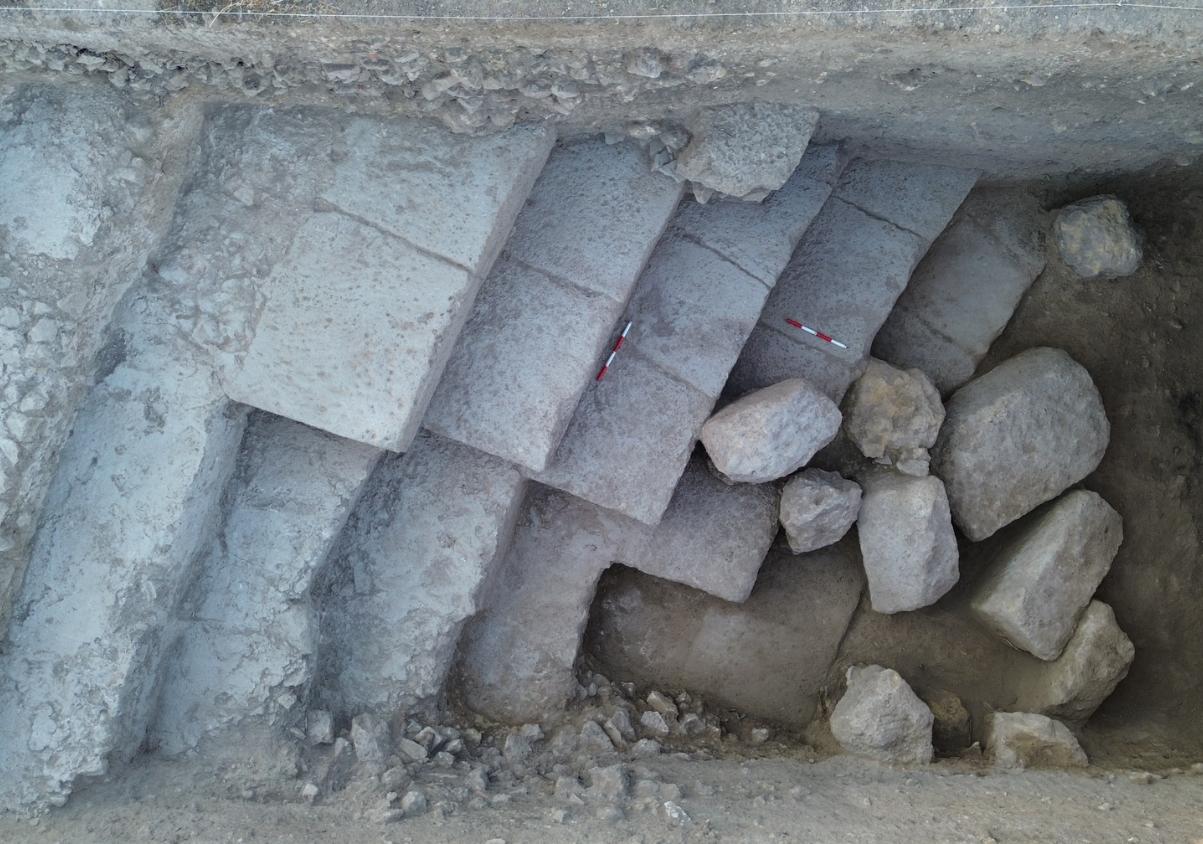

Beneath the land of Singilia Barba, a large part of one of the most important Roman settlements in the Antequera area still remains buried. A new archaeological campaign has returned to its theatre after decades without sustained excavation, and the first results are helping researchers understand the true scale of the building.
The work has revealed new structures belonging to the theatre, along with large architectural elements preserved after the building collapsed.
The Complutense University of Madrid (UCM), which leads the research project, says archaeologists have identified an important collapse layer in which many structural elements remain close to the position they occupied when the building fell.
The theatre is estimated to have measured around 52 metres in diameter and to have held approximately 2,000 spectators, dimensions that help illustrate the importance Singilia Barba reached during the Roman period.
A 52-metre theatre for around 2,000 spectators
The theatre formed part of the monumental centre of Singilia Barba.
According to documentation from the UCM research project, the building measured approximately 52 metres across and could accommodate around 2,000 people.
Its size is significant.
Roman theatres were not simply places for performances. They were major public buildings that also reflected the political, economic and social importance of a city.
At Singilia Barba, the theatre stood alongside other known monumental structures, including the forum and circus, creating an urban centre with a considerable degree of architectural development.
Excavations return after more than three decades
The last major systematic archaeological campaigns at Singilia Barba date back to the late 1980s and early 1990s.
The Complutense University notes that modern excavations began in 1985, led by the University of Málaga, and continued until 1991.
Those campaigns studied the forum and part of the theatre, while also documenting temples, a basilica, paved areas and sections of the upper seating.
After that period, the site no longer had a continuous programme of large-scale excavation.
There were later emergency interventions and individual studies involving cemeteries, villas, topography and inscriptions, but not a comprehensive research programme comparable to the one now under way.
What has been uncovered now?
The latest campaign is once again focusing on the theatre.
Researchers Luis Romero Novella and Sergio España-Chamorro have explained that the excavation is exposing new structures and a substantial layer of collapsed architectural material.
The preservation of these remains is particularly important because it can reveal not only how the building functioned during its lifetime, but also how it eventually collapsed and which parts survived beneath the ground.
Excavations carried out in the 1980s had already identified part of the cavea, the seating area used by spectators.
However, a substantial part of the lower sections is still buried and, according to the research project, may be especially well preserved.
This means the theatre still has considerable potential to provide new information about its architecture and the urban development of Singilia Barba.
Large stone blocks preserved underground
One of the most striking aspects of the latest excavation is the presence of large architectural blocks preserved within the collapse layer.
Finds like these can help archaeologists reconstruct the original layout of ancient buildings with much greater precision.
When a structure was dismantled over centuries and its stone reused elsewhere, much of the architectural evidence disappeared.
By contrast, when elements remain buried after a collapse and stay relatively close to their original position, researchers can better understand how the building was constructed.
The UCM considers the theatre at Singilia Barba to be one of the Roman theatrical complexes in ancient Baetica with particularly strong research potential.
Singilia Barba, a Roman city near Antequera
The archaeological site lies at the present-day Cortijo del Castillón, around seven kilometres northwest of Antequera and approximately two kilometres from the Guadalhorce river.
Its location was strategically important.
Singilia Barba stood on ancient communication routes and was mentioned by classical authors including Pliny the Elder and Ptolemy.
The settlement predates Roman rule and is documented from at least the 3rd century BC.
It later became fully integrated into the Roman world and, during the Flavian period, achieved municipal status under the name Municipium Flavium Liberum Singiliensis.
A forum, theatre, circus and more than 70 inscriptions
The scale of the theatre fits with the other known features of the city.
Singilia Barba had a forum, theatre, circus, domestic areas and burial zones, as well as significant ceramic production.
One of the most important sources of information about its inhabitants is its epigraphic record.
The research project has documented more than 70 inscriptions, which are essential for reconstructing aspects of the city’s political, religious and social organisation.
Earlier excavations in the forum also identified two major temples, other religious spaces, a paved public square and a basilica used for judicial and civic functions.
All of this shows that Singilia Barba was far more than a small rural settlement.
New technology to explore what remains buried
The new phase of research does not rely solely on traditional excavation.
The project “Rediscovering Singilia Barba: between geoarchaeology and the characterisation of material culture” also uses techniques such as ground-penetrating radar, magnetometry, advanced topography and photogrammetry.
These tools allow archaeologists to investigate buried structures without excavating the entire area.
One of the main aims is to reconstruct the urban layout more accurately and understand the relationship between visible remains and those that are still hidden underground.
The project includes geophysical surveys around key areas such as the theatre, forum and circus.
Who is leading the excavations?
The research is being directed from the Complutense University of Madrid.
The principal investigator is Luis Romero Novella, a specialist in Roman forums and decorative programmes.
The project is also co-directed by Sergio España-Chamorro, a UCM researcher specialising in the Roman landscape of Baetica and Latin epigraphy.
They are joined by Manuel Romero Pérez, Antequera’s municipal archaeologist, who has extensive knowledge of the site and was already involved in earlier work there.
The wider project also includes researchers and specialists from several universities and institutions.
A project funded until the end of 2026
The research forms part of an agreement between the Community of Madrid and the Complutense University of Madrid, under a funding programme for projects led by emerging researchers.
The project runs from 1 January 2025 to 31 December 2026 and has total funding of €42,494.63.
Alongside archaeological work, the programme includes a review of materials held at the Museum of the City of Antequera and the Museum of Málaga.
It also includes outreach activities, guided visits, workshops and the creation of a Virtual Museum of Singilia Barba using three-dimensional models.
The site is also moving towards greater public access
The scientific research coincides with other work aimed at improving the conservation and presentation of Singilia Barba.
Antequera Town Council announced on 31 August 2026 an investment of more than €380,000 to protect and improve the archaeological site.
The project includes cleaning and consolidation of structures, new protective fencing, improved access and visitor routes, as well as new signage and interpretation materials.
Singilia Barba has been protected as a Site of Cultural Interest with the category of Archaeological Zone since 1996.
The official designation already recognised the presence of the theatre, forum, production areas, homes and necropolises within the ancient settlement.
A theatre with much more still to reveal
The latest excavation does not mark the end of the research into Antequera’s Roman theatre. Quite the opposite.
A large part of the structure remains buried, and future campaigns will be needed to define its chronology, architectural phases and the full layout of the seating area.
What is already known gives a clear idea of its scale: around 52 metres in diameter, space for roughly 2,000 spectators and large architectural remains still preserved underground.
After decades without a continuous excavation programme, Singilia Barba is once again revealing part of Antequera’s Roman past — a history that still remains, quite literally, beneath the fields.
Original source
The main original source is the Complutense University of Madrid, which leads the project “Rediscovering Singilia Barba: between geoarchaeology and the characterisation of material culture.”
The UCM published an update on 24 September 2026 confirming that the current campaign is uncovering new theatre structures and large architectural elements preserved within collapse layers.
Official project documentation also places the theatre at approximately 52 metres in diameter with an estimated capacity of around 2,000 spectators, and explains that the excavations of the 1980s documented the upper areas of the cavea while lower sections remain buried.

Latest news