La Extranjera Pool in Estepona: the hidden Río Padrón spot with natural pools between Sierra Bermeja and the Costa del Sol
Just a few kilometres from Estepona’s beaches, the Río Padrón forms natural pools, small waterfalls and shaded sections surrounded by Mediterranean vegetation. La Extranjera is one of its best-known spots, and September offers a good opportunity to discover this protected area away from the busiest beach tourism.
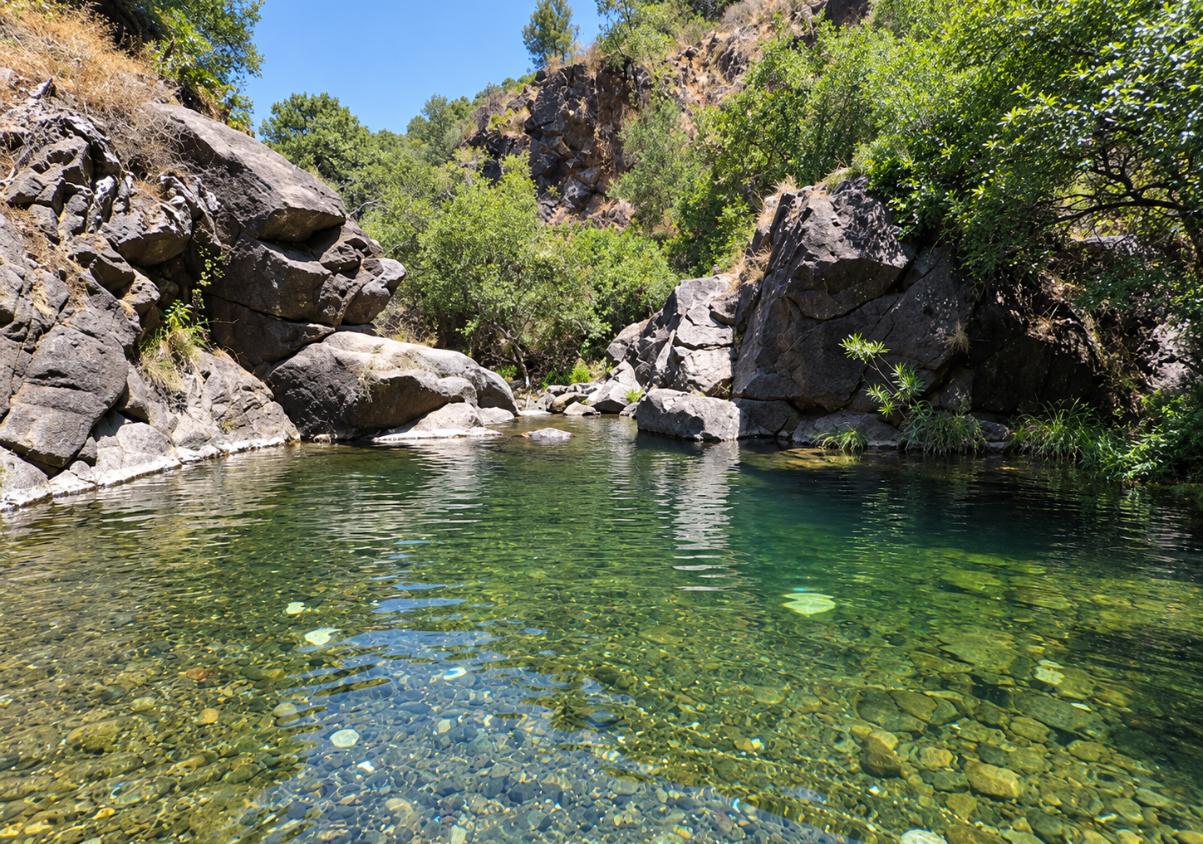

There are places on the Costa del Sol where the landscape can change completely within just a few kilometres.
In Estepona, leaving the coastline behind and heading towards the foothills of Sierra Bermeja is enough to move from beaches, hotels and major roads into a river corridor surrounded by rocks, trees and riverside vegetation.
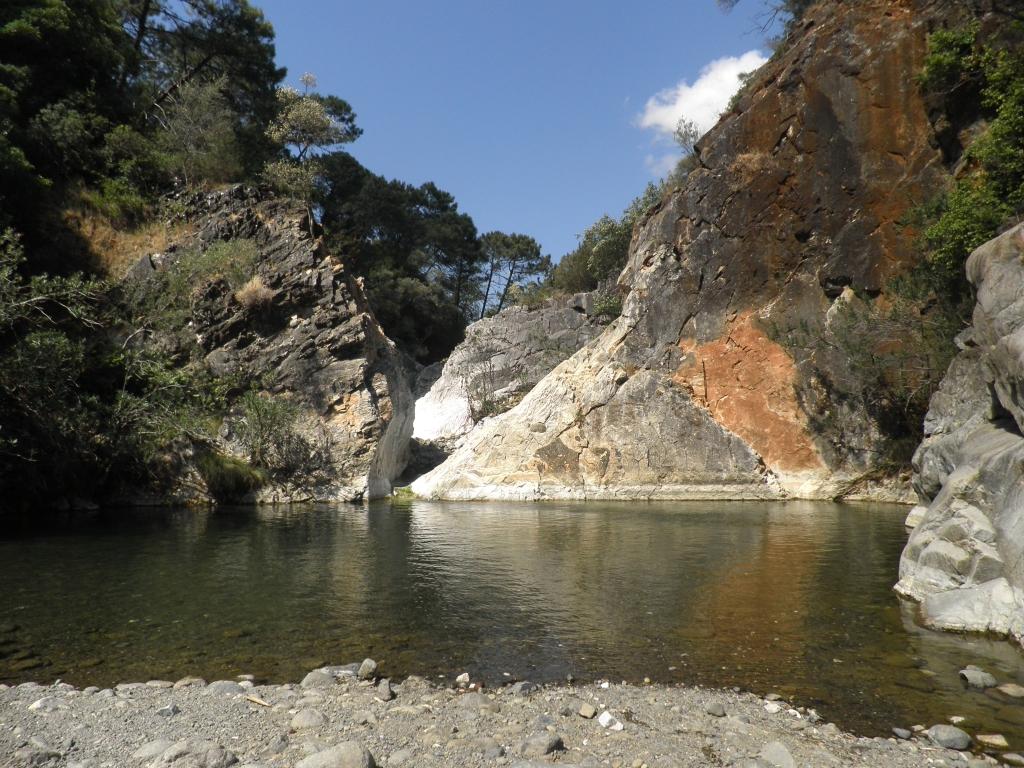
This is where La Extranjera Pool can be found, one of the best-known natural pools along the Río Padrón and a spot that has become increasingly popular with hikers and visitors looking for an alternative to the usual coastal plans.
Part of its appeal comes precisely from that contrast.
During the approach, major infrastructure such as the AP-7 motorway can still be seen. But closer to the river, the scenery changes: rocks dominate the riverbed, vegetation becomes denser and the water gathers in small natural pools.
La Extranjera is the best known, but it is not the only one.
Along its course, the river creates pools, small rapids and narrow rocky sections, forming a landscape very different from the tourist areas of Estepona only a few kilometres downstream.
There is also one important fact to know before planning a visit: this is not simply a scenic place for photographs. The Río Padrón forms part of the Natura 2000 Network and is designated a Special Area of Conservation (SAC) because of its environmental importance.
Where is La Extranjera Pool?
La Extranjera is located along the Río Padrón, within the municipality of Estepona.
The river rises in the Sierra Bermeja and Sierra Real area, close to Puerto de Peñas Blancas and Cerro del Majuelo, before flowing down towards the Mediterranean and reaching the sea at Padrón beach.
Although some references describe the river as being around 12 kilometres long in total, the protected Special Area of Conservation covers just over seven kilometres of the watercourse before it reaches the sea.
La Extranjera is located further inland, away from the mouth of the river and surrounded by a much more wooded landscape.
That helps explain why the area can feel so different despite being relatively close to some of the most urbanised parts of the western Costa del Sol.
A protected river just outside Estepona
The importance of the Río Padrón goes far beyond its natural swimming pools.
The area was declared a Special Area of Conservation in 2015, becoming part of the European Natura 2000 Network because of the habitats and species of community interest found there. The protected area covers approximately 41 hectares.
The landscape is strongly shaped by the presence of water.
Along the riverbanks, visitors can find willows, poplars, oleanders, tamarisks and other Mediterranean species, creating valuable corridors of vegetation in an area characterised by dry summers.
The wildlife is equally significant.
Official information highlights species such as the European otter, Spanish pond turtle and Guadiana nase, as well as amphibians, fish, invertebrates and birds including kingfishers and dippers.
This natural value means the visit should be approached differently.
La Extranjera may be a leisure destination, but first and foremost it is part of a protected ecosystem.
How the natural pools of the Río Padrón are formed
One of the most distinctive features of the river is the shape of the terrain.
In several places, the channel narrows between rocks and small natural walls. Continuous water erosion has gradually shaped these formations, creating areas where the current slows and water collects.
The result is the series of natural pools and swimming holes that characterise parts of the river.
The Andalusian regional government specifically mentions some of the most popular spots, including the Marmitas del Padrón and Charca de las Extranjeras.
Not all of them are the same size, and they do not look identical throughout the year.
The flow of a Mediterranean river can vary considerably depending on rainfall, temperature and the time of year, so a photograph taken at one moment does not guarantee that the same conditions will be found several weeks later.
Why September can be a good time to discover the Río Padrón
During July and August, inland river pools across Málaga have become increasingly popular as an alternative to the coast.
September offers a slightly different situation.
Temperatures can still be high on the Costa del Sol, but the intense tourist pressure of peak summer gradually begins to ease.
That can make a walk through the inland landscape particularly appealing for visitors who want to combine nature and water without spending their entire stay in Estepona on the seafront.
Riverside vegetation also provides shaded areas that contrast with the more exposed spaces along the coast.
However, September does not guarantee a specific water level or identical route conditions.
Before entering a natural river environment, visitors should check the weather forecast and avoid the area if there is any risk of heavy rain or storms upstream.
La Extranjera is not a conventional swimming pool
Its growing popularity on social media can make La Extranjera look like a hidden outdoor swimming pool.
It is not.
There is no designated bathing area, lifeguard, access ladder, regular depth or the facilities found at a public swimming pool.
It is a natural river environment within a protected area.
Rocks can be uneven and slippery, depths may vary and the state of the river changes depending on natural conditions.
The Andalusian regional government acknowledges that these pools attract visitors interested in both the landscape and the water, but it also specifically asks people to take extra care of the environment when entering the river.
The visit is therefore better approached as a river walk through a natural area rather than a day at a conventional swimming facility.
How to reach La Extranjera Pool
One of the usual reference points for approaching the Río Padrón from the coast is exit 160 of the A-7, heading towards the area around the Costa del Sol Equestrian Art School.
From there, the route continues inland following the general direction of the river.
One of the most unusual moments comes when the path passes beneath the large AP-7 viaduct.
It is probably the image that best sums up the contrast of the area: one of the Costa del Sol’s main motorways runs overhead while, just a few metres below, the river continues between vegetation and rocks.
The Forest Hills development can also serve as a visual reference along the route towards the inland sections.
As the route progresses, the urban landscape begins to disappear and tracks and footpaths take over.
The final section to the pool must be completed on foot, following the area around the riverbed.
Do not rely only on your satnav
There is one particularly important point when visiting less developed natural areas.
Entering “La Extranjera” into a navigation app does not necessarily mean a car can reach the exact location shown on the map.
The final sections involve tracks and unpaved roads whose condition can change.
The safest option is to park only in permitted areas and never block tracks, private entrances or routes that may be needed by emergency vehicles.
It is also best not to try to drive as close to the riverbank as possible.
Part of the experience lies precisely in completing the final section on foot.
Proper footwear is important near the river
Even if some shorter versions of the route do not require advanced fitness, walking beside or through a river is very different from using a pavement or a fully developed hiking trail.
There may be loose stones, wet surfaces and slippery sections.
For that reason, closed shoes with good grip or footwear suitable for walking near water are much better than flip-flops or open sandals.
It is also advisable to carry only what is needed and protect phones, cameras and other items that could be damaged by water.
The level of difficulty also depends on how far the route is extended.
Reaching La Extranjera is one thing; continuing upstream towards additional pools turns the outing into a different and more demanding route.
There is more to the river beyond La Extranjera
One common mistake would be to assume that the entire visit ends at the most photographed pool.
The Río Padrón continues to offer interesting landscapes further upstream.
Longer routes can reveal additional pools, rock formations and sections where the water continues to shape the riverbed.
Among the better-known areas are the Marmitas del Padrón, associated with sections where rock formations and flowing water create some of the most distinctive scenery along the route.
However, extending a river route also increases the level of difficulty.
Visitors should not assume that everyone can continue simply because the first section was easy.
An unusual recommendation: disinfect footwear before entering the water
Among the official recommendations for visiting the river, there is one that many walkers may not be familiar with.
If entering the water, the Andalusian authorities recommend that footwear, clothing and any equipment that may come into contact with the river should be disinfected beforehand.
The aim is to prevent fungi or other harmful microorganisms from being transferred between different aquatic environments.
It is a simple precaution that highlights how vulnerable small river ecosystems can be.
Someone who uses the same shoes in different rivers, streams or wetlands can unintentionally carry organisms from one ecosystem to another.
Do not move rocks or alter the riverbanks
Another official recommendation concerns behaviour that may seem harmless at first.
Visitors should not move rocks, alter the riverbed, disturb the banks or damage vegetation.
Life exists beneath and around those stones.
Invertebrates, fish, amphibians and other species use the river as shelter, feeding areas and breeding habitat.
The authorities also point out that otters are present in the Río Padrón and ask visitors to take particular care during breeding periods.
The best rule is simple: leave the area exactly as you found it.
Do not leave rubbish around the pool
Popularity has an obvious consequence in small natural spaces.
A place receiving more visitors can deteriorate quickly if every person leaves even a small trace behind.
Bottles, cans, wrappers, wet wipes and food remains should never be left in the area.
And the absence of bins does not make the ground an acceptable alternative.
Anything brought to the river should leave with the visitor.
Even organic waste should not be abandoned on the assumption that it will disappear quickly, as it can change the behaviour of wildlife and attract animals into areas heavily used by people.
A natural area that also requires preventive maintenance
Estepona Town Hall includes the La Extranjera and Río Padrón area within zones where preventive work is carried out along rivers and streams.
These actions include vegetation clearance designed to reduce flood and wildfire risks and to maintain certain crossings within the municipality.
That reflects another reality of Mediterranean river landscapes.
A river can be used recreationally in summer and, at the same time, become a critical natural drainage system when periods of heavy rainfall arrive.
For that reason, visitors should never enter the riverbed while ignoring weather warnings or temporary restrictions.
What to bring when visiting La Extranjera
For a straightforward visit in September, a few basic items are worth preparing:
- Closed footwear with good grip, especially for wet sections.
- Enough drinking water, as there are no facilities like those found at a recreational area.
- Sun protection, even if some of the route is shaded.
- A hat or cap during the hottest parts of the day.
- A bag for taking all rubbish away.
- Waterproof protection for phones, documents or keys if entering the water.
- A small backpack rather than loose bags that are difficult to carry over uneven terrain.
Before setting out, it is also worth checking the weather forecast and any current restrictions or warnings affecting the natural area.
A very different side of Estepona from beaches and beach clubs
La Extranjera reveals an Estepona that is very different from the version usually shown in Costa del Sol tourism images.
There is no promenade, no sun loungers and no chiringuitos.
Instead, there is rock, water, riverside vegetation and a river flowing down from Sierra Bermeja towards the Mediterranean.
That proximity between two very different landscapes is precisely one of the municipality’s greatest attractions.
Within a relatively short distance, visitors can move from the coast into a protected natural environment inhabited by otters, turtles, amphibians and numerous species associated with freshwater ecosystems.
September can be an especially interesting time to discover it, while late-summer temperatures remain but the pace of tourism on the Costa del Sol begins to change.
The best photograph is the one that leaves no trace
The popularity of places such as La Extranjera also creates a small dilemma.
The more people discover a natural space, the greater the risk that the very qualities that made it attractive begin to deteriorate.
In this case, there is an additional reason to be particularly careful: this is not an unprotected scenic corner.
The Río Padrón forms part of a Special Area of Conservation within the Natura 2000 Network and contains habitats and species whose survival depends directly on the good condition of the river.
Enjoying the area therefore also means following a few very simple rules.
Do not alter the surroundings.
Do not leave rubbish.
Do not disturb wildlife.
Do not assume every natural pool is an officially managed swimming area.
And remember that the photographs that have made La Extranjera famous show a natural place that will remain attractive only if it continues to preserve exactly that character.
The designation of the Río Padrón as a Special Area of Conservation, its natural values and recommendations for visiting its river pools, including Charca de las Extranjeras, can be found in the official information from the Andalusian Regional Government’s Ventana del Visitante.

Latest news


Upcoming events
17
Sep
La Pequeña Cuba Gastro-Cultural Festival in San Pedro Alcántara 2026
18
Sep
World Wellness Weekend Marbella 2026
18
Sep
Candlelight: Queen vs. ABBA in Málaga
18
Sep
Candlelight: Coldplay and Imagine Dragons in Málaga
18
Sep
3 de Corazones – Pancho Céspedes, Enrique Ramil and José Luis Jaén in Málaga
Similar News
Charca de las Nutrias, Estepona: Málaga's Most Refreshing Natural Pool for July
Estepona