


Fabí González: biologist, musician, and school principal in Marbella
The boy who lived in a hostel in the old quarter of Marbella, frequented by Triana or Lola Flores, achieved musical success during the "movida" years and dedicated himself to teaching. La Tanke and La Toñi: The drag performers of golden Marbella.

He grew up opposite the convent of the nuns in Plaza San Bernabé, in the El Castillo de Marbella hostel, where Swedish tourists stayed. The women of the village, their heads covered with veils, marched to church to attend mass, while the foreigners looked out from the balcony to see what the weather was like, wearing nothing at all.
Buses carrying Swedes and Norwegians stopped at the Málaga Bridge; my father loaded the suitcases onto the trailer pulled by the Seat 600. I walked ahead, acting as a guide, with the Nordic tourists behind me; “Here is the castle,” I would say. The hostel was decorated with Norwegian and Swedish flags. My mother had prepared sangria, which the tourists drank like water. From there they were taken to Ana María's tablao, recalls José Luis González, Fabí, director of the Alborán school and sailing enthusiast, remembering his childhood in the 1970s.
In those early days of tourism, there was naivety and an enormous desire to serve. It was like the childhood or adolescence of a child. A unique ecosystem, in which travelers discovered the personality of Marbella. Foreigners perceived the innocence. You could tell that the Northern Europeans were on another social level and that the Spaniards had a complex about it. When these people arrived, so tall, modern, and civilized, you had the feeling that they came from another world. Blond hair was sold above all else. There was admiration for Europe, we went out of our way to please, so that these people would come back. I think they found what they were looking for.
Fabí González. / JOAQUÍN MUÑOZAt night, there were gatherings in the neighborhood. At the doors of the hostel, decorated with jasmine and night-blooming jasmine, the neighbors would gather with their chairs and a crowd of Swedes and Norwegians would sit around, speaking broken Spanish. Juan Alonso, the father of the owner of Club Premier, who came from Seville to work, would take out his Spanish guitar at night and play rumbas; the tourists would drink and dance in the square. Some Dutch and South African families had their children at the hostel and stayed with us until they found a house. The bellboy or the cleaning lady were like family to the tourists, who came for the location, but above all for the charm of a very naive Marbella.
Travelers experienced the Mediterranean in the siphon factory, the ice factory, and the fishing district. The big stars who came at that time also sensed this. There were specific names, such as Ricardo Soriano, Alfonso de Hohenlohe, and the Count of Perlac, who led us to this. Now I find it insulting when I hear: “If the people of Marbella can't afford to buy a house here, let them go to another town and come here to work.” I think we should focus on those people who played rumba or carried suitcases on donkeys, on the workers. The people have given their all; the town deserves a monument; they are the real driving force behind Marbella.
During the attempted coup d'état in 1981, all the nuns from the convent ran to take refuge in the hostel, thinking that the communists were coming. The memory of the Civil War was still present in the minds of the older people. The tourists wondered what was happening in Spain. It was a huge shock. The contrasts of a Spain that was awakening before the eyes of the Nordics.
Those who lived through the sixties and seventies saw an idyllic and picturesque Marbella that no longer exists.
Fabí's mother, dancing at the hostel. / LUIS GONZÁLEZKid, watch out for the longhairs!, our parents warned us about “the hippies” who came to give concerts and stayed at the hostel, like Triana. I saw those people, demonized by society, who were cool. I had the band that was on TV and all the characters who hung out there at home. My mother is a big fan of Rocío Jurado. One day, they suddenly knocked on the door and it was Rocío with the boxer Pedro Carrasco; they asked if they could come in for a coffee. They spent the afternoon there, on the day Marbella was brought to a standstill by Lolita's wedding. Lola Flores also stayed at the hostel on occasion.
I was more attracted to the anonymous characters. The undercover cop, dressed as a hippie, who came to investigate the robbery of the Andalucía bank. Or the South Americans with their lovers, on getaways to Marbella. You discovered the relationship by listening to their phone conversations with their wives or by the noises coming from their room, which overlooked the inner courtyard. I have always been fascinated by that melting pot of cultures, especially the Nordic one, it was very enriching.
There is some truth in the myth of the Arab who splashes you with ice cream and buys you a suit. They left a huge amount of money here. What strikes me is the servility and lack of criticism of the origin of certain fortunes, such as that of the very rich man who was an arms dealer and whom everyone in Marbella bowed down to.
Once, I was on the beach with my partner and a lot of paparazzi arrived. Mariano Barbacid was under a parasol, and I said, “How nice, how a scientist is valued!” They went over to his parasol, but the photographs were not for him. They asked his permission to shelter from the sun and photograph the bullfighter who was with a folk singer on the beach. The scientist gave them the shade so they could simulate a stolen report: the difference between the important and the famous.
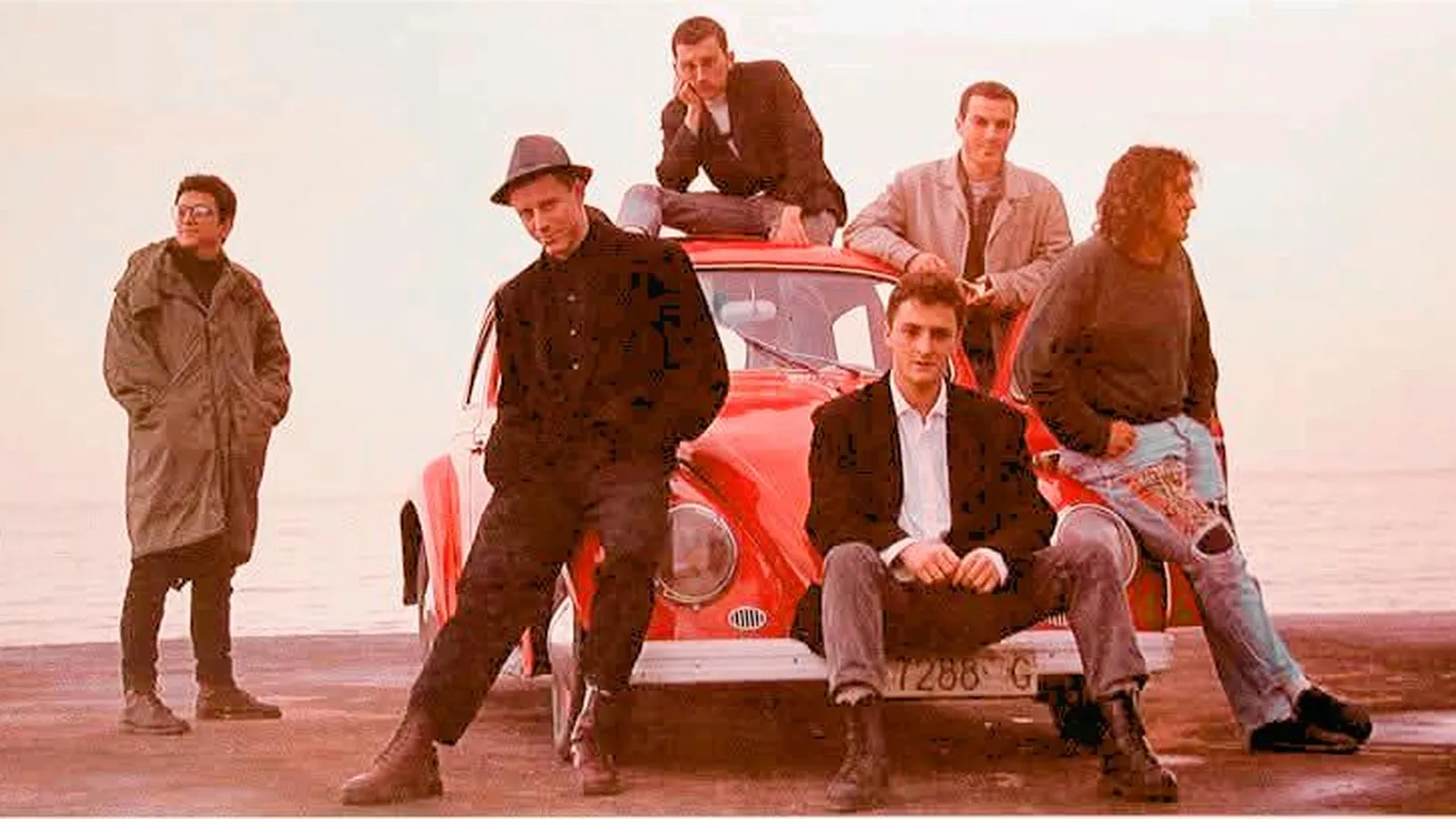
Fabí in the musical group Briatore. / JESÚS CHACÓNDuring my high school days, I was part of La Leshe que Mamate, a musical group that became relatively well known. In a book, La vida láctea, I recounted the story of the group that, with great enthusiasm but no idea what they were doing, made it onto TVE and, upon returning to high school, found themselves surrounded by people. In the mid-1980s, there was a huge boom; there were seventy bands in Marbella, with many places to play. A municipal official, José Luis Gutiérrez, and the councilor for youth, José Pernía, said, “Let's do something.” The first edition of Marbepop emerged, which ended with an album in Madrid. From playing in small venues, we went on to fill festival tents and release albums. We appeared on television when TV was still relevant.
We neglected our careers. I'm a biologist; in a couple of years, my studies weren't going well; we had the enthusiasm and the data that the group was going to do well. “You're going to reach number eight on the Top 40 and tour with Rick Astley,” one of the record label people told me when we were recording in Madrid.
We released albums, played on the radio, appeared on television, filled venues, and hung out with bands from the Madrid scene. We had come quite far.
The album we released sounded really bad, and everything fell apart. At twenty, we reached a balance, after the disappointment and learning that it was the best thing that could have happened to us: to finish our studies and stay together for something we are passionate about. Making a living from music in Spain is complicated; I saw how bands from that era evolved, and I don't envy them.
The family in the doorway of the hostel. / PERSONAL ARCHIVE We continue to play, now one is a lawyer, another a computer scientist, each in their own profession. We call ourselves Briatore, we get together, rehearse, and release an album from time to time. Our rhythm is to play once a month. We perform in Marbella once or twice a year; we prefer to play elsewhere. We've been to Barcelona, Tenerife, Seville, Jaén, Madrid, and Alicante. The secret is that we're not musicians, but friends who make music. Many musicians join a band and when they don't achieve their goal, they tend to get discouraged; in our case, friendship is what holds us together. Now it's been forty years, and we're going to commemorate it.
I remember a Marbella at a manageable speed, compared to a world that now overwhelms you. The daily grind that rolls over you. A hamburger joint replacing the Marbella café and another replacing the Santiago restaurant are small but significant lost battles. We are left with the architecture and the people. Marbella has an important part that is preserved; let's hope it is not lost.
The fishing district, with its ice factory, was replaced by a huge concrete monstrosity during the Jesús Gil administration. It was a stab in the back for the town, at a time when money was king. “There are jobs. Marbella has marble. Anyone with money can bring it here, wherever it comes from, it doesn't matter” was very misguided. I was angry with my town; later I was able to understand, although I still don't agree. Trumpism is a global reflection of what Gil was. His bad manners, rude, without values, where only the economy mattered. I believe that life is more than money, but here people were blinded. Part of the population accepted that they had been drunk, but another part did not, and that worries me, as does the polarization it caused.
My father was the civil servant who spent the most years in the City Council, joining at 13 and leaving at 70, rising from bellboy to head of several departments. From his perspective, I experienced his view of Francoism, the transition, and democracy at home in the healthiest way possible. He was a hard worker, a public servant who never argued and learned to get along with everyone. He taught me to live with all kinds of people; he always saw something positive in everyone.
I believe that education is the key, educating and informing people. There was never any planning for the city, and I don't even know if it's feasible without losing its essence. We are selling our soul to the devil; one day we will realize it. In an image taken from the Skol building in a film by López Vázquez, you could see the beaches with dunes all the way to Puerto Banús. If it had been preserved, it would be a major attraction. Little remains of the dunes; a Kuwaiti fund built a housing development in Río Real over there; the original dune reached the highway.
Of the primary dune, with the barronal, followed by valleys and dunes, only the first line remains; everything else has disappeared. The future has been mortgaged because there was no planning; we have eaten it up. My mother remembers that the beach began at the bottom of the alameda. The manna of tourism brought development to the city, but there has been a lack of adequate planning and sustainability.
Fabí González in 1993. / MIGUELÓNE I am writing a book about tourism development, how Marbella grew as I saw it from my childhood. I asked my parents to write down things about the hostel in the 1950s and 1960s. It was a good intellectual and emotional exercise; they wrote some notes that will serve as an introduction to my novel about the pre-development of tourism in Marbella after the war, the first hostels, beach bars, and hotels. Through the eyes of an observant child, seeing how the Vikings entered my parents' conversations, together with my personal archive and information, I managed to give shape to those memories.
Teenagers are unfamiliar with the city. If you ask them about Marbella, 100% know La Cañada and Starlite, but very few know about the necropolises, the thermal baths, the Roman villa, or Puerto Rico. I defend that Marbella, which is a great unknown to them. Teachers have an important job, and we are doing it: getting to know the city, getting to know its history inside and out. Here we have the Phoenicians, the Romans, the Arabs, the Reconquista—everything is here. Education is the only alternative to misinformation, which causes terrible damage. It is the challenge of adults, and teachers in particular, to make children love their land and know it.

Latest news

Similar News
The writer doctor from Marbella
Marbella
Kristina Szekely, the First Multilingual Real Estate Agent in Marbella
Marbella

Lope de España, the butler who served the jet set of Marbella
Marbella
