A notarial record changes the account of the last hours of Federico García Lorca
In April 1936, Primo de Rivera gave full powers to Ruiz Alonso to reorganize the Falange. The Rosales could never have saved the poet, because they were not fighting against a political rival, but against his boss.

Rounding out the narrative of the events that led to the assassination of the Granadan poet Federico García Lorca in the early hours of August 18 at the ... Barranco de Víznar has become one of the great challenges for many researchers, shortly after this unfortunate event occurred. Some have focused on his possible burial site, still not found despite a number of excavation campaigns being carried out at the indicated place of his execution and its surroundings. Others, on the days leading up to his arrest, since his arrival from Madrid on the night of July 13 fleeing the tension of the capital and to celebrate his name day and that of his father – July 18, Saint Federico's Day – with family.
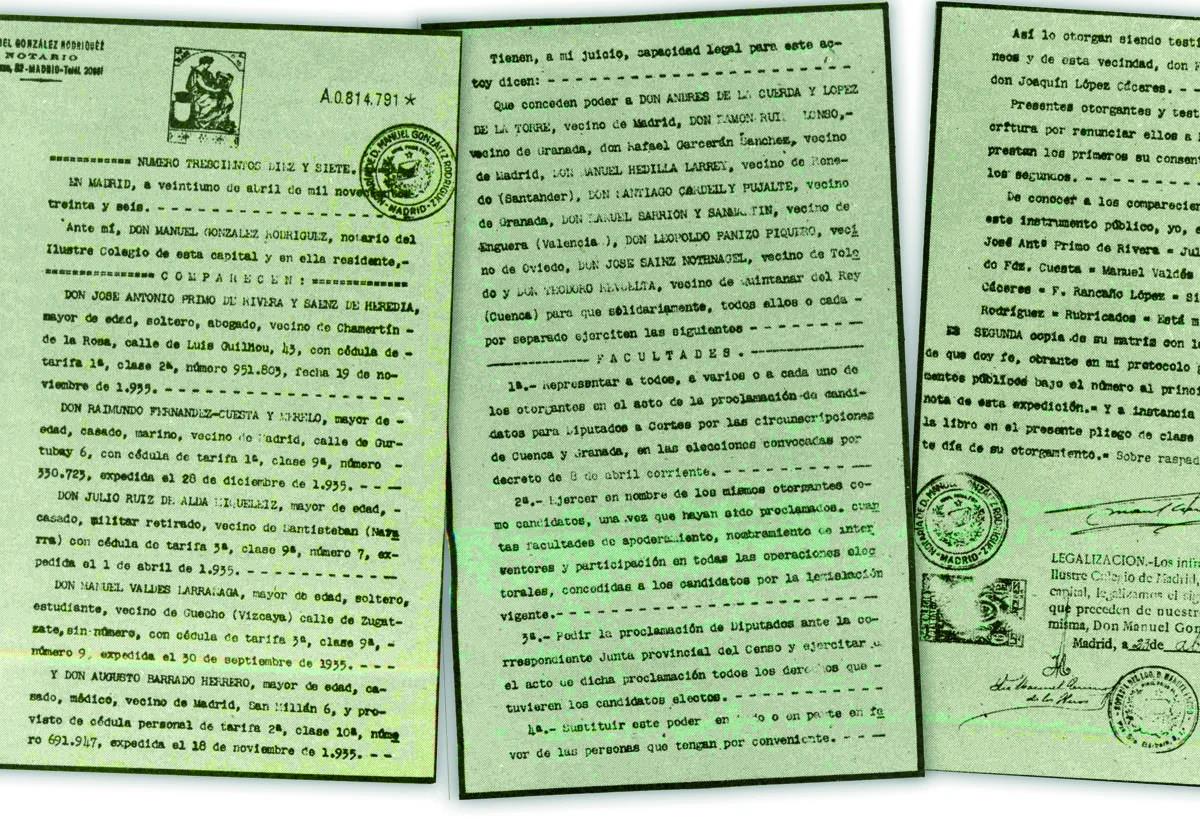
There are those who have dedicated their time to reconstruct the hours between his arrest at the Rosales' family home on Tablas Street on August 16, and his assassination. Undoubtedly, this is the part of the narrative that has sparked a greater cross-examination of theses. Now, an unpublished document that IDEAL publishes today provides key data that changes the narrative of the last hours. It consists of three pages, the notarized copy of a notarial deed granted on April 21, 1936, in the Modelo Prison in Madrid, and signed by José Antonio Primo de Rivera, Raimundo Fernández-Cuesta, Julio Ruiz de Alda, Manuel Valdés, and Augusto Barrado, the leadership of the Spanish Falange, a political organization declared illegal on the previous March 17.
The content of the deed, granted before the notary Manuel González, is unequivocal. It grants full powers to reorganize the structure of the party in the provinces of Granada and Cuenca, where the general elections that had been held between February and March were to be repeated on May 3, and which, at the request of the deputy Fernando de los Ríos, had been declared invalid due to alleged electoral tampering of a local boss nature. The individuals receiving this mandate are nine, but the names of particular interest are two from Granada: Santiago Cardell and Pujalte, who served as a lawyer for the Falange, and Ramón Ruiz Alonso, who has been pointed out as the betrayer of the poet, and who had been a deputy for Granada in the previous legislature, under the banner of the CEDA, Spanish Confederation of Autonomous Right-wing Groups. This document places Ruiz Alonso as one of the top leaders of the Falange in Granada. The implications of this fact are several.
"Primo de Rivera appreciated the Rosales as men of action, but needed a political profile to lead"
Miguel Caballero
Lorca researcher
The narrative of García Lorca's last hours accepted until now, as stated by researcher Miguel Caballero, who has had access to the document and will publish it in his upcoming book, placed Ruiz Alonso as a CEDA deputy who had lost his seat in the May elections. "Some researchers took for granted that having been elected by the Gil Robles party in February, he would have run for the same formation in May. This document proves that no, that in the so-called Counterrevolutionary candidacy, Ruiz Alonso entered in the sixth position already as a member of the Falange," he asserts emphatically. This dismantles the narrative that Ruiz Alonso had gone to Madrid accompanied by the Rosales brothers, Luis and Pepe, to meet with Primo de Rivera in prison, where he requested a salary of 1,000 pesetas per month as a released politician – professional politician – and that the Falange leader had refused to meet such a request, turning Ruiz Alonso from that moment into an enemy of both the Falange itself and the Rosales brothers, which would have motivated his denunciation of Federico García Lorca, sheltered in their house, obtaining the arrest order that ultimately led the poet before the firing squad, as published by 'Ideal'.
He was the boss
But no. Ruiz Alonso was not the political enemy of the Rosales. He was their boss. This refutes more or less apocryphal facts such as Pepe Rosales asking him in the courtyard of the Civil Government, during the fight they had after the arrest of García Lorca, to "stand at attention before a superior." It could not be, because the superior was Ruiz Alonso. Other claims also lose weight, such as those that the Rosales laughed at his cowardice and lack of character, because, as Caballero states, "Ruiz Alonso was anything but a coward. He is a character with many shadows and some lights, but he was not timid. In fact, he had some scuffles in the Cortes where he did not back down and came to blows with the opposite bench."
"In a party that venerated hierarchies, like the Falange, it was impossible not to comply with an order"
Miguel Caballero
Lorca researcher
With this background, a doubt that has hovered over Lorca researchers for decades is cleared. Could the Rosales have saved Lorca from death? The answer, according to Caballero, is no. Definitely. The one who had betrayed his friend and then would facilitate his execution was his superior, not a political rival. "It was not a squabble between parties, but a dispute within the Falange that the Rosales could only lose, because hierarchies in a fascist-inspired party like the Falange were the supreme norm. Once the arrest order was obtained, Federico's fate was sealed. Whoever ordered the shooting did so at the behest of a Falange leader, not an unseated deputy," he concludes.
How Ruiz Alonso became the utmost confidant of the Falange leadership, displacing the Rosales, has a very clear explanation, according to the researcher. "José Antonio was a very intelligent politician. He appreciated the Rosales brothers as 'men of action,' and knew they controlled a shock force capable of resolving many issues. But the power of attorney designates Ruiz Alonso to lead the party because he had greater political experience, knew the ins and outs of power, and was capable of rousing the masses with his speeches." The poet, caught in the crossfire. The same fire that killed him.

Latest news





Upcoming events
12
Nov
El Desembarco, la traición de Viriato at La Caja Blanca
12
Nov
HOMER El Mero Mero at Sala Trinchera Málaga
13
Nov
Marbella Startup Lab – Innovate & Collaborate
13
Nov
Candlelight: Coldplay & Imagine Dragons at Sala Fundación Unicaja María Cristina
13
Nov
Candlelight: Tribute to Ludovico Einaudi at Anantara Villa Padierna
Similar News

Bruno Mars Ends a Decade Without a Solo Album with 'The Romantic'
Málaga