The Way of St. James Revives Italian Cinema

With 75 million euros, 'Good Way' has already become the highest-grossing film at the Italian box office and is about to reach 10 million viewers, a figure that only two other films in the country have surpassed in recent decades, 'Titanic' and 'Life is Beautiful' from 1997. Released on December 25, the new production from Checco Zalone, a master of satire revered in his homeland who brought 'An Italian in Norway' to Spanish cinemas, is on track to break all records with this film in which he narrates the adventures of a lazy millionaire addicted to luxury who must walk the Camino de Santiago to find his teenage daughter. Like so many others, the experience of walking for days, resting in hostels, and meeting diverse people ends up changing him internally and helping him rebuild his relationship with his daughter.
The film addresses this transformation with irony and in a fun way, to the point that the audience has a great time. 'Good Way' has sparked the interest of Italians in the Camino de Santiago, and searches for information about pilgrimages in Spain have increased fourfold on the internet in the days following the film's release, according to Google. This is notable considering that Italians were already the third most numerous nationality among the pilgrims who arrived in Compostela in 2025. They were 26,680 out of a total of 531,000 people, according to the Pilgrim's Office.
The great success of Zalone's film among his compatriots suggests something similar to what happened with American pilgrims after the 2010 release of 'The Way', starring Martin Sheen. That year, 3,300 Americans arrived in Santiago, but the number has continued to grow since then, reaching nearly 44,000 in 2025, making them the second most common nationality among the walkers, after the Spaniards. The number of Americans has multiplied by 13 in 15 years.
"It's an extraordinary impact that leads us to wonder what will happen with Zalone, in terms of time and how it will influence Italians" with the Camino, states Miriam Giovanzana, author of several travel guides, in an interview in 'Il Venerdì'. "I loved the film and it made me consider doing the Camino de Santiago. I already thought about it when I saw 'The Way'," says Ilaria, a twenty-something nurse from Rome. Alessandra, who describes herself as a "walker" and has already traveled various routes to Santiago, confesses, on the other hand, to being "terrified" at the possibility that the film will worsen the overcrowding that occurs at certain times of the year on part of the French Way. "From April onwards, it's almost impossible to enjoy any moments of solitude."
The overwhelming success of 'Good Way', which continues in theaters with up to five screenings daily in some cinemas, raises the question of why walking trips have not yet taken off in Italy, a country full of natural, scenic, and urban wonders and with a history linked to pilgrimages. For centuries, one of the most important was the one made by Christians to Rome to visit the tombs of the apostles Saint Peter and Saint Paul.
The route that leads to the current Italian capital is called Via Francigena because it crosses France and extends some 3,000 kilometers starting from Canterbury, in the United Kingdom. Although there have been various projects to relaunch it for years, the truth is that in 2024, the last complete year for which data is available, there were 6,000 pilgrims who arrived in Rome via this route and received the 'Testimonium' in the basilica of Saint Peter, a document similar to the 'Compostela' that is delivered in Santiago.
The 'Quo Vadis' Route
On the occasion of the Holy Year that concluded in January, the Italian authorities announced that they were going to invest 22 million euros in infrastructure, promotion, and hospitality spaces to try to reach 100,000 pilgrims. There are still no official data for 2025, but it is clear that the gap compared to the 531,000 walkers of Santiago de Compostela is still very wide.
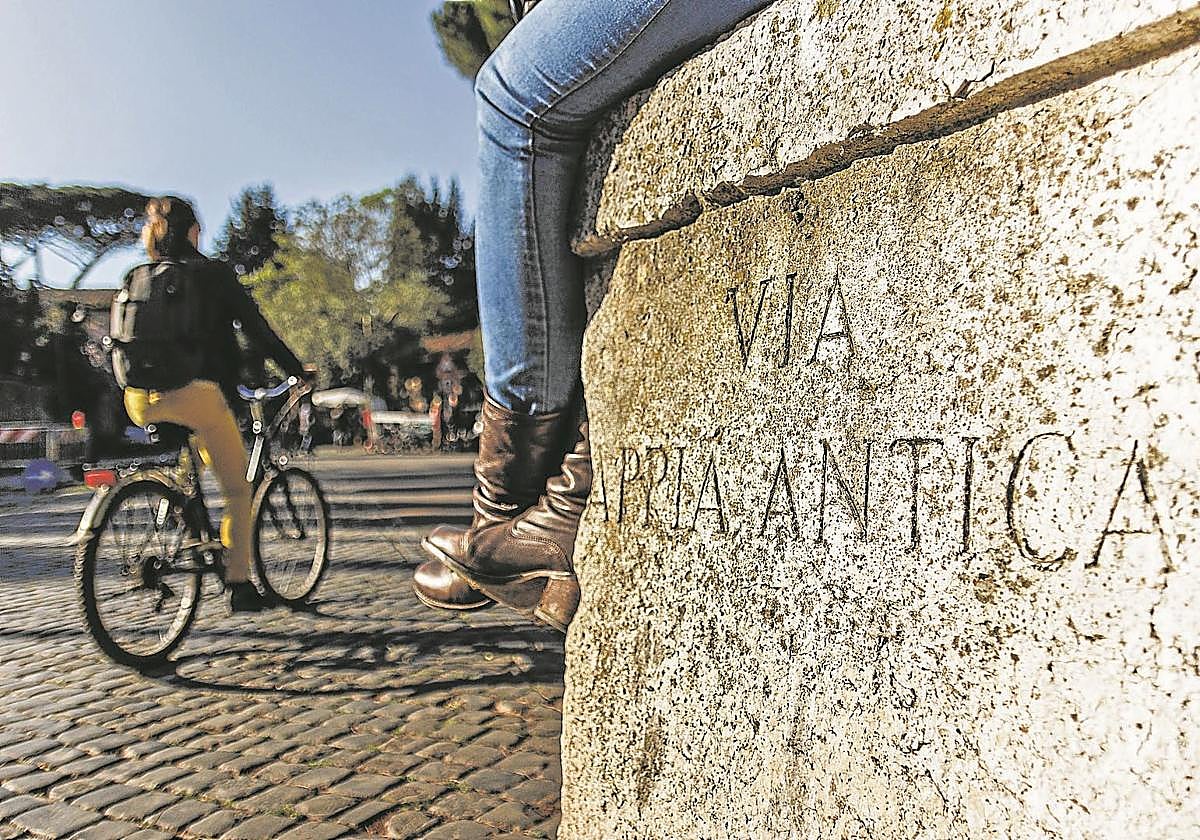
Another important route in Italy is the Via Appia, built by the ancient Romans to connect the Eternal City with the southern ports, first with Capua and later with Brindisi. This route, immortalized in the film 'Quo Vadis', offers a panorama of enormous beauty in its first kilometers out of Rome, living up to its nickname of 'regina viarium', 'queen of the roads', as it is a work of engineering dating from the 4th century BC.
Together with his wife and a group of friends, the Italian writer Paolo Rumiz traveled the Via Appia years ago to recover the lost part of its route, as he captured in his book 'Appia'. He was unpleasantly surprised to discover how little the inhabitants of the places through which this road passes knew about their surroundings. "I deceived myself thinking that I was offering Italy a great element of unity. We came on foot from the north and the people from the south were amazed that we loved those places. We told them: 'You are important! You belong to a legend and they never told you!' In the end, they understood," says Rumiz, celebrating that the Via Appia could become a "strong symbol of belonging" for the people, something that, in his opinion, no Italian government has yet understood.

Latest news



Upcoming events
17
Sep
La Pequeña Cuba Gastro-Cultural Festival in San Pedro Alcántara 2026
18
Sep
World Wellness Weekend Marbella 2026
18
Sep
Candlelight: Queen vs. ABBA in Málaga
18
Sep
Candlelight: Coldplay and Imagine Dragons in Málaga
18
Sep
3 de Corazones – Pancho Céspedes, Enrique Ramil and José Luis Jaén in Málaga
Similar News

Bruno Mars Ends a Decade Without a Solo Album with 'The Romantic'
Málaga