About snacks, outings, picnics, and other summer gatherings
Picnics or outdoor meals have been an essential element of summer enjoyment for centuries.

Do you remember the movie Picnic? It features William Holden as a charming drifter, a stunningly beautiful Kim Novak, an unforgettable dance, and several American customs that Spanish audiences probably didn't fully understand when the film was released here in the fall of 1956. They likely didn't know what Labor Day was, the national holiday during which the plot unfolds, nor what its celebration implies every first Monday of September. They also wouldn't have had any idea that this date traditionally marks the end of summer and the return to work or school routines, making Labor Day the last chance to indulge in summer follies, unleash passionate affairs—as happens in the movie—or say goodbye to many summer activities.
Since 1882, this American version of Labor Day has been inextricably linked to public parades, outdoor festivals, picnics, barbecues, and any other type of collective revelry. That's why in Picnic, aptly enough, the massive picnic organized by the residents of a small Kansas town is so significant. The camera captures various scenes reminiscent of Norman Rockwell paintings, epitomes of the famous American lifestyle like the town band, the pie-eating contest... and a meadow covered with blankets, lunch boxes, and thermoses. By then, the word "picnic" (adopted into Spanish with an accent in both singular and plural) had been in the RAE dictionary for 29 years, but it seems that for the vast majority of Spaniards it was still a novel term: this is the only way to understand why some promotional ads and numerous reviews of the film felt the need to explain what exactly its title meant. The Diario de Burgos marked as an important news item in the film section this clarification: "If you gather with your friends or neighbors and take over a beautiful spot to savor the delights of a good meal, you will have had a PICNIC. But, moreover, at that PICNIC everyone is obliged to forget their quarrels, if they had any; their little differences, their bad moods... PICNIC is joy, happiness, well-being that is adorned with the most amusing occurrences and the most original games. In America, where PICNIC comes from, these rural outings are very common, involving children and elders, women and men, without the rigor of social differences imposed by the city and which cause so many troubles to one and another."
The movie was a hit, and with it, everything that jumped on the modern picnic bandwagon. Between 1956 and the early 1960s, our country saw the launch of Picnic cookies by Artiach, a Pic-Nic soft drink, a homonymous young women's magazine, a clothing brand of the same name, numerous bars and restaurants so named, and even a music group with the same name, in which Jeanette began her career. Perhaps the word was new and sophisticated, but the concept behind it was older than cough. The picnic was nothing more than a pilgrimage or a countryside snack filtered through the Anglo-Saxon lens, more elegant if you will, but just as gluttonous. In contrast to British phlegm (capable of organizing picnics in the jungle or in the middle of the desert) or the abundance of American means, with their shiny cars, portable refrigerators, and hamburgers, Spain has always favored paella, tortilla, and two-kilo loaves. Of potato salad, gazpacho, stuffed eggs, melon with ham, and watermelon cooled in the river. Of Magefesa lunchboxes and espadrilles.
The outdoor feast has served us for centuries as a release valve from urban society and its miseries. Long before the English adapted the French pique-nique (from piquer, to pick or steal, and nique, trifle), a collective meal where each person paid their share or contributed something, the Spaniards already had outdoor snacks, field trips, feasts under the trees, and above all, jiras with a 'j'. The Royal Academy defines the jira as a banquet or meal "especially in the countryside, among friends, with joy and noise" and indicates that it comes from the French expression "faire bonne chère" (formerly chière), which means to eat abundantly or offer a good meal. "To make a good jira" in the 16th century was to entertain someone at the table, and from there it came to be understood first as any large or joyful banquet and then, from the mid-19th century, as the same but transferred to a countryside setting.
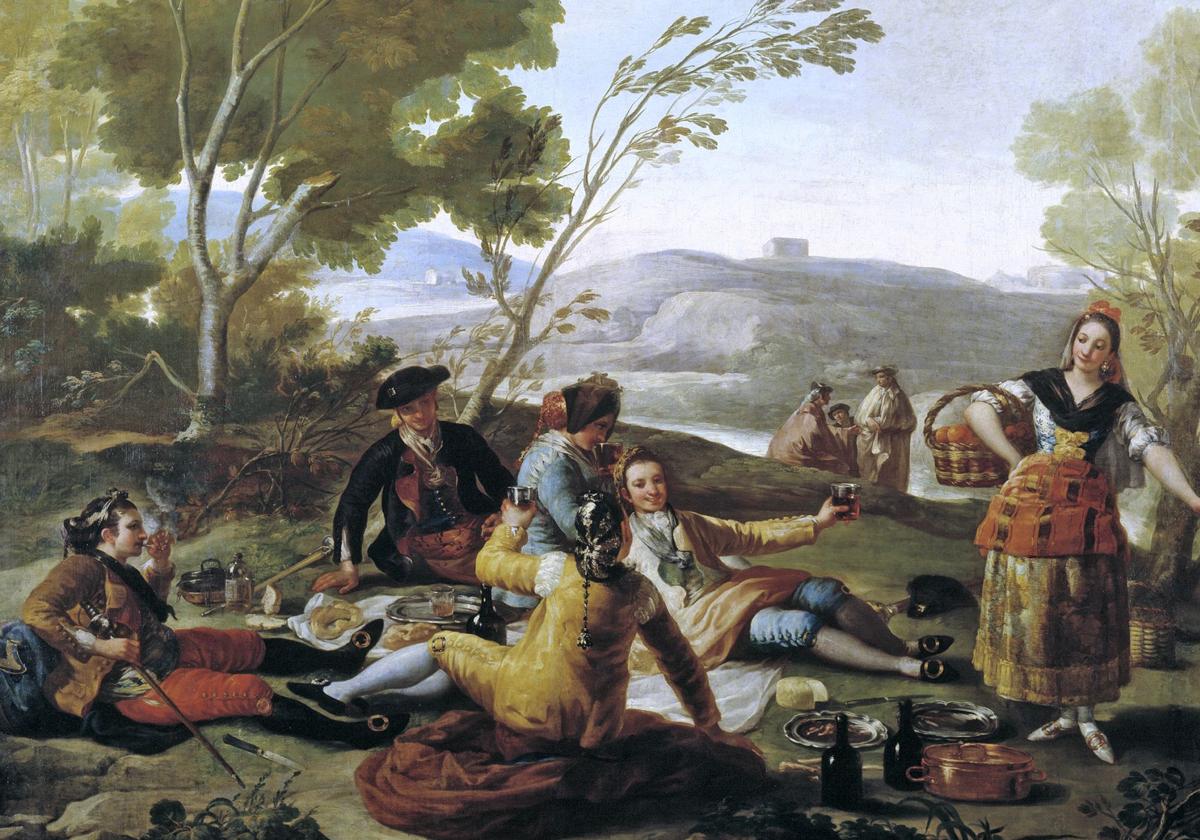
Although in Goya's times it was simply called "merienda" (snack), this lack of lexical specificity does not imply that they did not know how to enjoy the pleasures of eating outdoors. You just have to look at the many cartoons that both Don Francisco and his brother-in-law Ramón Bayeu painted for the Royal Tapestry Factory of Santa Barbara: in the one we are discussing today, wine, bread, cheese, and chops stand out, while in 'La merienda' by Bayeu, you can see that on the cloth on the grass there are slices of freshly cut salami, a loaf, and an endive salad. Next week we will see how another Anglo-Saxon concept, camping, forever revolutionized these traditional summer feasts.

Latest news





Upcoming events
12
Nov
El Desembarco, la traición de Viriato at La Caja Blanca
12
Nov
HOMER El Mero Mero at Sala Trinchera Málaga
13
Nov
Marbella Startup Lab – Innovate & Collaborate
13
Nov
Candlelight: Coldplay & Imagine Dragons at Sala Fundación Unicaja María Cristina
13
Nov
Candlelight: Tribute to Ludovico Einaudi at Anantara Villa Padierna
Similar News
Bruno Mars Ends a Decade Without a Solo Album with 'The Romantic'
Málaga