"Hitler considered Paris a mandatory destination for his soldiers to go partying"
Historian Philippe Collin novels the story of the Ritz bartender who witnessed the Nazi occupation of the French capital
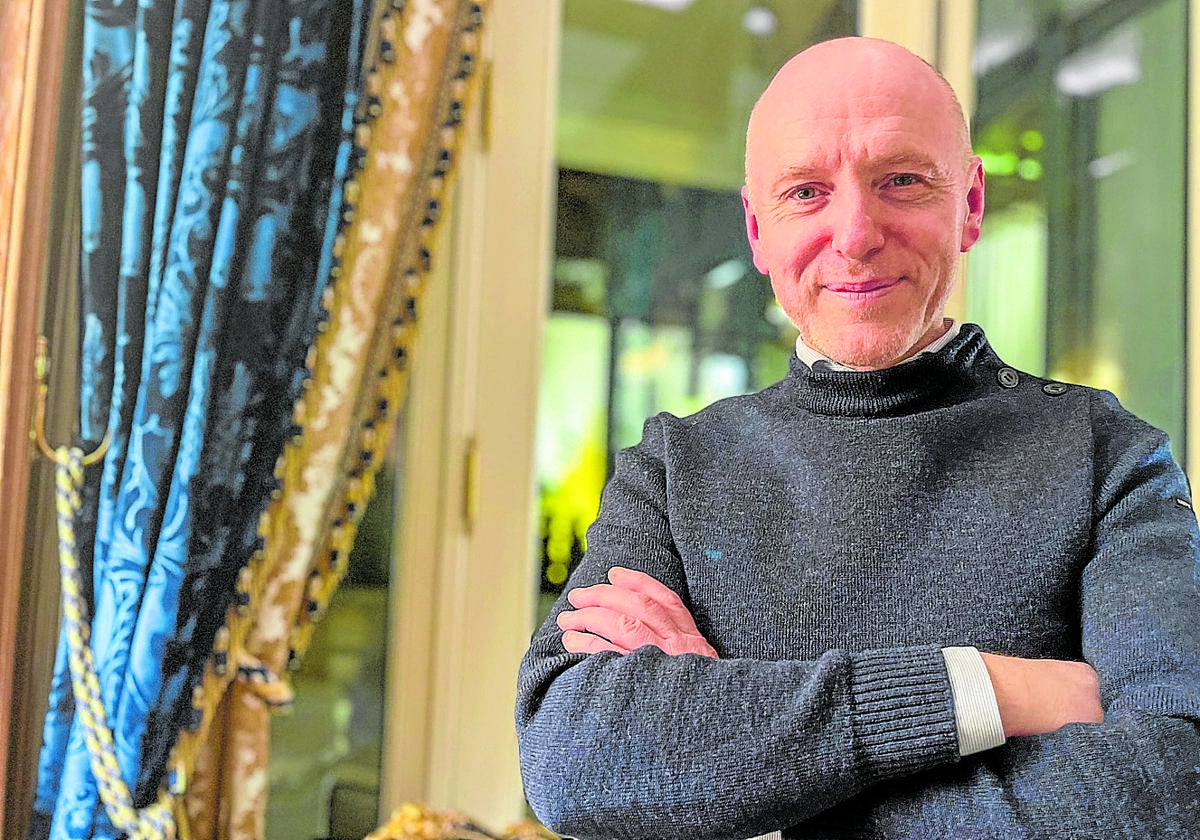

Dozens of people usually line up every afternoon on one side of Vendôme Square, in the center of Paris. There, they wait to enter the Ritz. Opened in 1898, it is a place cherished by tourists, especially Americans, who revel in the luxury of the French capital. But it is also an ideal space for time travel. Thanks to Ernest Hemingway and his autobiography 'A Moveable Feast', the hotel's past endures with the strength of literature.
Like many Hemingway admirers, the French journalist and historian Philippe Collin (Brest, 1975) was fascinated by the Ritz. His work at the radio station France Inter allowed him to discover its rooms and covered passageways in 2002. From this professional experience, he inherited the habit of going almost every Sunday to the Ritz bar. It was Colin Field, who managed that place from 1994 to 2023, who told him about the first bartender of the legendary hotel: Frank Meier (1884-1947), to whom he has dedicated his first novel.
'The Bartender of the Ritz' was published last year in French and has now arrived in Spanish bookstores, published by Galaxia Gutenberg. "It is a work of fiction set in a framework of real events," explains Collin about this book set in Paris under Nazi occupation. The story is told from the perspective of Frank Meier, an Austrian immigrant who discovered the art of cocktails in a luxurious New York bar and obtained French nationality after having fought with the Foreign Legion during World War I.
In an interview with this newspaper in one of the bar areas of the Ritz -opened in 1934 by Meier himself, being then the first place in Paris where women could drink alcohol in public outside of brothels- this historian by training justifies his choice for the historical novel genre. "Fiction allows me to delve deeper into the psychology of the characters and enter the room of Hermann Göring," the Nazi minister who lived in the hotel, explains Collin, who has achieved great success in recent years with his podcasts on historical figures, such as Léon Blum or Simone de Beauvoir. "I have disguised myself in the person of Frank Meier to try to understand what happened," he adds about the symbiosis between author, narrator, and protagonist. After France's surrender to Nazi Germany in June 1940, the Ritz was one of the first places that opened that summer in the French capital due to the supposed neutrality of its owners, a bourgeois family from Switzerland. "That turned it into a small theater of occupied France. There were Nazi soldiers, Gestapo members, artists -from Sacha Guitry to the German Ernst Jünger- spies, Resistance members...," the author recalls. Even Ramón Serrano Suñer, Franco's Foreign Minister, appears in one of the chapters.
"Adolf Hitler considered Paris a mandatory destination for his soldiers to party and rest," asserts Collin. According to this novelist, Parisian society during World War II was a dichotomous place where "luxury and mundanity coexisted with hunger, fear, and the persecution of Jews." His skills as a historian are evident in how well-documented his work is, which could be criticized for a lack of stylistic ambition.
"Only two characters did not actually exist," states Collin. However, he acknowledges having imagined a significant detail: Frank Meier's Jewish background. "I haven't found any document that really proves it," he admits. Although the Gestapo suspected it and opened an investigation, "a few weeks ago I received a baptism certificate as a Catholic from his family," he recalls.

Latest news





Upcoming events
12
Nov
El Desembarco, la traición de Viriato at La Caja Blanca
12
Nov
HOMER El Mero Mero at Sala Trinchera Málaga
13
Nov
Marbella Startup Lab – Innovate & Collaborate
13
Nov
Candlelight: Coldplay & Imagine Dragons at Sala Fundación Unicaja María Cristina
13
Nov
Candlelight: Tribute to Ludovico Einaudi at Anantara Villa Padierna
Similar News

Bruno Mars Ends a Decade Without a Solo Album with 'The Romantic'
Málaga