The Hidden Messages of the Streets of Málaga
Some have been among us for centuries, but due to constant exposure, they have become invisible. If we look closely, the facades of the capital display historic warnings, prayers with years of forgiveness, eternal poems, and even prohibitions on keeping pigs at home.

There are those carved in stone or painted. There are advertisements, informational, commercial, poetic, supplicatory, legal, and of course, prohibitive signs. But all of them have something in common: they go unnoticed or are hidden, even though some have been impassively among us for several centuries. Now that the heat is pressing, if the Reding fountain were still pouring water, more than one person would approach it and not only quench their thirst but also take away a sip of Malaga's moral after looking up and reading the motto that shines above the spout: "Viva Málaga". It happened to a friend who sent me the photo of that exclamation of homeland carved in stone and that, adding other letters scattered around the city and lost in its streets, have filled this report with messages beyond time that speak to us of another Malaga that is also ours.
The signs at the entrance or exit of cities come from old times. A precedent is on the old Road to Vélez, where the Reding Fountain is located, at which we no longer stop since its spouts dried up. But everyone who for centuries approached to refresh themselves or let their animals do the same at the trough could read the enthusiastic message on white marble: "Viva Málaga". The origin of this slogan is not documented, but it seems that it was added after its construction in 1675, specifically during the fountain's restoration in 1806 by the Governor of Malaga, Teodoro Reding, whose patriotism is beyond doubt. This city-exalting motto from the times before the Napoleonic invasion points to his authorship.
It opened as a Tobacco Factory in 1829 and has also served as a Provincial Council, police station, civil government, temporary residence for kings visiting Malaga, and today, the splendid Malaga Museum. But for the people of Malaga, it is the Customs House. One might think it is just a matter of tradition, but if we look above the door of its old main facade on Císter street, the name carved in stone that imprints character reads: "National Customs Year 1842". That use has prevailed in collective memory, and part of its explanation lies in that inscription that today is almost invisible, but which, as Madoz recounts, once shone in the city as it was covered in gold letters.
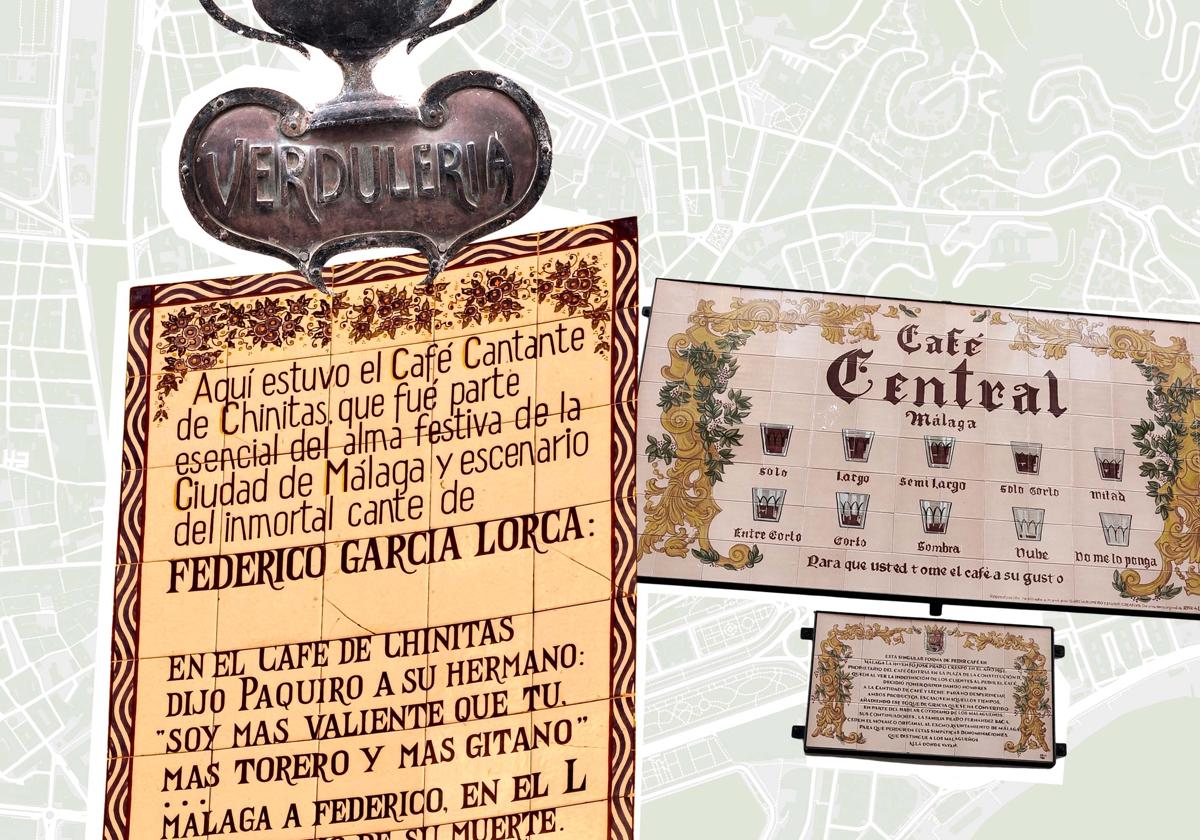
Until recently, Chinitas Passage still displayed the wrought iron signs indicating the presence of the sharpener or the shoemaker. According to historian Víctor Heredia, during the era of Mayor García Grana (1958-64), those signs were commissioned to the master of iron, José Espinós, who gave artisanal uniqueness to an already historic corner. None of those signs have remained except a fabulous example of the 'Greengrocery' which, after the restoration of the premises where it was located –now a bar, a sign of the times–, has been installed on the facade. Thus, the eggplant, pomegranate, or pear in forged metal from the past mix with the current business's tap vermouth and Malaga wines advertisements, but the ensemble does not clash in the slightest. Quite the opposite.
Staying in the passage, another of those signs that go unnoticed has to do with García Lorca and his famous poem 'El café de Chinitas', a temple of flamenco and bullfighting. To see it, one must look up from the ground since it is located on the facade of the old tavern, but on the first floor. The ceramic was placed almost four decades ago on the occasion of the 50th anniversary of the death of the man from Granada, who has had a more significant presence in this enclave since a tavern with the legendary name of the poem and a life-size statue of Federico leaning on the bar has recently reopened in the building.
It is not common for Malaga's buildings to bear the signature of their architect. Therefore, the bronze letters on an emblematic building at Larios corner with Liborio García, reminding us of the hand of Fernando Guerrero Strachan and a year: 1941, draw attention. Curiously, by that date, the man who was also mayor of Malaga had been deceased for a decade, so the architect Francisco González clarifies that the signature actually corresponds to his son, Fernando Guerrero-Strachan Rosado, who rebuilt the estate after the civil war and indeed died on the date of this inscription. This sign was on the part of the facade that corresponded to the hardware store of Juan Temboury, a personal friend of the architect.
The old shops of Malaga also continue to announce themselves, although we no longer notice their signs. Above the sunglasses in the display window of the Sunglass Hut optician on Granada street, the carved stone sign "Sucesores de Ghiara" is clearly visible, although the sign starts on Santa Lucía street –with which this business makes a corner– and informs that it was a "Watchmaker Deposit Workshop". Or in other words, a luxury jewelry store that was launched by Juan Ghiara, son of an Italian entrepreneur who landed in Malaga at the beginning of the 19th century. The name chiseled in stone, the noble woods of its exterior, and the frescoes of its interior are the best examples of the powerful commercial past of the capital. Even Queen Victoria Eugenia couldn't resist buying here during a visit to the city, as historian Fernando Alonso recounts.
The church of San Juan treasures the well-known five balls, but that is not the only thing that draws attention on its facade. Next to the door of the central nave –which only opens during Holy Week and on special occasions–, there is an official edict that has partially disappeared but testifies that, in 1800, this busy road was also the great commercial artery of the city, the Larios street of that time: "The Governor of this place prohibits bakers and resellers of any kind from selling more stop on the street..." (sic). The message cannot be continued reading because it is erased by later reforms, but there remains the testimony of the hustle and bustle and chaos that must have been San Juan.
Poetry is not only present with García Lorca in the streets of Malaga, but also with contemporary authors such as Rafael Perez Estrada, whose legendary motto "Malaga, martini of the sea", invites you to enter the alleys of Pozos Dulces where verses with a denomination of origin also assail the pedestrian, like "Your only possession is the moment", by the Persian Omar Khayyan, or "I entered the labyrinth and have not come out", by the Italian Petrarca. And yes, these alleys of the old town of Malaga have something of a poetic labyrinth.
Returning to the businesses, with the fabric store Los Mellizos, which was founded in 1920 by Evaristo García, whose name has been recovered in the old paintings that have been restored from his business on Compañía street. The messages on the facade informed that there they sold "Knitwear and Garments" and to convince the clientele it was emphasized: "Prices without competition". The remodeling a few years ago of this premises as a poke restaurant uncovered and respected all this legendary commercial literature painted on its facade, although unfortunately, the new firm that has taken over the premises has hidden and drilled the letters of this heritage legacy.
The latest recovery of messages from the past is found in the recently restored Brotherhood House of Salutation. In the mural paintings on its facade, half of an inscription has appeared in which the word "sean" and other partial letters can be read within what appears to be a heart held by an angel. Historian Víctor Heredia has already deciphered the message, which is related to the owner of this estate and the adjacent one, where the other part of the drawing is still hidden. Both properties belonged in the 18th century to Father Martín Pardo de la Casta, who wrote in a book the text of this prayer, assuring that 1060 days of indulgence were earned each time this prayer now discovered was repeated. So if you want mercy for the next three years, repeat after me: "Blessed be the most holy hearts of Jesus and Mary".
Very close to the previous one is the María Victoria Atencia Cultural Center. Above its large entrance door on Parras street, there is a semicircular arch with the sign of its old tenants engraved in stone: "San José Home". In Malaga, this institution was popularly known as Casa Cuna or Gota de Leche, since its charitable activity was dedicated to the care of orphans. That is what the other Latin inscription that presides over its facade, "Omnibus", whose translation "to all" refers to the welcoming of children. The building has changed its use, although the message remains valid: culture for all.
The antiquity of some streets and urban changes can also be followed by the different formats we encounter in the plaques that give them their names. And at this central corner, we find up to three of those signs. The oldest informs us that we are on Niño de Guevara street, a marble model with the name engraved in black that was used between the end of the 19th century and the first three decades of the 20th century. Perpendicular is the name of Pito street with white ceramic letters on a green background that was used during the dictatorship and until the time of Pedro Aparicio (early 80s), while the denomination of the pedestrian street José Denis Belgrano is the 'premium' version that is currently placed, as the signs with a white background and black characters with the initials in red are reserved for the historic center.
Without leaving Pito passage, this narrow street holds an enigma that, for now, has no resolution. In the middle of the street, one must look up to notice the inscription painted under the window of the facade of a building, in which only a few loose words can be deciphered: "Resolution of the cases of the (...) / Rea(le)s (...)os (...)". These are two lines that could be of legal or religious content, but as historian Víctor Heredia says, they require timely restoration to decipher a message that, by the language and calligraphy, seems to accumulate centuries of antiquity.
From 'solo' to 'don't put it on me', the canonical nomenclature of Malaga's cafes immortalized by the Central Bar until its closure in 2022 is still visible in the streets of Malaga and, more specifically, on the Facade of the Peña Juan Breva where this ceramic is now displayed, considered heritage of the city. By the way, it is not the only vestige of the legendary cafe now converted into a Swedish pub. The access to the premises by Chinitas Passage still displays the old sign and even the photos of the combined dishes.
Among the houses with history in the center, an inscription in stone on Granada street warns us that we are in front of the House of Luis de Eslava, a military man with the rank of captain, perpetual councilor of Malaga and almojarife of the royal customs. Despite how well his eternal title sounds, it was actually a city councilor in the 17th century, as well as a tax collector, as explained by Víctor Heredia. The sign, added in the restoration of the building in 2007, is located next to a beautiful cannon-shaped guardacantón that protected the corner of the building from the blows of carriages.
The winemaking tradition of Malaga also appears in some forgotten corners of the city. In the La Goleta area, an industrial building with a twilight appearance that is now municipal property still displays a frieze in which you can read "Union of Wineries" and to which "Andaluzas" is missing, which was the commercial firm of the powerful Mata Company, dedicated to the aging of wines. This house bet on quinine wines with the brand 'Aníbal', an extra old that was advertised as an effective restorative in the 20th century.
Regarding Malaga with fountains and signs, there is enough for a second part with that of Olletas and its animalist commitment decades before society became aware of their rights. "Do not mistreat the animals, they make your work easy and help you earn bread," says the sign carved on stone of this watering trough that was built in 1788 and from which water from the San Telmo Aqueduct flowed through a spout. The message for the welfare of the beasts was apparently introduced in the reform of 1938-39, although the current fountain is not the original, but another version from 1960-61 when the original was demolished for the alignment of the road.
To close this review of signs from another time, nothing better than going to the San Eugenio Colony, a working-class neighborhood of the current Bailén district built between 1889 and 1918 by the entrepreneur Eugenio García Serrano. To avoid coexistence problems, the entrepreneur filled the streets with signs informing about the names of the tenants of the houses –today it would not comply with the data protection law–, the fine of up to 5 pesetas for throwing garbage on the street or the "expulsion" from the neighborhood if one did not act with "sanity". In addition, a ceramic with the basic rules of the colony is preserved, a kind of table of the 7 commandments, in which it is striking that raising "chickens, rabbits, and goats" inside the houses was allowed, but, with good judgment, "having pigs" was prohibited.

Latest news





Upcoming events
12
Nov
El Desembarco, la traición de Viriato at La Caja Blanca
12
Nov
HOMER El Mero Mero at Sala Trinchera Málaga
13
Nov
Marbella Startup Lab – Innovate & Collaborate
13
Nov
Candlelight: Coldplay & Imagine Dragons at Sala Fundación Unicaja María Cristina
13
Nov
Candlelight: Tribute to Ludovico Einaudi at Anantara Villa Padierna
Similar News

Bruno Mars Ends a Decade Without a Solo Album with 'The Romantic'
Málaga