From the Alfóncigo to the Pistachio

It's literally everywhere. Even I, who am from the provinces and had not tried a Lotus cookie until recently, have noticed that there's a new flavor that has ousted it and is now cutting a swath in terms of ubiquity and supreme capacity to bore: pistachio. It is almost impossible today to go to a restaurant, a pastry shop, or a supermarket and not come across an example—or several, or many—of the current pistachio craze.
Now there are pistachios in chocolate bars, in croissants, in cheesecakes, in mortadella, in a billion types of ice cream, in Christmas nougats, salads, sauces, and even in perfumes, but I did not expect to also find them in newspaper headlines. "Frenzy for pistachios: the millionaire figures moved by the trendy nut," says one. "Pistachio supplies running out worldwide," claims another. Both are from this past May, just like "Pistachio, the new green gold revolutionizing gastronomy and agriculture in Spain," "The health benefits of pistachios," "Why have pistachios run out in Aragon?" or "Castilla-La Mancha emerges as the fourth world power in pistachio acreage." And that's just to name a few.
Although the trend had been pointing this way for a while, it seems that the blame for the soaring demand and price of this nut in recent months is due to something called "Dubai chocolate." This bar filled with pistachio and kadayif (very crunchy filo pastry threads) and invented by a company from the UAE went viral last year on these 21st century courtyards that are TikTok and Instagram. Since we are foolish and don’t want to miss out on anything others are trying, the mediocre copies and clones of this Dubai chocolate have multiplied in such a way that they have caused a global pistachio supply crisis.
The fruit of the Pistacia vera is experiencing its own gold rush and the reasons for this dazzling success are divided between pure cyber following, its striking green color—which it shares, by the way, with other "phenomenon" ingredients like avocado or matcha tea—, its recognized health benefits, and its pleasant taste, but what we cannot attribute it to is its alleged novelty. Pistachio, dear readers, is older than the hills and has not only been a regular product in food stores for decades but can also boast of having a long history in our country.
If you look in the old dictionaries of the RAE, you might discover that the word "pistachio" was first recorded in 1803 and assume that the consumption of this fruit began shortly before that date. In fact, the current Dictionary of the Spanish Language indicates that "pistachio" is an adaptation to Spanish from French pistache or Italian pistacchio, as if we had to adopt a foreign term for something that was not known in our country.
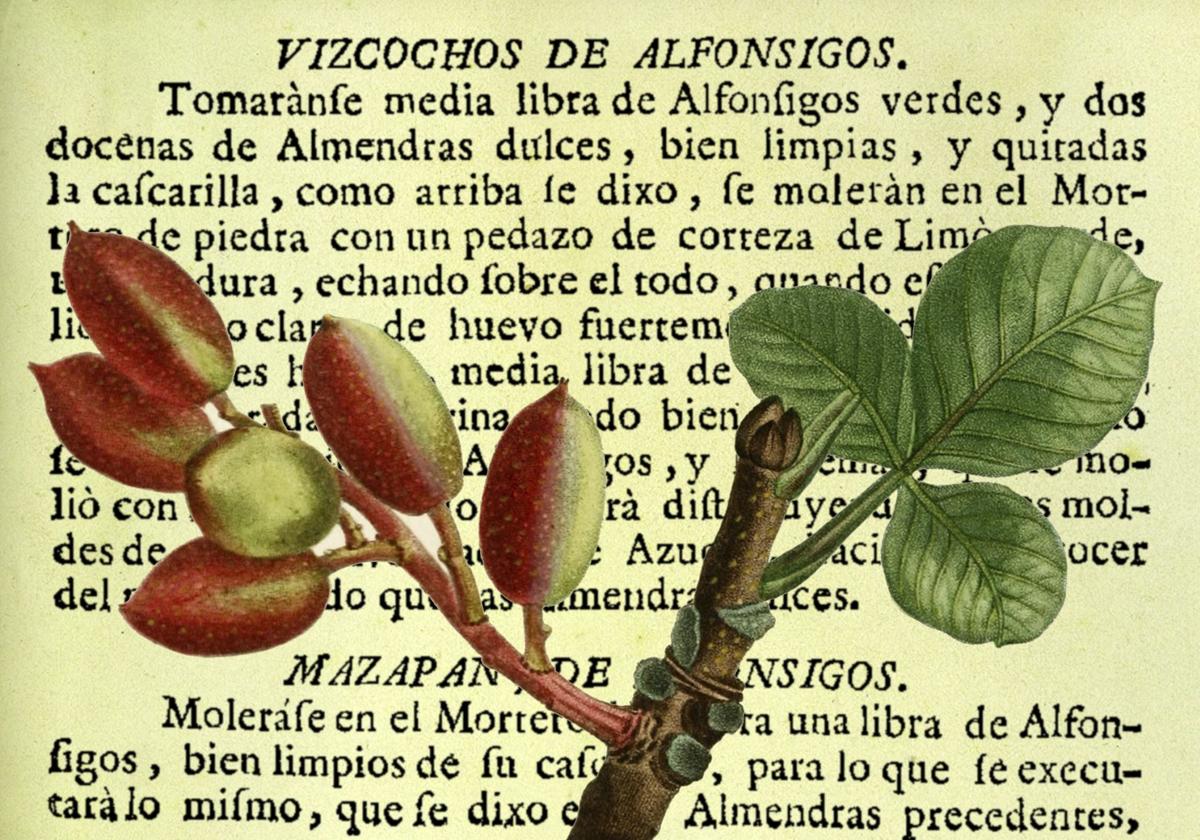
This impression is misleading: what really happened was that by the end of the 18th century it became fashionable among the pretentious to use an Italian word to refer to something that had for centuries had a name as authentically Spanish as alfóncigo. It was also known as alfónsigo, alfocigo, alhócigo, alhostigo, or fístigo, words that, although it may not seem like it, share an etymological root with the now undisputed "pistachio." The old Spanish versions come from the Hispanic Arabic alfústaq, which in turn came from classical Arabic fustuq and was originally of Iranian origin (pistaka, pistag), just like the Greek pistákion (the fruit) and pistákē (the plant) or the Latin pistacium.
The pistachio tree began to be cultivated in Western Asia more than 8,000 years ago and, if we trust Pliny's 'Natural History,' it reached the Iberian Peninsula in the first century AD by the hand of Pompey Flaccus, a Hispano-Roman official who was stationed in Syria under the command of Lucius Vitellius (father of the future emperor) around the year 35 AD. Now science knows that pistachios are rich in arginine, an amino acid with a vasodilator effect that improves erectile function, but as early as the 15th century, the Sevillian doctor Juan de Avignon recommended eating alfócigos because they helped to "give appetite to sleep with a woman."
They were consumed just like now, whether alone as an appetizer or as an integral part (often the star ingredient) of numerous sweet preparations. Do you think pistachio ice cream is something modern? Well, it turns out that in 1824 a cookbook titled 'The Art of Distilling Spirits and Liqueurs' already explained how to make it, with a pinch of green coloring and all to give it grace and visibility. And in 1747, the confectioner from León, Juan de la Mata, included in his 'Art of Pastry' a dozen recipes based on alfóncigos among biscuits, marzipan, or meringue of the same. Fashions always come back.

Latest news





Upcoming events
12
Nov
El Desembarco, la traición de Viriato at La Caja Blanca
12
Nov
HOMER El Mero Mero at Sala Trinchera Málaga
13
Nov
Marbella Startup Lab – Innovate & Collaborate
13
Nov
Candlelight: Coldplay & Imagine Dragons at Sala Fundación Unicaja María Cristina
13
Nov
Candlelight: Tribute to Ludovico Einaudi at Anantara Villa Padierna
Similar News

Bruno Mars Ends a Decade Without a Solo Album with 'The Romantic'
Málaga