The water that Philip II drank
The monarch wanted El Escorial to be self-sufficient.
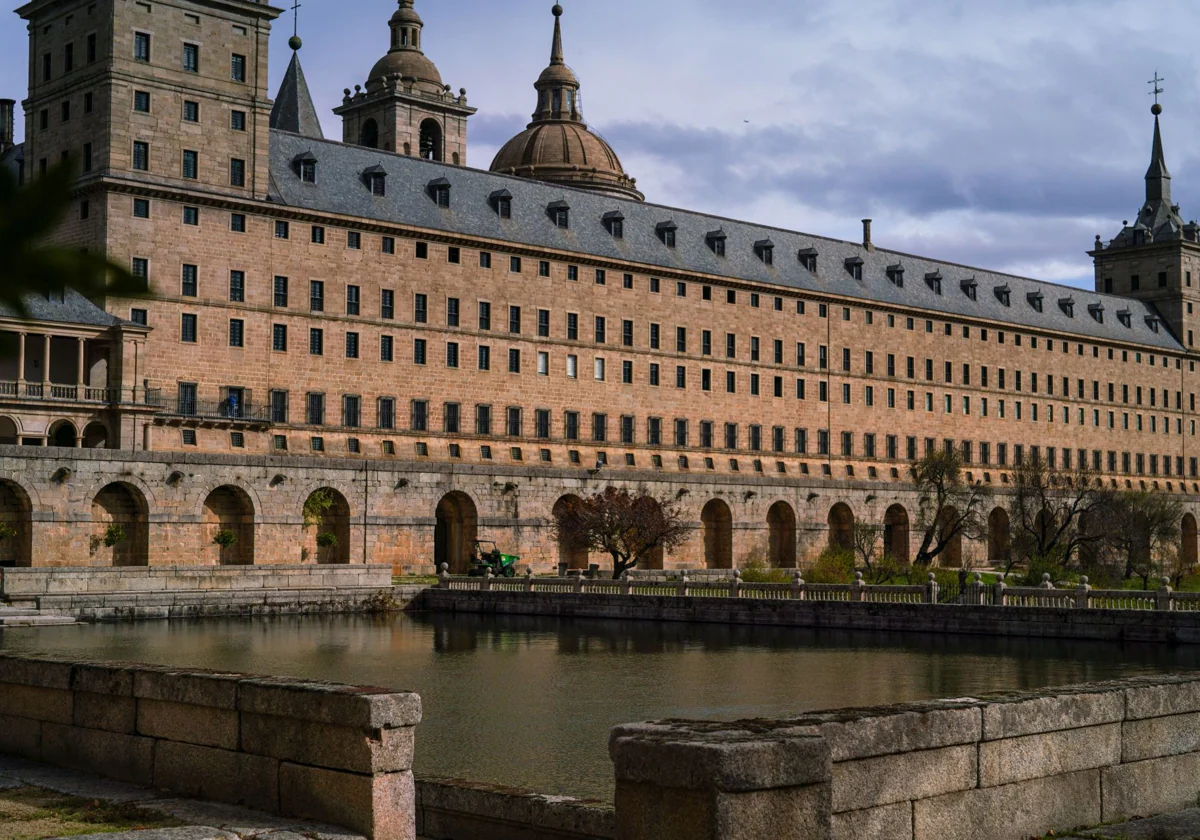

"Without water nearby, Felipe II would never have built the monastery here," asserts José María García Pacheco, delegate of National Heritage at the Royal Site of El Escorial, as he points from a viewpoint to the remains of a thick masonry wall, a remnant of the first dam that the powerful Spanish king, son of Emperor Charles V, ordered to be built in the 16th century for the continuous water supply to the monastery, even in summer.
The monarch spent three years searching for the ideal location for his grand personal project, which he finally erected at the foot of Mount Abantos (1,750 meters altitude), in the heart of the Sierra de Guadarrama, rich in stone, wood, and water from streams and springs—raw materials that made its construction possible.
Aware of the importance of water supply for the construction of the monastery (which lasted 21 years, from 1563 to 1584) and for life within the premises, the sovereign wanted El Escorial to be self-sufficient. Thus, he ordered the damming, channeling, and decanting of the waters from Mount Abantos through a set of constructions that, almost 500 years later, still retain their original architecture.
On the occasion of the 40th anniversary of the Monastery of El Escorial—considered the eighth wonder of the world—being declared a World Heritage Site by UNESCO, National Heritage has organized a tour this Saturday through the lesser-known 'water landscapes,' preceded by a lecture on the dams, fountains, and ponds of the Royal Site by architect Pilar Chías Navarro, an expert in the hydraulic system of the Escurialense heritage complex.
The water route that for five centuries quenched the thirst of the Austrias and Bourbons begins at the primitive Romeral Dam, located at 1,143 meters altitude, about 60 meters above the monastery. Javier Sánchez, chief ranger of El Escorial, highlights the existence of three walls that have marked the different eras of the ancient dam: the original 16th-century masonry designed by Juan de Herrera, another larger one made of ashlar from the 18th century by architect Juan de Villanueva, and the current one, dating from the 20th century, which shapes the current reservoir.
"The goal was to capture and store the flow of streams and tributaries from the entire Mount Abantos area and supply water for the construction of the monastery," explains Sánchez. It would later also serve to supply the first inhabitants of the convent, the community of Jeronimos monks, and the Royal Family itself, as well as for watering the gardens and orchards of the enclave. Today, the water is used to supply the monastery's own fire network.
The tour makes a second stop at the so-called Arca del Romeral or Cascajal, a 16th-century stone cistern that opens to the public for the first time during this visit, and whose function was to "tame" the water that furiously descended from the dam. It is a vaulted reservoir built in granite, which, in addition to taming the water "that descended at great speed due to the slope," filtered it through a decantation system, so that the water with which King Felipe II moistened his royal throat while administering half the world was of "great quality."
"This ark tamed the water and channeled it to the Arca de los Repartimientos, which no longer exists, from where it was distributed through pipes to the different areas of the monastery," says Sánchez, who counts 77 fountains located in various places of the enclosure.
"The water had many uses, the first being the construction of the monastery with its thousand workers, the second for human consumption, and the third for watering the gardens," details García Pacheco, who compares the great mass of stone "with a building ahead of its time, the Silicon Valley of the 16th century." "Today we turn on the tap and water comes out... but in the 16th century, it wasn't that simple. And in the monastery, there was potable water for drinking, but also for the latrines, for washing fish in the kitchens, and even for treating wounds in a small infirmary that treated the convalescents," points out the delegate of National Heritage.
The official visit concludes at the monastery's pond, next to the monument and located next to the abundant fountain of Blasco Sancho, which continues to provide flow, exactly as when it was built five centuries ago. The large pool, now used to water the gardens of the monastery, was populated with numerous freshwater species, such as carp and tench that the Prudent King ordered to be brought from Flanders and Milan, and which served both to supply the convent's table and for Felipe II to delight in the art of fishing while pondering how to invade England. There he indeed faltered.
Just above the pond and attached to the walls of the monastery runs the so-called 'Paseo de África', named because elephants, giraffes, and other exotic animals that both the Austrias and the Bourbons had brought from the continent paraded there for the delight of the court.
The route has a final and unexpected stop in the heart of San Lorenzo de El Escorial, the town founded in the times of Carlos III, in the 18th century, which grew under the thriving activity of the monastery. In Jacinto Benavente square stands today an ornamental fountain that occupies the same location of the now-disappeared Arca de la Repartición, from where various pipes distributed water to the different dependencies of the monastery.
Behind it stands a monolith known as 'El caño gordo', which recalls that there was a fountain there that supplied the town and that was dismantled in the last century. "It was where the neighbors came for water, and the water that has been consumed in San Lorenzo de El Escorial until the 80s," the same that quenched the thirst of Austrias and Bourbons while they held the reins of half the globe.

Latest news





Upcoming events
12
Nov
El Desembarco, la traición de Viriato at La Caja Blanca
12
Nov
HOMER El Mero Mero at Sala Trinchera Málaga
13
Nov
Marbella Startup Lab – Innovate & Collaborate
13
Nov
Candlelight: Coldplay & Imagine Dragons at Sala Fundación Unicaja María Cristina
13
Nov
Candlelight: Tribute to Ludovico Einaudi at Anantara Villa Padierna
Similar News

Bruno Mars Ends a Decade Without a Solo Album with 'The Romantic'
Málaga