Pope Francis as a Media Phenomenon: Between Faith and Social Media

The Catholic Church seeks means and languages to help
spread the faith in the cultural context of the 21st century, marked by the
prevalence of image and digital communication. But can a pope be relevant
today?

The pope's media value and visibility received a
considerable boost during the pontificate of John Paul II. The media have been
with Francis from the first day to the last. At the conclave that elected him
in 2013 there were thousands of accredited journalists from 65 countries; the
600 journalists covering the Holy See were joined by 4,432 special envoys.
Original expressions
Francis showed a special ability to convey the message through language, gestures and symbols. His magisterium was full of graphic and original expressions such as ‘make a mess’, ‘liquefy the faith’, ‘smell like sheep’, ‘Church on the way out’, ‘walk through patience’, ‘airport bishops’, ‘the idol of money’, ‘throwaway culture’, ‘globalisation of indifference’, ‘world war in pieces’, ‘sanctity next door’, ‘culture of encounter’, ‘balconising life’, ‘young people on the sofa’ ..... These expressions have been shaping a singular discourse and, at times, have made an impression on public opinion, both inside and outside the Church.
In addition to the initial meeting with journalists,
several milestones stood out in Francis' relationship with the media right from
the start. The trip to the island of Lampedusa in 2013 was one of them. After
learning of the death of another group of migrants who wanted to arrive from
Africa, the pope went there on a trip that he himself considered to be one of
the highlights of his pontificate.

In Lampedusa, Francis raised his voice:
"I felt I had to come here today to pray, to make
a gesture of closeness, but also so that what has happened will not be
repeated. We are disoriented, we are no longer attentive to the world in which
we live, we do not care, we do not protect what God has created for everyone
and we are not even capable of caring for one another".
The speech resonated strongly with world public
opinion.
Press conferences with questions
Another milestone came with the trip to Brazil for
World Youth Day (2013): the press conferences on the flights. On that first
occasion, the Pope was asked up to 23 questions, which were published in full
by some of the media. The frank and open style was characteristic of the
interventions: ‘To make an armoured space between the bishop and the people is
madness,’ he told the journalists.
In-flight press conferences have been a regular
channel of spontaneous communication and sometimes ended with one-on-one
conversations with journalists.
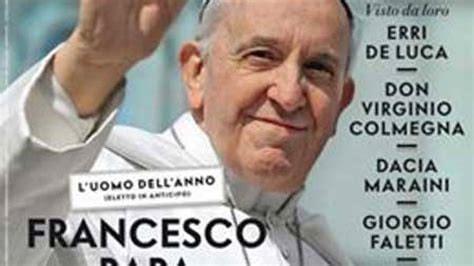
Time magazine named Francis ‘Person of the Year’,
recognising what it called the ‘people's pope’, ‘who adopted the name of a
humble saint’. Francis, Time said, ‘is called to transform a place that has
measured change for centuries’. The publication's nomination, which John XXIII
and John Paul II had already received, was yet another step in Francis'
remarkable prominence in world public opinion.
Time magazine cover naming Pope Francis “Person of the
Year” in 2013.
The Christmas cover of The New Yorker helped to
underline this, along with other cover appearances in such unusual outlets for
religion as Vanity Fair and Rolling Stone.
The pontiff has been a major player in the global
media, which has accelerated the more social aspect of his figure and his
leadership, inside and outside the Church. Initiated by Benedict XVI in
December 2012, the pope's social media accounts (now add the one inaugurated by
Francis on Instagram in 2016) have become global voices of reference in digital
environments.
The nine Twitter accounts (in Spanish, English,
Italian, Portuguese, French, Latin, German, Polish and Arabic) have more than
40 million followers. The potential for dissemination of messages is striking:
some of Francis' tweets have been retweeted more than 13,000 times.
Also striking is the number of messages that become
‘favourites’, another measure of the impact and engagement of audiences that is
often used to measure the effectiveness of network communication.
His vision of communication
What did Francis think about communication? In 2016
and 2017 the Pope had twelve meetings with the French sociologist Dominique
Wolton in which he held wide-ranging discussions on the great issues of our
time, including communication. Francis pointed to a model that emphasises
proximity: closeness to people is the crucial consideration, because in his
view communication is, first and foremost, personal communication.
"Communication is something that cannot be bought. You don't sell it. It
is given," he said.
Proximity is precisely the reason he gives for using
Twitter in his conversation with Wolton: "I have to use all means to get
close to people. I write tweets as if to open doors, I am sure that these
tweets touch hearts". He also highlighted humility as one of his priority
characteristics: ‘The only key that opens the door to communication is
humility’.
As for journalism professionals, Francis shared his
vision already in 2016 in a speech in Italy to the National Council of the
Order of Journalists. There he pointed out that it is up to them to write a
‘first draft of history’, which gives an idea of the transcendence of their
mission.
In his view, the vocation of journalism was ‘to make
the social dimension of a true citizenship grow’. ‘It cannot become a weapon of
destruction: I want journalism to be, increasingly and everywhere, an
instrument of construction, a factor for the common good, an accelerator of
reconciliation processes,’ he said. The philosophy of ‘building bridges’ was
key to his understanding of communication.
The strategy of the lack of strategy
Any assessment of Francis' pontificate is still
premature. But some conclusions can already be drawn. In a way, his strategy
consisted of a lack of strategy: freshness, spontaneity and proximity.
Difficult to pigeonhole into conventional media
categories, he also stood out with a smile that has gone around the world.
These qualities have allowed the Church to connect with freshness in less usual
contexts, with audiences who were less comfortable with religion. Francis'
message has been a source of opportunity for communicating faith in the 21st
century and has enabled the Church to reach new forums with its mission.
Cláusula de Divulgación
Francisco J. Pérez Latre no recibe salario, ni ejerce labores de consultoría, ni posee acciones, ni recibe financiación de ninguna compañía u organización que pueda obtener beneficio de este artículo, y ha declarado carecer de vínculos relevantes más allá del cargo académico citado.
Nuestros socios

Universidad de Navarra aporta financiación como institución fundacional de The Conversation ES.

Latest news





Upcoming events
12
Nov
El Desembarco, la traición de Viriato at La Caja Blanca
12
Nov
HOMER El Mero Mero at Sala Trinchera Málaga
13
Nov
Marbella Startup Lab – Innovate & Collaborate
13
Nov
Candlelight: Coldplay & Imagine Dragons at Sala Fundación Unicaja María Cristina
13
Nov
Candlelight: Tribute to Ludovico Einaudi at Anantara Villa Padierna
Similar News
Bruno Mars Ends a Decade Without a Solo Album with 'The Romantic'
Málaga