Scientists found a potential sign of life on a distant planet – an astronomer explains why many are still skeptical
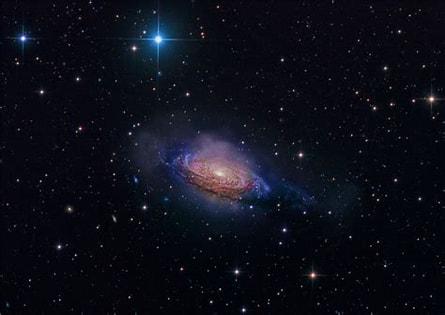

A team of
astronomers announced on April 16, 2025, that in the process of studying a
planet around another star, they had found evidence for an unexpected
atmospheric gas. On Earth, that gas – called dimethyl sulfide – is mostly
produced by living organisms.
In April
2024, the James Webb Space Telescope stared at the host star of the planet
K2-18b for nearly six hours. During that time, the orbiting planet passed in
front of the star. Starlight filtered through its atmosphere, carrying the
fingerprints of atmospheric molecules to the telescope.

A diagram
showing planets and stars emitting light, which goes through JWST detectors,
where it's split into different wavelengths to make a spectrum. Each spectrum
suggests the presence of a different element.
JWST’s
cameras can detect molecules in the atmosphere of a planet by looking at light
that passed through that atmosphere. European Space Agency
By
comparing those fingerprints to 20 different molecules that they would
potentially expect to observe in the atmosphere, the astronomers concluded that
the most probable match was a gas that, on Earth, is a good indicator of life.
I am an
astronomer and astrobiologist who studies planets around other stars and their
atmospheres. In my work, I try to understand which nearby planets may be
suitable for life.
K2-18b,
a mysterious world
To
understand what this discovery means, let’s start with the bizarre world it was
found in. The planet’s name is K2-18b, meaning it is the first planet in the
18th planetary system found by the extended NASA Kepler mission, K2.
Astronomers assign the “b” label to the first planet in the system, not “a,” to
avoid possible confusion with the star.
K2-18b is a
little over 120 light-years from Earth – on a galactic scale, this world is
practically in our backyard.
Although
astronomers know very little about K2-18b, we do know that it is very unlike
Earth. To start, it is about eight times more massive than Earth, and it has a
volume that’s about 18 times larger. This means that it’s only about half as
dense as Earth. In other words, it must have a lot of water, which isn’t very
dense, or a very big atmosphere, which is even less dense.
Astronomers
think that this world could either be a smaller version of our solar system’s
ice giant Neptune, called a mini-Neptune, or perhaps a rocky planet with no
water but a massive hydrogen atmosphere, called a gas dwarf.
Another
option, as University of Cambridge astronomer Nikku Madhusudhan recently
proposed, is that the planet is a “hycean world”.
That term
means hydrogen-over-ocean, since astronomers predict that hycean worlds are
planets with global oceans many times deeper than Earth’s oceans, and without
any continents. These oceans are covered by massive hydrogen atmospheres that
are thousands of miles high.
Astronomers
do not know yet for certain that hycean worlds exist, but models for what those
would look like match the limited data JWST and other telescopes have collected
on K2-18b.
This is
where the story becomes exciting. Mini-Neptunes and gas dwarfs are unlikely to
be hospitable for life, because they probably don’t have liquid water, and
their interior surfaces have enormous pressures. But a hycean planet would have
a large and likely temperate ocean. So could the oceans of hycean worlds be
habitable – or even inhabited?
Detecting
DMS
In 2023,
Madhusudhan and his colleagues used the James Webb Space Telescope’s
short-wavelength infrared camera to inspect starlight that filtered through
K2-18b’s atmosphere for the first time.
They found
evidence for the presence of two simple carbon-bearing molecules – carbon
monoxide and methane – and showed that the planet’s upper atmosphere lacked
water vapor. This atmospheric composition supported, but did not prove, the
idea that K2-18b could be a hycean world. In a hycean world, water would be
trapped in the deeper and warmer atmosphere, closer to the oceans than the
upper atmosphere probed by JWST observations.
Intriguingly,
the data also showed an additional, very weak signal. The team found that this
weak signal matched a gas called dimethyl sulfide, or DMS. On Earth, DMS is
produced in large quantities by marine algae. It has very few, if any,
nonbiological sources.
This signal
made the initial detection exciting: on a planet that may have a massive ocean,
there is likely a gas that is, on Earth, emitted by biological organisms.

An
illustration of what scientists imagine K2-18b to look like, which looks a
little like Earth, with clouds and a translucent surface.
K2-18b
could have a deep ocean spanning the planet, and a hydrogen atmosphere. Amanda
Smith, Nikku Madhusudhan (University of Cambridge), CC BY-SA
Scientists
had a mixed response to this initial announcement. While the findings were
exciting, some astronomers pointed out that the DMS signal seen was weak and
that the hycean nature of K2-18b is very uncertain.
To address
these concerns, Mashusudhan’s team turned JWST back to K2-18b a year later.
This time, they used another camera on JWST that looks for another range of
wavelengths of light. The new results – announced on April 16, 2025 – supported
their initial findings.
These new
data show a stronger – but still relatively weak – signal that the team
attributes to DMS or a very similar molecule. The fact that the DMS signal
showed up on another camera during another set of observations made the
interpretation of DMS in the atmosphere stronger.
Madhusudhan’s
team also presented a very detailed analysis of the uncertainties in the data
and interpretation. In real-life measurements, there are always some
uncertainties. They found that these uncertainties are unlikely to account for
the signal in the data, further supporting the DMS interpretation. As an
astronomer, I find that analysis exciting.
Is life
out there?
Does this
mean that scientists have found life on another world? Perhaps – but we still
cannot be sure.
First, does
K2-18b really have an ocean deep beneath its thick atmosphere? Astronomers
should test this.
Second, is
the signal seen in two cameras two years apart really from dimethyl sulfide?
Scientists will need more sensitive measurements and more observations of the
planet’s atmosphere to be sure.
Third, if
it is indeed DMS, does this mean that there is life? This may be the most
difficult question to answer. Life itself is not detectable with existing
technology. Astronomers will need to evaluate and exclude all other potential
options to build their confidence in this possibility.
The new
measurements may lead researchers toward a historic discovery. However,
important uncertainties remain. Astrobiologists will need a much deeper
understanding of K2-18b and similar worlds before they can be confident in the
presence of DMS and its interpretation as a signature of life.
Scientists
around the world are already scrutinizing the published study and will work on
new tests of the findings, since independent verification is at the heart of
science.
Moving
forward, K2-18b is going to be an important target for JWST, the world’s most
sensitive telescope. JWST may soon observe other potential hycean worlds to see
if the signal appears in the atmospheres of those planets, too.
With more
data, these tentative conclusions may not stand the test of time. But for now,
just the prospect that astronomers may have detected gasses emitted by an alien
ecosystem that bubbled up in a dark, blue-hued alien ocean is an incredibly
fascinating possibility.
Regardless
of the true nature of K2-18b, the new results show how using the JWST to survey
other worlds for clues of alien life will guarantee that the next years will be
thrilling for astrobiologists.

Latest news





Upcoming events
12
Nov
El Desembarco, la traición de Viriato at La Caja Blanca
12
Nov
HOMER El Mero Mero at Sala Trinchera Málaga
13
Nov
Marbella Startup Lab – Innovate & Collaborate
13
Nov
Candlelight: Coldplay & Imagine Dragons at Sala Fundación Unicaja María Cristina
13
Nov
Candlelight: Tribute to Ludovico Einaudi at Anantara Villa Padierna
Similar News


Bruno Mars Ends a Decade Without a Solo Album with 'The Romantic'
Málaga