


Málaga María Zambrano to get Andalusia’s largest new station information screen
Adif will upgrade passenger information systems at Málaga María Zambrano and Antequera Santa Ana with 88 new screens, high-definition technology and a new model designed to make journeys through stations easier.
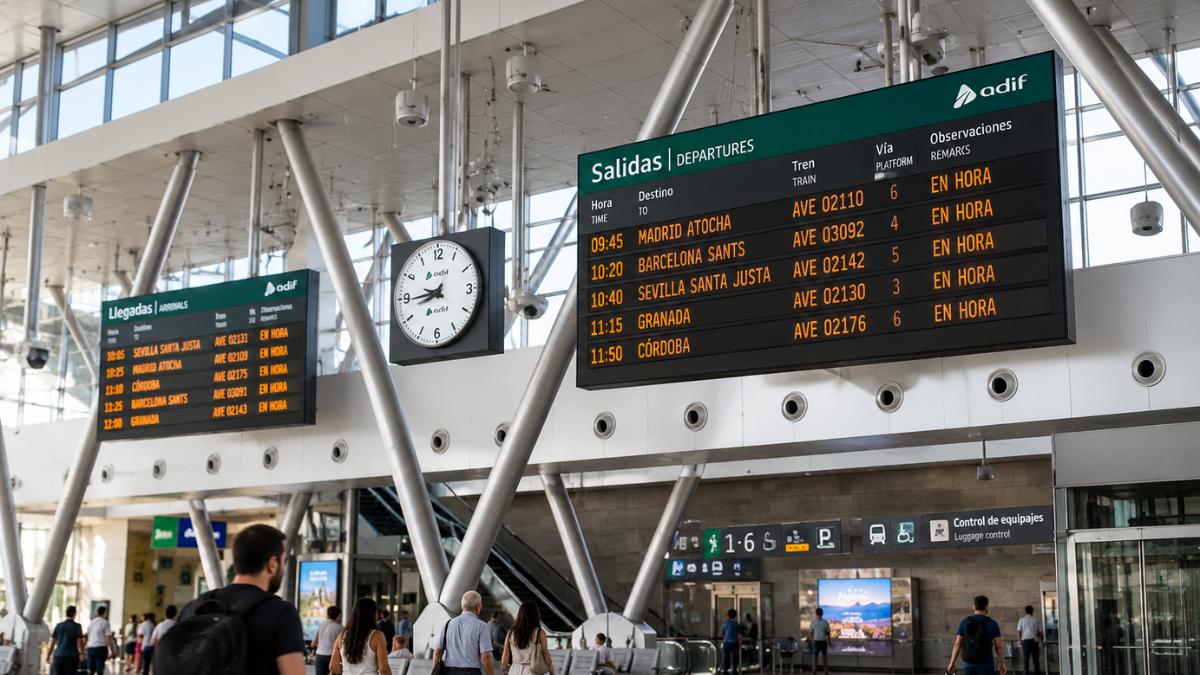

Málaga María Zambrano and Antequera Santa Ana are preparing for a major technological upgrade. Adif Alta Velocidad has launched a project to modernise passenger information systems at six of Andalusia’s main high-speed railway stations.
Across Málaga province, 88 new screens will be installed: 60 at María Zambrano and 28 at Antequera Santa Ana.
The most eye-catching addition will be in Málaga city. María Zambrano will receive a large-format display measuring 18 metres wide and 1.75 metres high, making it the largest screen planned for any Andalusian station included in the project.
60 new screens for Málaga María Zambrano
Málaga’s main railway station will receive one of the largest numbers of new devices.
Adif plans to install 60 new information screens throughout Málaga María Zambrano.
The idea is to allow passengers to check departures, arrivals, platforms and other useful information without relying only on the large central boards traditionally located in specific parts of the station.
The new system is designed so that information follows passengers as they move through the terminal.
An 18-metre screen, the largest in Andalusia
The standout feature will be a giant display measuring 18 metres wide by 1.75 metres high.
It will be the longest screen included in the modernisation programme across the six Andalusian stations.
Its size will allow a large amount of information to be displayed at the same time, including train schedules, station services and other important notices.
The installation will significantly change the visual appearance of María Zambrano, a station used every year by large numbers of high-speed, long-distance, medium-distance and commuter rail passengers.
Antequera Santa Ana will receive 28 new screens
The upgrade will also reach Antequera Santa Ana, a strategically important station within Andalusia’s rail network.
A total of 28 new screens will be installed there.
The station acts as a connection point between several major rail corridors and receives services from Málaga, Seville, Granada, Madrid and other destinations.
The new system will modernise the way passengers receive information about arrivals, departures, platforms and possible service changes.
High-definition, full-colour displays
The new devices will be a major step forward from traditional text-heavy information boards.
Adif is introducing ultra-high-definition, full-colour and more energy-efficient screens.
In addition to train information, they will be able to display other content that may be useful to passengers.
This can include:
- station services;
- baggage information;
- connections with other forms of transport;
- operational changes;
- special notices;
- service disruptions;
- information linked to specific events.
This means the content can be adapted according to what is happening at the station at any given time.
A new visual design to make information easier to understand
The modernisation will not be limited to the hardware.
The information displayed will also have a new visual identity.
Adif plans to use new fonts, colours and pictograms to improve readability and make navigation easier for passengers.
Accessibility will also be one of the key criteria behind the redesign.
The objective is for passengers to identify the information they need quickly, even in stations with high levels of traffic and frequent train movements.
Information throughout the station
One of the biggest changes will be the way the screens are distributed.
Traditionally, large departure and arrival boards are concentrated in certain parts of a station.
This often results in groups of passengers gathering around a small number of screens, especially during busy periods.
The new model changes that approach.
Screens will be placed throughout entrance halls, circulation areas and platforms, allowing passengers to check information from different locations.
Fewer crowds around central departure boards
The aim is to make it unnecessary for passengers to walk to a single central board every time they want to check their train.
If information is available throughout the building, unnecessary movement and crowding can be reduced.
This could be particularly useful at Málaga María Zambrano during weekends, holidays and major events, when passenger numbers rise significantly.
It also allows messages to be adapted depending on where each screen is located.
The model has already been introduced at Madrid Chamartín
The system follows the model developed by Adif at the renovated Madrid Chamartín-Clara Campoamor station.
The transformation of the Madrid terminal has served as a reference for a new approach to passenger information.
Instead of displaying everything only on large central boards, information is distributed through different parts of the station so that passengers can follow it from arrival until they board their train.
That model is now being extended to Andalusia’s main high-speed rail stations.
New clocks, public address systems and signage
The technological upgrade will not be limited to screens.
The project also includes the renewal or installation of other passenger information systems.
These include clocks, public address equipment and new wayfinding signage.
All of these elements form part of the same objective: making it easier for passengers to move through stations and receive updated information throughout their journey.
Six Andalusian stations included in the first phase
In addition to Málaga María Zambrano and Antequera Santa Ana, four other major high-speed stations are included.
A total of 293 new screens will be installed.
The planned distribution is:
- Seville Santa Justa: 125 screens
- Córdoba: 61 screens
- Málaga María Zambrano: 60 screens
- Antequera Santa Ana: 28 screens
- Puente Genil-Herrera: 13 screens
- Villanueva de Córdoba-Los Pedroches: 6 screens
The project also includes several particularly large-format displays.
Seville will get two large screens
Although Málaga will have the longest screen, Seville Santa Justa will also receive two major displays.
They will measure approximately 12 metres wide and two metres high.
Seville will also receive the highest total number of devices, with 125 screens.
The rollout reflects the heavy passenger volumes handled by Andalusia’s main high-speed rail terminals.
A multi-million-euro investment
Adif Alta Velocidad has put the supply and commissioning of the new passenger information system out to tender.
The contract represents an investment of around €5.5 million before tax, covering the six Andalusian stations.
The project forms part of wider investments aimed at modernising facilities that have had to adapt to growing passenger numbers and increasing rail traffic in recent years.
Around 30 million passengers used these stations in 2025
Together, the six stations included in this first phase handled around 30 million passengers in 2025.
The expansion of high-speed rail services and the arrival of new operators have increased the number of connections available and the volume of travellers using these terminals.
That growth also creates new operational needs.
Clearer and more widely available information can be particularly useful during platform changes, delays or last-minute service adjustments.
Málaga is one of southern Spain’s key rail hubs
Málaga María Zambrano has become one of southern Spain’s main railway hubs.
The station offers high-speed connections with Madrid and other parts of the country, as well as services to Andalusian cities and the Costa del Sol commuter rail network.
It is also located next to the bus station and connects directly with a range of urban transport services.
The upgraded information system is intended to make navigation easier for both local residents and the millions of visitors who use the station.
Antequera is strategically important within Andalusia’s rail network
Antequera Santa Ana plays a different but equally important role.
Its geographical position makes it a key railway junction for services towards Málaga, Granada, Seville, Córdoba and Madrid.
The installation of 28 new screens will allow passengers to access updated information from more points around the station.
This is particularly useful at terminals where many passengers are transferring between different services.
The modernisation will gradually reach more stations
The six Andalusian stations are part of an initial phase.
Adif’s intention is to gradually extend this new passenger information model to other stations.
This means the system first introduced in Madrid Chamartín and now being rolled out in Andalusia could become a reference model for other railway terminals across Spain.
Older information boards will progressively be replaced by more flexible digital systems.
Technology designed to make travel easier
For passengers, the change will be highly visible.
The new screens will offer more information, better image quality and greater coverage throughout the station.
But the upgrade also aims to solve a simple everyday problem: having to locate one large central board every time a passenger wants to check a platform or departure time.
With the new system, information will be available throughout the terminal.
At Málaga María Zambrano, that transformation will have one particularly striking symbol: an 18-metre screen, the largest planned for any Andalusian station included in the project.

Latest news




Similar News
Málaga’s Low Emission Zone stops issuing fines: what changes now and what happens to existing penalties
Málaga
University of Málaga studies how a new La Rosaleda stadium could affect the Teatinos campus
Málaga

Virgen del Rosario Procession in El Palo This Saturday: Full Route and Times
Málaga
