From medieval shipyard to food market: the remarkable history of Atarazanas in central Málaga
Before becoming one of Málaga’s best-known markets, this site stood beside the sea and housed a large shipyard where vessels were built and repaired.

Anyone walking into Málaga’s Central Atarazanas Market today to buy fish, fruit, meat or enjoy a tapa is stepping into one of the most historically transformed places in the city centre. Long before it became a food market, the site was directly connected to the sea and to Málaga’s medieval naval activity.
For centuries, the coastline lay much closer to this area than it does today. This was the location of the old Atarazanas of Málaga, a vast complex originally used for building and repairing ships.
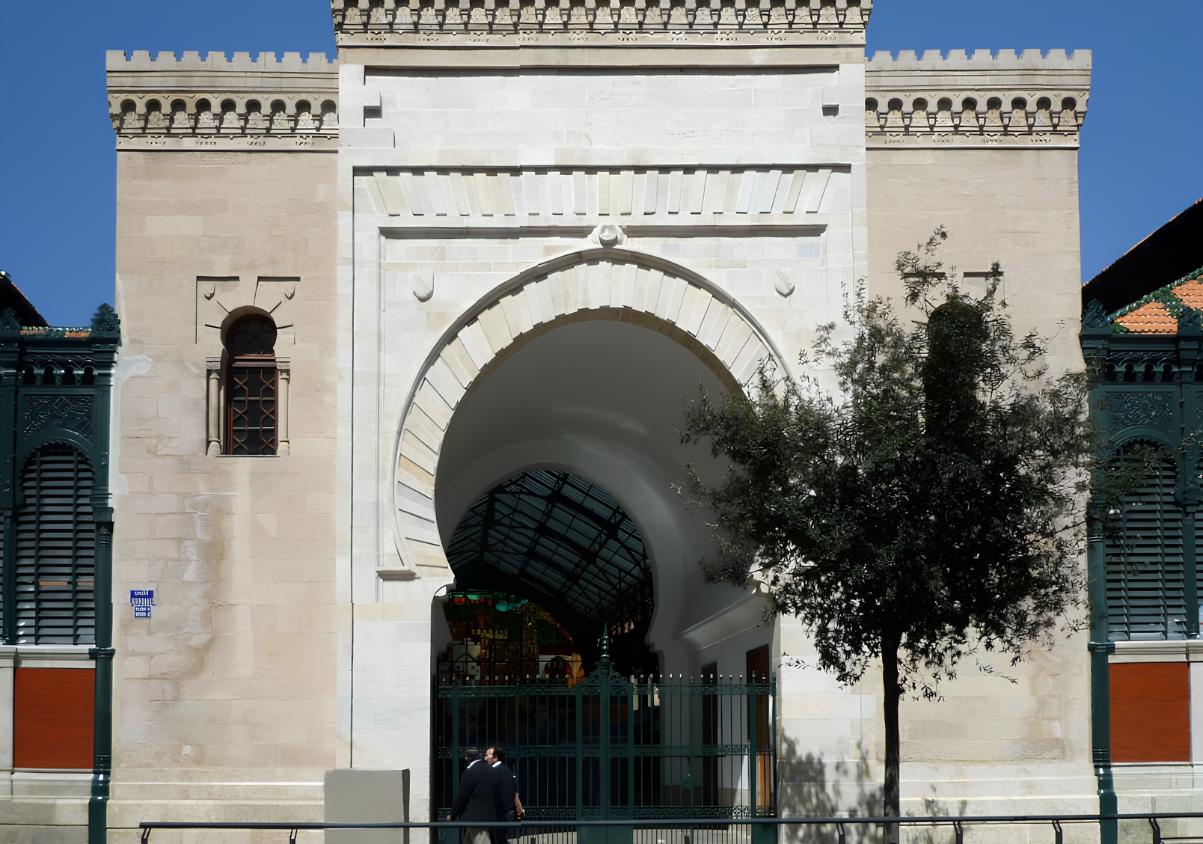
Very little remains of the Islamic structure today, apart from its monumental gateway, which was incorporated into the façade of the current market and has become one of the most recognisable features of Málaga’s historic centre.
A shipyard beside the beach in medieval Málaga
The origins of the Atarazanas go back at least to the 12th century, although archaeological studies do not rule out the possibility of earlier structures on the site.
The setting was completely different from what visitors see today.
The shipyard stood outside the main walls of the medina, close to the Guadalmedina River and beside a beach area southwest of the city.
This allowed vessels to reach the facilities directly from the sea.
The word “atarazana”, of Arabic origin, refers to spaces used for the construction, repair and storage of ships and naval equipment.
Five large halls opening towards the sea
The original complex was substantial in size.
According to archaeological documentation from Málaga City Council, the shipyard had a rectangular layout made up of five longitudinal halls.
These spaces opened towards the shoreline through two entrances and were crossed by another ten perpendicular sections.
The design made it possible to carry out different activities connected with ships in a facility directly linked to the coast.
The Málaga surrounding the complex at that time would be almost unrecognisable today: the sea was much closer and large parts of the modern city centre had yet to exist.
A major expansion during the Nasrid period
The Atarazanas underwent a major transformation during the 14th century, under Nasrid rule.
The complex was extended towards the west and south, while different parts of its perimeter were reinforced.
An open area was also created between the original shipyard and a new defensive outer wall.
This eventually became a porticoed courtyard accessed through a monumental gate.
That gateway, although significantly altered over the centuries, is the main surviving element of the medieval complex.
More than 5,000 square metres
The Atarazanas complex covered approximately 5,008 square metres.
Its size demonstrates the importance of the site within medieval Málaga.
In addition to its naval role, the building eventually became part of the city’s defensive system.
Its thick walls connected with the walled enclosure on the northern and eastern sides, reinforcing protection around this area close to the coastline and the Guadalmedina River.
The gateway that can still be seen today
The most recognisable surviving feature is the Atarazanas Gate.
It consists of a large pointed horseshoe arch built from blocks of marble and other stone.
The gateway formed part of the monumental entrance to the complex and may have been built during the reign of Yusuf I in the 14th century.
Originally, it also contained other decorative and architectural elements that have not survived intact.
When the old complex was dismantled, the gateway itself was taken apart piece by piece.
It was later reconstructed and incorporated into the entrance of the new market.
What happened after Málaga was conquered
Málaga’s incorporation into the Crown of Castile in 1487 did not immediately bring an end to the Atarazanas.
The large building continued to be used for centuries, although it gradually lost its original naval function.
Over time, it served a variety of purposes.
These included use as a military barracks, hospital, ammunition store and surgical college.
This continued reuse helped parts of the complex survive for several centuries after the end of Muslim rule.
The 19th century changed Atarazanas forever
The major transformation came during the second half of the 19th century.
By then, the old complex was badly deteriorated and Málaga needed a modern central market where food trading could be concentrated.
Municipal architect Joaquín de Rucoba was commissioned to design the building that would become the present Central Market.
Construction took place mainly between 1876 and 1879, with Málaga City Council identifying 1879 as the year the new market opened.
Almost all of the old medieval complex disappeared during the redevelopment.
The monumental Islamic gateway was one of the few elements that was preserved.
Iron and glass for the new market
The new building represented a completely different architectural style.
Rucoba designed a structure in which iron and glass played a central role, reflecting the new construction techniques spreading across Europe during the 19th century.
The design also incorporated neo-Arabic references and decorative features inspired by Andalusian architecture.
The metal structure was closely linked to Málaga’s own industrial tradition.
The result was a building that was modern and functional for its time while still maintaining a visual connection to the historical identity of the site.
The old gateway became the main entrance
Preserving the Atarazanas Gate created a direct connection between the medieval complex and the new market.
After being dismantled, it was rebuilt and incorporated into the main façade.
However, not every original piece returned to exactly the same position.
Archaeological documentation notes that the arch itself is the principal element that survives intact, while other components were lost or rearranged during the transformation.
Today, thousands of people pass beneath it every week without necessarily realising that it once belonged to a vast medieval shipyard.
A market protected as a cultural landmark
The Central Atarazanas Market gradually became one of Málaga’s main municipal markets.
Its architectural and historical significance led to it being declared a Bien de Interés Cultural, or Asset of Cultural Interest, in 1979.
Since then, the building has undergone several restoration projects aimed at preserving it while adapting it to modern commercial needs.
One of the most important renovations took place between 2008 and 2010.
Archaeological monitoring during those works also documented remains of the foundations of the original Islamic structure.
The stained glass recalls a Málaga that faced the sea
Another of the market’s most striking features today is its large stained-glass window.
The images help visitors imagine a historic Málaga in which the sea reached areas that are now completely integrated into the urban centre.
Over the centuries, changes to the coastline gradually pushed the sea farther away from Atarazanas.
Where ships once arrived, there are now streets, buildings, squares and a large part of central Málaga.
From building ships to selling fish
The evolution of the site reflects much of Málaga’s own transformation.
It began as a place directly connected to the Mediterranean and naval activity.
Later, it became part of the city’s defensive infrastructure and took on military, medical and administrative uses.
Finally, in the 19th century, it became a market.
Today, its stalls mainly sell fish and seafood, meat, fruit, vegetables, spices, local products and other food, while a strong food-and-drink scene has also developed in and around the market.
One of the most visited places in central Málaga
Atarazanas is no longer simply a place where local residents do their shopping.
In recent years, it has also become a regular stop for visitors to Málaga.
Its architecture, fresh produce and the opportunity to eat at nearby bars have increased its appeal as a tourism destination.
Despite this shift, the building still maintains its original function as a traditional food market and remains one of the city’s main centres of everyday commerce.
A building that tells centuries of history
Few places in central Málaga allow visitors to read so many centuries of history simply through their architecture.
The gateway recalls the city’s Islamic and naval past.
The iron structure reflects the urban modernisation of the 19th century.
The stalls continue a commercial tradition that has lasted for well over a century.
And beneath the building, remains of the original Atarazanas still survive from a time when the Mediterranean reached this part of the city.
Centuries have passed since ships were built and repaired here, but the name Atarazanas still preserves the memory of the original purpose of one of Málaga’s most emblematic landmarks.

Latest news