Quirónsalud Málaga operates two haemodynamics labs 24/7 for heart attack care
The hospital has two dedicated facilities for cardiovascular procedures and maintains a year-round primary angioplasty programme, a treatment used to restore blood flow as quickly as possible when a coronary artery becomes blocked.
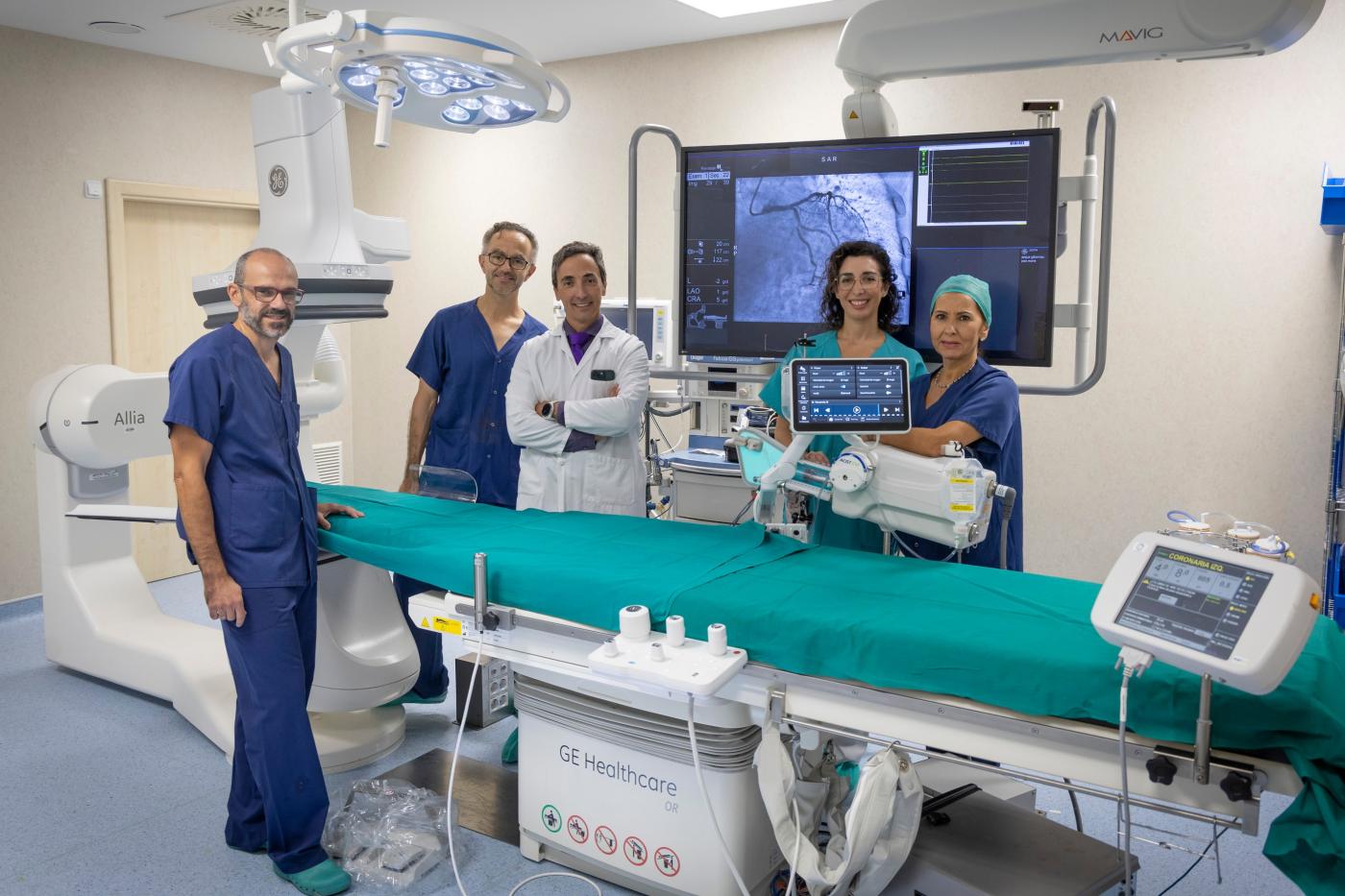

A heart attack does not wait for a scheduled procedure to end, nor does it depend on whether it happens during the day, at night or on a public holiday. That is why having both specialised staff and facilities ready to respond immediately can be crucial in the treatment of a coronary emergency.
Hospital Quirónsalud Málaga currently has two haemodynamics labs and operates a primary angioplasty programme 24 hours a day, 365 days a year.
According to the hospital, it was also the first private hospital in Andalusia to have two haemodynamics labs, giving it greater capacity to respond to heart attack patients as well as other cardiovascular procedures.
What happens to the heart during a heart attack?
An acute myocardial infarction can occur when blood flow to part of the heart muscle is interrupted because a coronary artery becomes blocked.
In cases of ST-elevation myocardial infarction, or STEMI, restoring circulation as quickly as possible is particularly important.
The aim is to bring blood and oxygen back to the affected area and reduce, as far as possible, the amount of heart muscle that is damaged.
This is the origin of the expression often used in cardiology: “time is muscle.”
Dr Antonio Esteban, Head of Cardiology at Hospital Quirónsalud Málaga, explains that the sooner the blocked artery can be opened and blood flow restored, the greater the chances of limiting damage to the heart.
What is primary angioplasty?
One of the main treatments used for certain types of heart attack is primary coronary angioplasty.
The procedure involves inserting a catheter and guiding it towards the coronary arteries to identify the point where the blockage has occurred.
Access is commonly obtained through an artery in the wrist.
Once the affected area is reached, different devices can be used to restore blood flow. In many cases, a stent is implanted to help keep the artery open after circulation has been re-established.
These procedures take place in haemodynamics labs, specially equipped rooms that allow specialists to visualise the coronary arteries and carry out catheter-based cardiovascular interventions.
Why 24-hour availability matters
A heart attack can happen at any time.
It can occur in the middle of the night, during a weekend or while one of the hospital’s procedure rooms is already being used for another intervention.
For that reason, a permanent primary angioplasty programme depends on more than having the necessary equipment.
It also requires an organisation capable of mobilising interventional cardiologists, clinical cardiologists, nurses, technicians, emergency professionals and intensive care specialists whenever needed.
Quirónsalud Málaga maintains this programme 24 hours a day throughout the year.
The European Society of Cardiology also stresses that heart attack care systems should be organised to ensure rapid coordination between emergency services and hospitals capable of providing percutaneous coronary intervention around the clock.
What does having two haemodynamics labs provide?
A second lab does not simply mean being able to carry out more procedures.
It also provides an additional level of availability.
If one room is being used for a scheduled procedure or a complex intervention, the second can remain available for an emergency.
The same applies when one facility requires maintenance or when several cardiovascular cases need to be managed at the same time.
The hospital’s Head of Cardiology highlights this as an important factor in terms of safety and organisation, reducing dependence on a single procedure room.
Quirónsalud Málaga introduced its second haemodynamics lab specifically to reinforce its response to acute myocardial infarction and other cardiovascular procedures.
The labs are not only used for heart attacks
Although primary angioplasty is one of their most important emergency functions, haemodynamics labs are used for a much wider range of procedures.
At Hospital Quirónsalud Málaga, diagnostic procedures include:
- cardiac catheterisation;
- coronary angiography.
Therapeutic procedures can include:
- coronary angioplasty;
- stent implantation;
- catheter-based closure of certain intracardiac defects;
- other interventional cardiology procedures.
These facilities are therefore used for both urgent treatment and planned diagnosis and management of different cardiovascular conditions.
Reducing time before the patient reaches the lab is also essential
Technology is only one part of heart attack treatment.
Before angioplasty can be performed, the patient must first be identified, assessed, tested, referred to the specialist team and transferred to the procedure room.
European acute coronary syndrome guidelines emphasise that invasive strategies are time-sensitive.
For patients with STEMI, they recommend an immediate invasive strategy and establish primary angioplasty as the preferred reperfusion treatment when it can be performed within the recommended time window.
Heart attack care is therefore a coordinated process involving several teams from the first assessment through to definitive treatment.
Care begins before the patient reaches haemodynamics
Quirónsalud Málaga stresses that the procedure room is only one part of the overall care pathway.
A patient may initially arrive through the Emergency Department, where staff must quickly identify a suspected acute coronary syndrome and carry out tests such as an electrocardiogram.
From there, the interventional cardiology team can be activated and care coordinated with other departments, including the Intensive Care Unit.
The hospital has also used multidisciplinary simulation to train this process.
In 2023, Quirónsalud Málaga introduced a simulation room where professionals reproduced the complete care pathway for a patient with acute coronary syndrome, from arrival at the Emergency Department through primary angioplasty and subsequent admission to intensive care.
The role of haemodynamics in modern cardiovascular care
Interventional cardiology has made it possible to treat certain cardiovascular conditions through catheter-based procedures that are less invasive than traditional surgery.
In coronary artery disease, specialists can reach the site of an obstruction, reopen the artery and implant a stent directly where blood flow has been interrupted.
But the effectiveness of these treatments depends not only on the technology available, but also on how quickly they can be performed.
That is why European Society of Cardiology recommendations place such emphasis on organised care networks and access to centres capable of providing urgent coronary intervention at any time of day.
Two labs help maintain continuity of care
The organisational advantage of having two labs becomes particularly clear when one is temporarily unavailable.
That may happen because it is already being used for another patient, because a complex intervention is in progress or because of technical maintenance.
With a second facility available, the hospital has an alternative for continuing cardiovascular procedures.
Quirónsalud Málaga says this redundancy helps provide greater response capacity and continuity of care, particularly when a coronary emergency occurs.
A year-round service that has been operating for several years
The hospital’s emergency primary angioplasty programme is not new.
In 2023, Quirónsalud Málaga reported that it had already been running a 24-hour, seven-day-a-week, 365-day-a-year primary angioplasty programme for acute myocardial infarction for four years.
The presence of two haemodynamics labs further reinforces that structure.
The aim is not simply to have more equipment available, but to ensure that when an emergency occurs there is an organisation capable of taking the patient from the first signs of a problem to definitive treatment as quickly as possible.

Latest news




Upcoming events
2
Oct
Marbella Championship 2026 – International Outdoor Fitness Festival
2
Oct
Misery – Stephen King’s Psychological Thriller in Málaga
2
Oct
The Happiness Pill – La Coracha Theatre Premiere in Málaga
3
Oct
Ovi at FITZ Marbella 2026
3
Oct
Flamenco Patrimonio – Ballet Flamenco de Andalucía at Marbella TodoDanza 2026