


Are you slicing the ham properly?
Alberto Corbacho, Champion of Spain, reveals the secrets to cutting a good slice without hesitationBuying Iberian ham: The new way to choose quality and origin in Spain
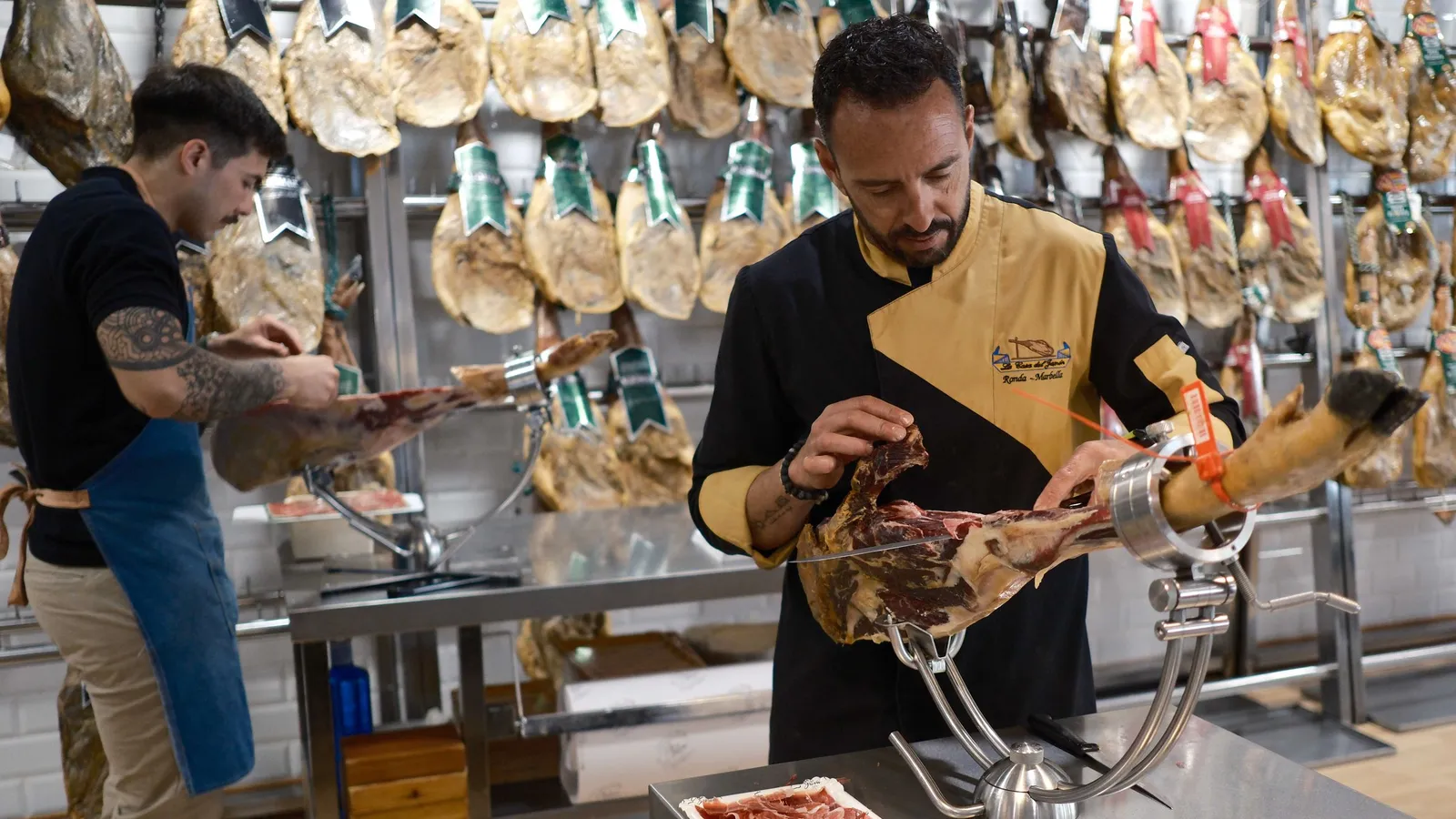

Ham is one of the star products of Spanish cuisine. There is no respectable party, gathering of friends, or celebration that doesn't feature dishes of this product among its starters. Another matter is which type is chosen, something that is often influenced by the budget, as there are many options. From white ham to 100% Iberian acorn-fed ham, which usually have much higher prices.
Beyond the type of ham we choose, another question is whether we are really cutting it properly. Although many people buy the product already sliced by professional cutters, others opt to take home whole pieces and slice it gradually for consumption.
There are not a few injuries that have occurred while cutting ham at home or by someone at an event. And indeed, although it may seem easy, it has its rules to avoid accidents.
Placement of the Ham
The first thing is to know how we need to place the ham depending on the time we plan to consume it. If we plan to do it quickly, something like less than a month, we can place it with the hoof facing up and start cutting from the widest part. If we plan to take longer to consume it, then we should place it with the hoof facing down on the holding board to start cutting from the narrower and more cured part. This way, we avoid it reaching an excessive point of maturation.
Regarding the actual task of cutting the ham, the main secret is to have a very sharp knife. "Although it may seem contradictory, it is the best way to avoid cuts," explained Alberto Corbacho, a cutter from Leocadio La Casa del Jamón and Champion of Spain. He pointed out that "most accidents happen because we exert force with the knife when it does not cut well and it slips; you should not exert force to cut ham, the knife should glide."
Hand Protection
Precisely at this point, the placement of the hand is another essential aspect. "The hand should never be in the path of the knife; if we cut forward, the hand must be behind the knife, whereas if we are cutting towards our body, we must protect it behind the bone or place it resting on the rear part of the ham always below the level of the knife cut," he explained.
In this way, even if the knife slips, it would never reach the free hand used to remove the slices.
Regarding the size of each slice, Corbacho maintained that "it should be two or three fingers wide and should be so thin that if we place a knife behind it, it should be translucent.

Latest news





Upcoming events
12
Nov
El Desembarco, la traición de Viriato at La Caja Blanca
12
Nov
HOMER El Mero Mero at Sala Trinchera Málaga
13
Nov
Marbella Startup Lab – Innovate & Collaborate
13
Nov
Candlelight: Coldplay & Imagine Dragons at Sala Fundación Unicaja María Cristina
13
Nov
Candlelight: Tribute to Ludovico Einaudi at Anantara Villa Padierna
Similar News

The 'Formula 1' team from Ronda qualifies for the international final of Stem Racing
Ronda

Arias launches a butter made from goat's milk cream produced in Ronda
Ronda

New project to rehabilitate the Casa del Rey Moro, one of the jewels of Ronda
Ronda
