


The 16th Century Treasures of the Library of the Royal Maestranza of Ronda
The exhibition featured 23 books dated between 1544 and 1600 to observe the evolution of printing. The Royal School of Cavalry of Ronda rescues 37 years of its history.
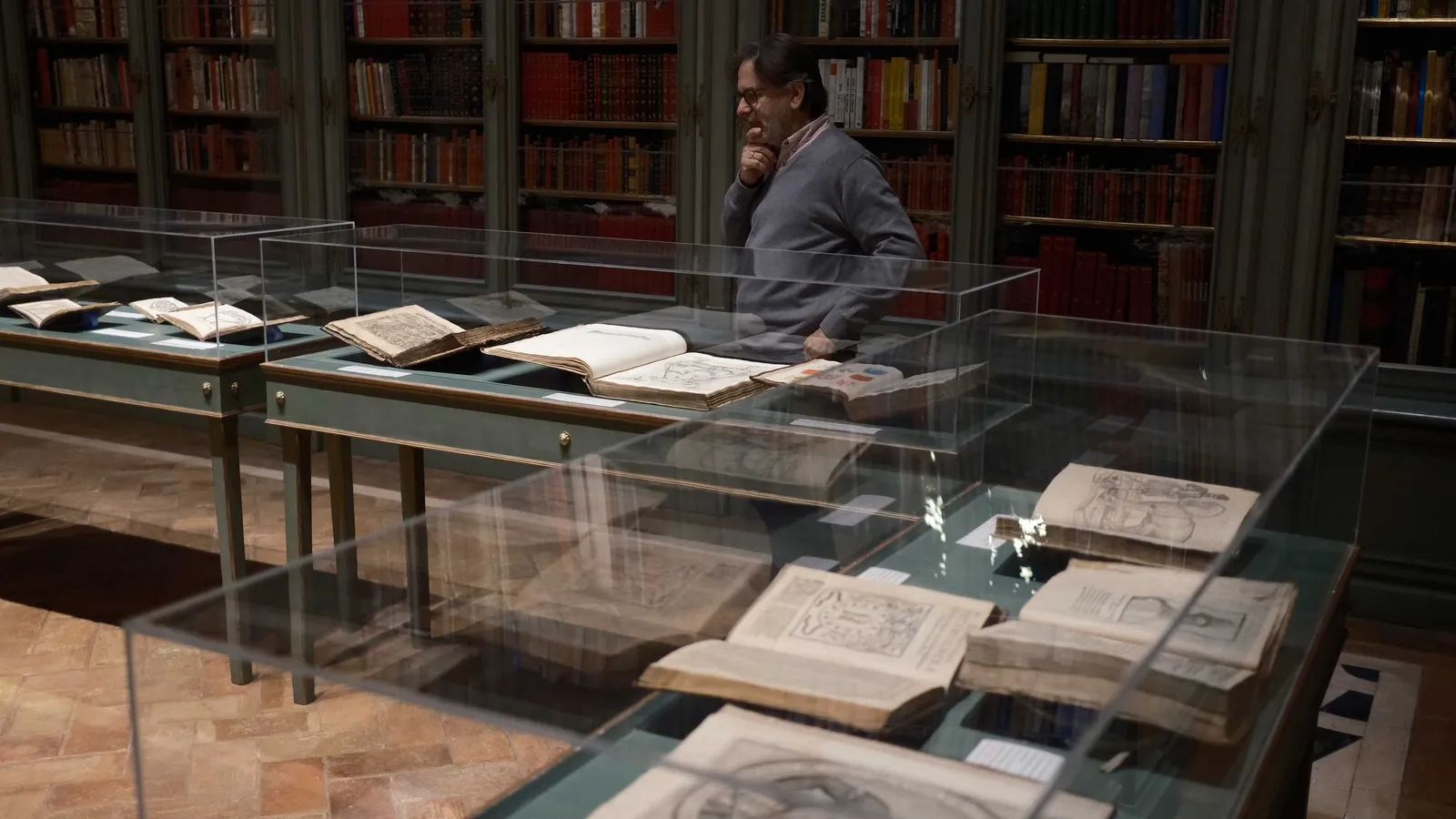

Known for its monumental bullring, which is a must-visit in Ronda, the Real Maestranza de Caballería holds another great treasure in the city of Tajo, its library. A quiet endeavor that allows this entity to house 30,000 fully registered volumes and another 20,000 in the process of being cataloged. A luxury and a privilege for a small city of just 35,000 inhabitants.
One of the souls of this historical gem is Juan Antonio Moreno, its librarian, who knows its shelves like the back of his hand. He has been in charge of selecting 23 books that have been displayed in the exhibition 'Treasures of the library, 16th century'. An exhibition that for one day allowed lovers of historical books to visit its main room and contemplate these true jewels of literature.
The exhibit, set up for World Book Day, beyond the historical value of each historical copy, also aimed to showcase the evolution of bookbinding and printing techniques.
The oldest copy dates from the year 1544, a time when one could appreciate the simplicity of those books which were still, in some way, in the early stages of the evolution of printing with a less complex binding, just like the first drawings that were beginning to be introduced.
Something very similar happens with another copy dated 1549, a book that describes cities from different parts of the Peninsula, including Málaga and Ronda, and which also includes drawings of castles, rivers, or the sea to illustrate each one of them. There are also printing errors, for example, the one referring to the capital of the province that appears under a heading of the Kingdom of Navarre.
Throughout the different copies and as the years progress, one can appreciate the evolution, the increasing complexity of each book and also of the printing used, to the point of reproducing authentic battles with great detail in the engravings. It was even possible to observe one of the first books of the era in which color was used to reproduce noble coats of arms, as until then only black was used.
All the books displayed are part of the so-called ancient collection of the library, the most important collection it holds. A significance that lies in the antiquity of the publications and their value due to their rarity or the few copies that usually exist in the world.
Ancient Collection
“The ancient collection is considered a treasure because these are copies that are difficult to see or that there are few in the world,” Moreno explained.
He also noted that “they are a testament to a production that today has been lost; here we can see drawing techniques, printing, or binding that are arts that no longer exist today.”
“We have aimed to show how the production evolved in the second half of the 16th century,” Moreno insisted.
On another note, an open day was also sought in which fans could not only see the spine of the books but also view them open, read them, or appreciate how the drawings were made.
“We have also sought to make people shed their fear of an old book and see that these are copies that they can enjoy firsthand,” Moreno indicated.
Among the books shown was a copy by Pedro de Medina titled ‘Memorable Things of Spain’ which contains the oldest text with references to Ronda that the institution has.
Collection of 30,000 Volumes
Beyond these small treasures shown during a day, the library has a collection of 30,000 classified volumes. Most of them are dedicated to the five specialties they focus on: Equestrianism, bullfighting, heraldry and genealogy, nobility, and Ronda. Additionally, they have a specific section on travel in the area.
85% of these books are published in Spanish, while the remaining 25% are mainly in English and French, although there are also publications in Portuguese or Italian, among others.
These are joined by another 20,000 volumes that are currently being cataloged. “In recent years, we have acquired or have been donated large libraries that have brought us 5,000 or 10,000 copies at once,” Moreno pointed out.
These books span a period from 1544 to the present, as the Real Maestranza tries to acquire all the books of interest it can on these topics.
Regarding the great treasure of this library, beyond the collection on travel literature featuring Ronda, Moreno highlights the equestrian collection with books from the 16th century.
In heraldry and genealogy, he has highlighted the Rújula collection, which gathers bibliography over two and a half centuries. This collection is international as it includes copies from various European and Hispano-American countries.
However, if Moreno has to choose just one, it is clear that it is the collection of 33 books that make up the Encyclopédie, a collection of the first French encyclopedia by Denis Diderot and Jean Le Rond d'Alembert that is complete. “It is the great treasure of the library, it is unique,” Moreno assured.

Latest news





Upcoming events
12
Nov
El Desembarco, la traición de Viriato at La Caja Blanca
12
Nov
HOMER El Mero Mero at Sala Trinchera Málaga
13
Nov
Marbella Startup Lab – Innovate & Collaborate
13
Nov
Candlelight: Coldplay & Imagine Dragons at Sala Fundación Unicaja María Cristina
13
Nov
Candlelight: Tribute to Ludovico Einaudi at Anantara Villa Padierna
Similar News

The 'Formula 1' team from Ronda qualifies for the international final of Stem Racing
Ronda
Arias launches a butter made from goat's milk cream produced in Ronda
Ronda
New project to rehabilitate the Casa del Rey Moro, one of the jewels of Ronda
Ronda
