


Clinical Challenge in the Face of Growing Inflammatory Bowel Disease
In Andalusia, around 30,000 patients with Crohn's disease or ulcerative colitis are already being treated. The incidence continues to grow with about 15 new cases per 100,000 inhabitants.
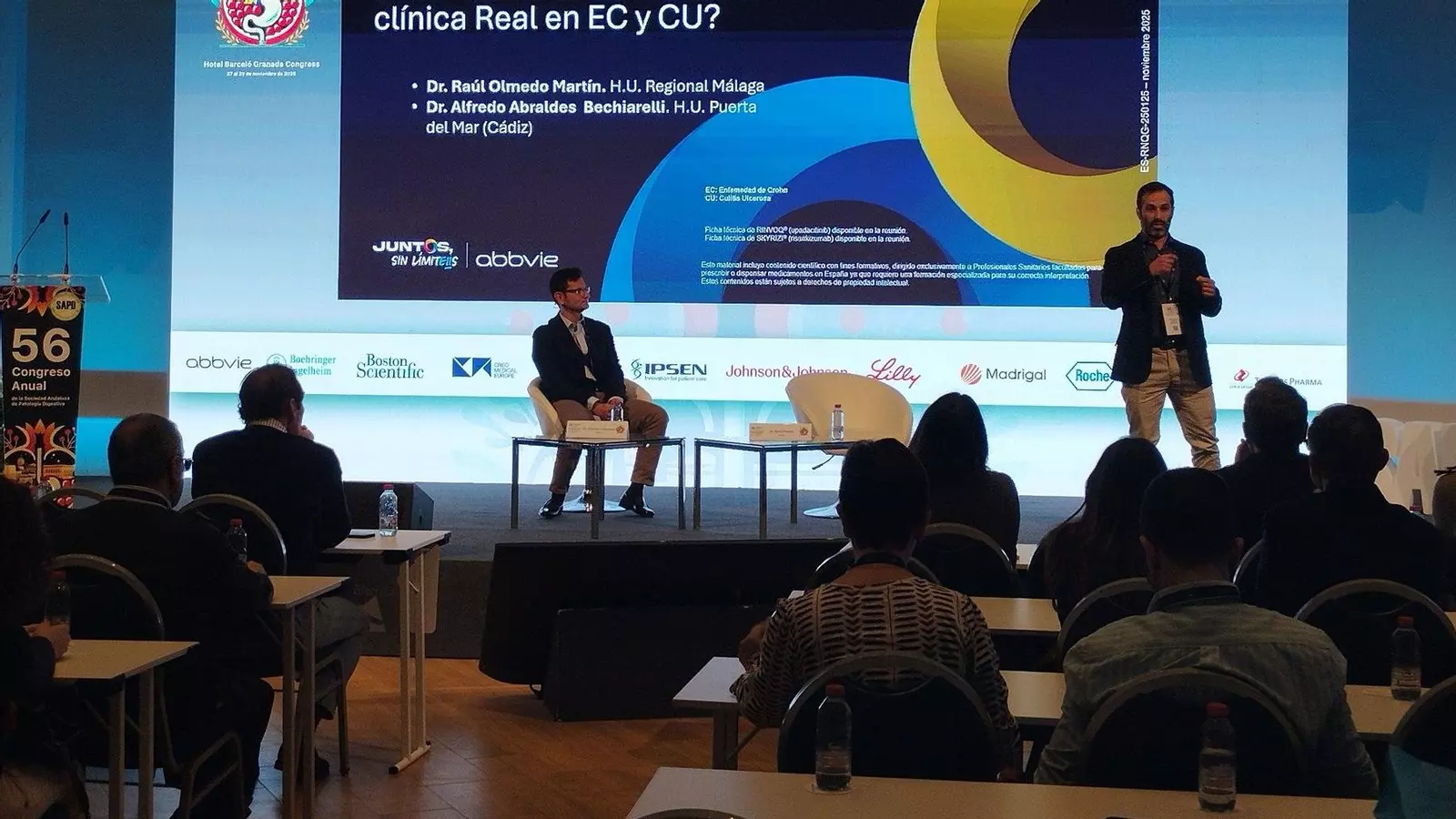

Inflammatory Bowel Disease (IBD) is no longer a minor pathology. In Andalusia, around 30,000 patients are already being treated and the incidence continues to grow, with about 15 new cases per 100,000 inhabitants. "It is going to be a significant health issue in the future," states Dr. Raúl Olmedo, coordinator of the Inflammatory Bowel Disease Working Group at the Andalusian Society of Digestive Pathology, which recently held its annual congress. Nationally, he adds, there are about 300,000 cases, and if the trend continues, "probably one in every 100 people could suffer from IBD in the next five years.
Ulcerative colitis can evolve with structural damage to the colon due to fibrosisThe term IBD mainly encompasses Crohn's disease and ulcerative colitis. Olmedo admits that information systems can still be refined, but in clinical practice, he observes a majority of cases of Crohn's over ulcerative colitis. He emphasizes that “ulcerative colitis can also evolve with structural damage to the colon due to fibrosis, with symptoms such as urgency or incontinence which later become difficult to reverse.”
The first major problem occurs before the hospital consultation: the diagnosis. “The diagnostic delay continues to be an unmet need, especially in Crohn's,” he states. In ulcerative colitis, bleeding usually speeds up the suspicion; in Crohn's, the onset can be more nonspecific and the referral is delayed. In this race, the importance of fecal calprotectin, "a non-invasive marker that helps in Primary Care to discriminate which patients may have intestinal inflammation and should be prioritized for specialized assessment,” grows.
The second bottleneck is organizational. Olmedo points to the coordination between care levels: from suspicion in the health center to the specialty, the processes can be slow. Once in the hospital, he advocates for multidisciplinary and accredited IBD units according to standards of the Spanish Working Group on Crohn's Disease and Ulcerative Colitis (Geteccu), with surgery and support from other specialties (rheumatology, dermatology), as well as psychological care when necessary.
In Andalusia, the IBD Group combines care, teaching and research. It holds courses for residents and a master's degree linked to the University of Seville (fifth edition) and advocates for intestinal ultrasound as a non-invasive monitoring tool. Moreover, the Andalusian Group is working on a shared electronic registry to generate real-life data that have already been communicated at national and international congresses.
The pharmacological approach also evolves. Olmedo explains that the goal is to surpass the "efficacy ceiling," increase the proportion of patients in remission, and enhance safety. “We have moved from a phase where we were satisfied with the patient feeling well to a phase where we want to modify the natural history of the disease, to have the patient undergo fewer surgeries, to have a good quality of life, to maintain good work performance, that is, to avoid work absenteeism and presenteeism, and ultimately to have a life as close to normal as possible,” the expert states.
Intestinal Ultrasound for 'Real-Time' Monitoring
Intestinal ultrasound emerges as a tool for 'real-time' monitoring. “More and more centers in Andalusia are using intestinal ultrasound as a way to monitor patients non-invasively. This saves colonoscopies, invasive techniques like MRI, which includes the administration of intravenous oral contrast. It allows us to determine 'in real time' if the patient has inflammatory activity and if a change in treatment is necessary,” explains Dr. Olmedo. The first specific course of the SAPD will be held on January 23 in Marbella.

Latest news





Upcoming events
12
Nov
El Desembarco, la traición de Viriato at La Caja Blanca
12
Nov
HOMER El Mero Mero at Sala Trinchera Málaga
13
Nov
Marbella Startup Lab – Innovate & Collaborate
13
Nov
Candlelight: Coldplay & Imagine Dragons at Sala Fundación Unicaja María Cristina
13
Nov
Candlelight: Tribute to Ludovico Einaudi at Anantara Villa Padierna
Similar News

Marbella Launches ‘Summer Youth’ Programme with 2,500 Free Places
Marbella

Premium Tourism Drives Marbella’s Hotel Profitability to Record Levels as Overnight Stays Exceed 291,000
Marbella

‘Machos Alfa’ seeks extras in Marbella for filming of its sixth and final season
Marbella
