Pepe Imaz, Djokovic's Emotional Coach
The tennis player, who went from suffering to love, denies being a guru. He shares his experiences among athletes, schools, businesses, and in a book, after suffering from bulimia for five years.Josefina Arias: the influencer grandma from Marbella
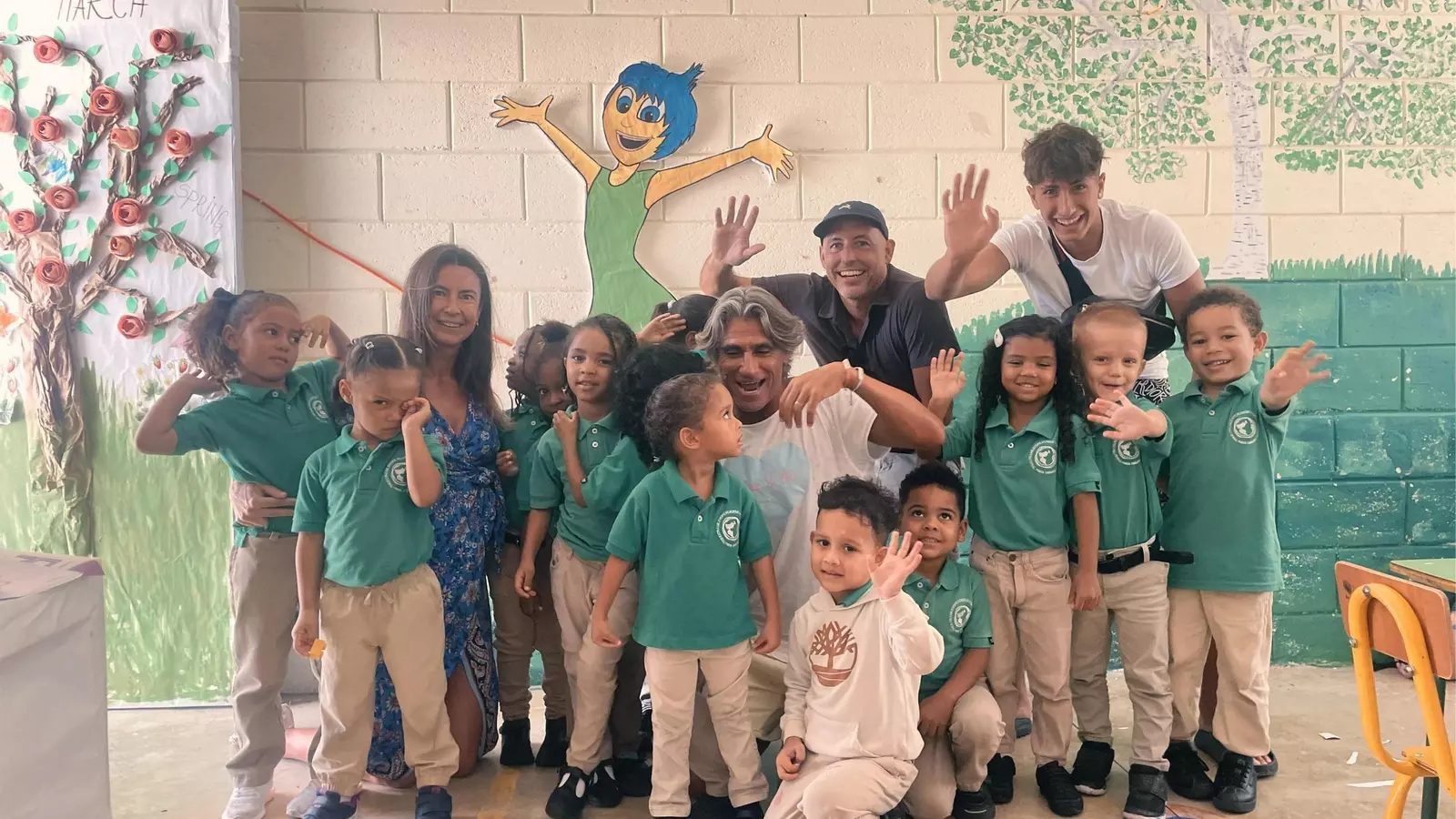

I hit the jackpot! For me, it was like being given a cake, your favourite kind, and being told: you can eat the whole thing. That's how Pepe Imaz remembers it when, at the age of nine, a report on the summer tennis programme taught by former Roland Garros champion Andrés Gimeno concluded: ‘José is a diamond in the rough’.
You eat the cake and a few hours later your tummy hurts. It wasn't a few hours, it was years later. What affected me was a weight that brought with it obligation, frustration, guilt and fear. It started with the fear of failing, of not succeeding; the frustration of not succeeding, and the guilt of not having succeeded. Then you start to belittle yourself. That moment in my life has changed a lot. And I am grateful for that. Thanks to that miserable life of fear, frustration, anguish and guilt, I crashed, I collapsed. It's like a ball that falls to the ground, if it bounces, it goes up, up, up. It helped me to look at myself more and learn a little more about being, not about the character. You internalise: if someone who knows a lot about tennis says it, it must be true, and I must be a great champion. That's how I interpreted it, but these are interpretations.
At the age of ten, I left Arnedo (La Rioja) for Barcelona, the cradle of tennis. Human beings need the closest affection and love, that of their parents and family. You have to have that every day; it's not the same being 500 kilometres away. Growing up without that is a handicap. Although in my case it wasn't compulsory, but my own desire, I had emotional and financial support, but that doesn't take away the loneliness and the self-imposed obligation to succeed. I was very lucky not to suffer pressure from my surroundings, from my mother.
With Manolo Santana. / PERSONAL ARCHIVE During his youth, from the age of 18 to 23, he suffered from bulimiafor five years.
When I realised I had a problem, I decided to seek help and solutions. I was mental and pragmatic. Very sensitive, but I lived from pragmatism. Now I am more of a being, when I need the mind I turn to it. Closer to being than to the mind.
I found the solution, secretly, in books and professionals. I spent many years reading about anorexia, bulimia, psychology and self-help, six or seven hours a day, out of necessity. I understood many things. I learned about the side effects, on a physiological level, when you vomit, you lose water and mineral salts. I was very curious, I read about nutrition and supplements in sport. Knowing about supplements, I instantly replenished the deficiencies with water and mineral salts; I brushed my teeth so that the acid would not damage my gums, which helped me not to faint. After each last episode of bulimia, I would vomit and eat the nutrients my body needed for digestion. Everything was very calculated. The next day I had five or six hours of training. I knew the ins and outs and how to hide it. I kept it quiet. When I told people, none of those close to me could believe it. I was leading a double life with emotional turmoil. When I was playing tennis, I destroyed myself with self-imposed demands, and in my self-destruction with bulimia, I literally destroyed myself. Until I realised that what I was looking for was love.
It all started with becoming aware that I am a human being before I am a tennis player and treating myself with kindness and love. A huge change began to take place in me and in my relationship with bulimia. In tennis, I began to moderate myself, to find balance on the court, to enjoy playing without being so demanding on myself and without beating myself up for making mistakes. I began to win much more, infinitely more. When you are in harmony and at peace with yourself, things improve.
The coaches believed that I had found maturity. In my case, it came from behind, from ten years or more ago; I had been mature since I was a child. The fact that I was more irascible and insecure in tennis was not immaturity, it was the imbalance of my being, the lack of love, affection, and respect. When I began to experience this within myself, calmness came.
When I was winning the most and performing the best, I decided to stop playing tennis. I came to Marbella trying to get away from Barcelona, believing that perhaps there was too much focus on tennis there. I came to see a friend, a tennis coach, and I felt very good. He treated me as a friend, not as a personality, and I felt very comfortable here. Manolo Santana had a tennis club and there was a group of young guys who played well, and in Marbella and Malaga there were two or three players who were at a good level. I stayed, trained for a month and went to my first tournament. The match was 6-6, we started the tie-break, and there on the court I felt it and said, “It's over”.
Two or three months before coming to Marbella, I had been thinking about giving up tennis. But I said to myself: how can I give it up now that everything is going well and I'm getting closer to my dream? It was like a fly that wouldn't stop buzzing around. I lost the match 7-6 and 6-1 and returned to Marbella feeling calm.
I knew what I was going to do: not play tennis. Normally, decisions are made with a card up your sleeve. You go from mind to mind. You are in your mind. When you make a decision from your being, you are free, and what comes next is usually clean, unconditioned, unneeded. I decided to live more in the now than in the future. You can see how someone leaves something wonderful for something they don't have. I had my well-being, freeing myself from everything I had experienced in that decade. What a gift!
Pepe Imaz. / PERSONAL ARCHIVEI lived thirteen years on fire, wanting to end my life and suffering like I don't know who, I don't know of any greater suffering. I'm not brave or anything, it was the need to know myself as I am, as a human being, and to treat myself with love and respect, nothing more. No one understood, only two friends. You've fought your whole life for this and now that you're getting close, playing Roland Garros, the final draw at a professional level, you suddenly give it up. Suddenly for them, not for me. I felt it very clearly, I didn't have to search my mind for anything, I decided to give it up.
In this society, the more you win, the closer they get to your persona, which they feed and flatter. I was working to leave the persona behind and live as a person. I couldn't change people and make them forget that I won matches, make them look at the person. I wasn't prepared for it not to affect me. I decided to quit so that no one would approach me because of the persona, or how well things were starting to go for me. I gave it all up for myself, to feel good about myself.
A year later, I was asked to coach some 16-year-old boys, to share my technical and emotional tennis experience. I hadn't planned it, I had no expectations. I had previously turned down offers to play professional tennis. My first time as a coach was on that court, the one in the middle, and from then on, more boys came to share.
Among them, years later, came Marko Djokovic, now Pepe's partner at his tennis school in Marbella.
–He was a 16 or 17-year-old player who was suffering a lot, going through a time that I knew very well, that anguish, the obligation to be very good. He had to be very good, he couldn't be less than his brother, he had been imposing this on himself for two years. Novak, his older brother, was aware of that. He is a wonderful person, very cool, very helpful, and when he saw that Marko was doing better, he became interested: “What's behind this?”, he wondered. I connected well with him; he is a very nice person, very respectful, but at that time he was in the mode of winning, winning and winning. He looked at me with suspicion, with a lot of respect, wanting to know things. I shared my journey with him; it wasn't about teaching or helping him or anyone else.
With Markos Djokovic. / PERSONAL ARCHIVE If they tell me I'm responsible for Juan's triumphs, or the architect of Juan's misfortune, I'm not. The only thing I'm responsible for is myself, my actions. I am not responsible for anyone else's good or bad, I am responsible for my own life. All I do is share with the person who asks me. I am very grateful to have been close to him during those difficult times for Novak, his times, not mine. I am grateful to have been close to him, observing that and accompanying him with great respect and love, learning. That I can be grateful for.
There is nothing more beautiful than feeling good about yourself, not because of what others say. You have to accept your mistakes with understanding, support and love. If someone comes up to you and says, ‘This is who you are,’ that is their opinion, and I am not going to argue with them, but I am fine with the nourishment I give myself so that I do not need them to think well of me. We are neither good nor bad, we are what we can be today. And it is up to us if we want to change so as not to be a slave to the opinions or judgements of others.
With Novak, I have had a wonderful personal relationship as a close friend, sharing our personalities, emotions and getting to know each other for ten years. Until about three years ago, when he stopped coming to Marbella so often.
With Novak Djokovic. / PERSONAL ARCHIVE When they tell you that to be respected you have to succeed socially, you believe it. We all try that path, I tried it, but the one who breaks his neck or explodes says, out of necessity, I'm going to look for something else. What do you mean, love? This is a knife in the mouth and winning above all else. As we have heard this lesson for generations, when someone comes along and says, “No, you already have everything, giving you love and affection,” they will say, “You're crazy,” because most people say the opposite. But to those of us who, due to painful circumstances, open the door and start to feel better, they may call you crazy, blind or blind to reality.
When I played, there were brands that paid me money, quite well. When I discovered the love that brought me peace, I said: this is my biggest sponsor, it has given me life, it gives me more than the other. Out, I'm changing it. At first, I wrote it in Chinese characters because I was embarrassed that people would look at me like I was crazy. Later, when I felt ready, I wrote: Love and Peace (to the tennis school). Those who live this experience have their lives changed. Who doesn't feel good when treated with affection? It's not an academy; there are no more than ten players who want to be professionals, and that takes a lot of time to share. I don't teach or help, I share, just like on a tennis court. Sometimes I still glance sideways and say, “Where are you looking, Pepe? You're here.” The jaws of ego are going to bite me.
He defines himself as a sharer of his experiences, which he recounts in talks to athletes, schools, companies or in presentations of his book El arte de entrenar tu mente (The Art of Training Your Mind).
There is no failure or success, everything is action, you have done it. Don't expect to reap success, even if you achieve it, you will be tainted by the fear of losing it, and if you lose, there is failure. I have shared with important people and with others who were suffering hardship. Whether they are doing well, normally or averagely, they are human beings, and if they are treated well, with affection and love, they feel better, regardless of their status.
I am a learner, I have been at it for 32 years, I am not a guru, that is not where I fit in. What helps most is to be very aware of the human beings that we are and to nurture ourselves with affection, love and respect. In that sense, I am here, in case it can be of use to anyone, to share my experience that has saved me from wanting to destroy my life.

Latest news


Upcoming events
17
Sep
La Pequeña Cuba Gastro-Cultural Festival in San Pedro Alcántara 2026
18
Sep
World Wellness Weekend Marbella 2026
18
Sep
Candlelight: Queen vs. ABBA in Málaga
18
Sep
Candlelight: Coldplay and Imagine Dragons in Málaga
18
Sep
3 de Corazones – Pancho Céspedes, Enrique Ramil and José Luis Jaén in Málaga
Similar News
Paco Guerrero: From Taking Care of Pigs to Serving in the Main Luxury Hotels
Marbella
Caroline Schell: Painter and Sculptor in an Actors' Clan in Marbella
Marbella
Josefina Arias: the Influencer Grandma from Marbella
Marbella