


An optimistic outlook to address rare kidney diseases
Clinicians, managers, and patients analyze the challenges posed by rare diseases and demand more early diagnosis, territorial equity, and accelerated access pathways to new therapies.
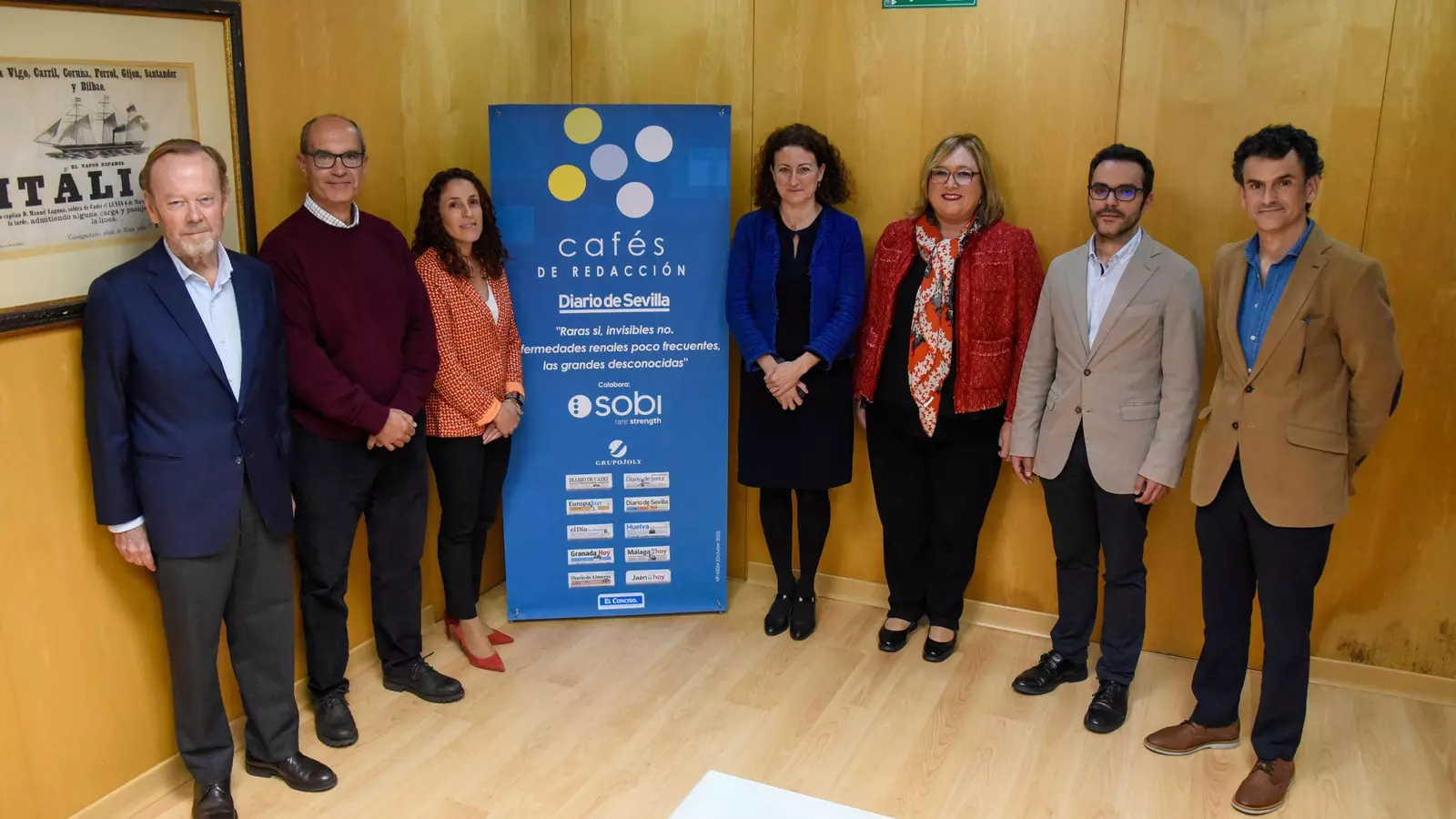

Rare kidney diseases, such as complement 3 glomerulopathy (C3G), have become a challenge for the healthcare system, presenting several difficulties. These challenges were examined during the colloquium ‘Rare, yes; invisible, no. Rare kidney diseases, the great unknowns’, held in Seville in collaboration with Sobi.
‘If public healthcare is the most important thing we have achieved as a democratic society, this has special significance in the case of rare diseases,’ said Nieves Romero, manager of the Virgen del Rocío University Hospital (Seville). At this hospital, rare diseases are ‘one of our reasons for being’.
Nieves Romero, manager of the Virgen del Rocío University Hospital in Seville. / Juan Carlos VázquezThe centre is the hospital with the most CSURs in Andalusia and one of the five leading centres in Spain, with 39 CSURs already recognised, five under evaluation and another eight in preparation. But this excellence comes at a cost: ‘Achieving and maintaining a CSUR is very difficult: you need a reference population, a sufficient number of patients and a very high level of expertise. And, in addition, you have to take care of the professionals who make it possible, sometimes with hiring and mobility frameworks that do not help to retain talent,’ warned Romero.
Participants at the meeting during one of the presentations by Pablo Beca, from Alcer Giralda. / Juan Carlos VázquezPathologies such as C3G pose specific diagnostic needs and evolve in different ways, requiring dialysis or transplantation in some cases. From the perspective of transplant coordination, the challenge remains to obtain organs in a scenario of elderly donors with comorbidities. ‘Our fundamental interest is that patients on the waiting list obtain an organ in the shortest possible time and with the maximum guarantees of quality and safety,’ summarised Domingo Daga, regional coordinator of transplants in Andalusia.
In rare kidney diseases, some patients develop the need for a transplant at an earlier age. ‘Paradoxically, it is now much easier to transplant from a cadaver to an older patient than to a young patient. Finding an optimal cadaver graft under the age of 50 is becoming increasingly difficult,’ he explained. Hence the ‘enormous importance’ of promoting living donor transplantation, a field that ‘in Spain still has much room for improvement.’ Despite everything, ‘in Andalusia, the average time from inclusion on the kidney transplant waiting list to transplantation is around three to four months. It is a resounding success,’ emphasised Daga.
Verónica López, head of the Nephrology Service at Malaga Regional Hospital. / Juan Carlos VázquezOn the clinical level, the first hurdle remains diagnosis. ‘One of the most important challenges is simply diagnosing them,’ said Verónica López, head of Nephrology at the Málaga Regional Hospital. ‘These are very rare diseases, with low caseloads; when the patient arrives at Primary Care, if they are not considered, the referral is delayed and the patient arrives at an advanced stage.’
In the case of C3G, the clinical presentation is very heterogeneous: microhaematuria or macrohaematuria, microalbuminuria, proteinuria, hypertension... ‘This means that diagnosis can take weeks or months. In addition to a kidney biopsy, many cases require genetic testing, which also takes longer than we would like,’ she added.
Once diagnosed, the therapeutic outlook remains limited. ‘Most rare diseases have no treatment, and when they do, it is usually experimental. If there is an effective drug, we face a daily struggle to obtain it, due to its high impact,’ he lamented. In C3G, the prognosis remains grim: ‘At ten years, approximately 50% of patients are on dialysis. The recurrence of the disease after transplantation is 80–90%. These are patients who go through all the stages of the disease and return to square one after a first transplant.’
In paediatrics, ‘C3G is somewhat more aggressive; around 70-80% need dialysis or a transplant within ten years,’ explained Francisco de la Cerda, head of Paediatric Nephrology at Virgen del Rocío. ‘We try to get to early transplantation without going through dialysis, but in these diseases it is very difficult.’ Added to the clinical complexity is the emotional and social burden. ‘Telling a family that their child has a rare disease, with an almost unpronounceable name, which they don't know how to classify, causes enormous anxiety,’ he said.
Francisco de la Cerda, head of the Paediatric Nephrology Section at Virgen del Rocío. / Juan Carlos Vázquez
Reference centres
Reference networks have changed this scenario. ‘Being part of CSUR and the European network ERKNet allows us to share cases, training and circuits with other centres. But we must be aware of the demands: we develop complex circuits for diseases that you may see once or twice a year,’ De la Cerda stressed.
The hospital pharmacist has become a key player in the management of orphan drugs. ‘Many treatments for rare diseases appear in the hospital pharmacy from one day to the next, and suddenly we have to deal with a condition that we have hardly ever encountered before,’ explained Alberto Jiménez, head of Hospital Pharmacy at Virgen de las Nieves Hospital (Granada).
Alberto Jiménez, head of Hospital Pharmacy at the Virgen de las Nieves Hospital (Granada) / Juan Carlos VázquezAt his centre, they have created specific clinical committees for certain pathologies and a pharmacy subcommittee where rare diseases, off-label uses and compassionate use are discussed. "Our first function is to evaluate the scientific evidence and make a therapeutic positioning. But we also facilitate access: we look for expanded access programmes, review trialdatabases, and see how to incorporate patients into these studies," he said.
The associative fabric
From the patients' point of view, dialysis remains the symbol of the harshness of advanced chronic kidney disease. ‘It is a very invasive treatment: four-hour sessions, three days a week. And it is not the same to live next to the centre as it is to live in a village two hours away by shared ambulance,’ said Pablo Beca, president of ALCER Giralda and a transplant recipient for almost 22 years. ‘The association tries to cushion that impact with psychosocial support, mutual aid groups and leisure activities, from Sunday outings — the only day without dialysis — to camps for children and trips coordinated with dialysis centres in other European countries,’ he explained.
Pablo Beca, president of ALCER Giralda and transplant recipient for almost 22 years. / Juan Carlos VázquezBeca also highlighted the role of the associative movement in rare kidney diseases and highlighted the work done by the association in bringing patients together so that they can resolve doubts and share experiences.
Drug R&D
For the industry specialising in rare diseases, the context is bittersweet. ‘Only around 6% of rare diseases have a treatment today, and barely 20% are under investigation,’ recalled Raquel Fernández, deputy director of Institutional Relations and Access at Sobi Spain.
Even so, the volume of research is growing: ‘Last year, more than 200 clinical trials on rare diseases were launched in Spain and more than 3,600 patients were able to participate; that is 10% more than in 2023.’
Raquel Fernández, Deputy Director of Institutional Relations and Access at Sobi Spain. / Juan Carlos VázquezThe big problem is time. ‘In rare diseases, drug development takes an average of 10-12 years, with a great deal of scientific uncertainty. And when European authorisation is granted, it takes almost two years in Spain to finance it. We are using exceptional channels designed for very specific situations simply to compensate for this delay,’ she said.
The collective goal is to have ‘accelerated access processes with subsequent re-evaluation, which allow patients to access treatment while real-life data is collected.’ Despite all the difficulties, the panel agreed on a certain optimism. ‘We are living in a very good time for nephrologists: glomerular diseases that previously only had supportive treatments are beginning to have specific drugs,’ said López.
Domingo Daga focused on the future of personalised medicine, emphasising that ‘we are in a time of innovation. The challenge will be to guarantee access and sustainability.’
In this regard, Alberto Jiménez encouraged rigour when conducting a comprehensive economic evaluation of the entire care process when incorporating an innovation. ‘If this treatment enables us to avoid a kidney transplant later on, we will have to assess how much a kidney transplant, and in many cases a second transplant, costs the system. A treatment can have a significant economic impact, but it can save the system many consultations, dialysis sessions and processes related to complications,’ he explained.
De la Cerda proposed ‘science and training concentrated in specialised centres, networking and empathy with the patient’, while Nieves Romero insisted that ‘everything we invest in research and innovation in rare diseases will pay off in the form of earlier diagnoses, more effective treatments and a better quality of life for those affected’.

Latest news





Upcoming events
12
Nov
El Desembarco, la traición de Viriato at La Caja Blanca
12
Nov
HOMER El Mero Mero at Sala Trinchera Málaga
13
Nov
Marbella Startup Lab – Innovate & Collaborate
13
Nov
Candlelight: Coldplay & Imagine Dragons at Sala Fundación Unicaja María Cristina
13
Nov
Candlelight: Tribute to Ludovico Einaudi at Anantara Villa Padierna
Similar News

Marbella Launches ‘Summer Youth’ Programme with 2,500 Free Places
Marbella

Premium Tourism Drives Marbella’s Hotel Profitability to Record Levels as Overnight Stays Exceed 291,000
Marbella

‘Machos Alfa’ seeks extras in Marbella for filming of its sixth and final season
Marbella
