


Pepe López, the diver from Marbella who witnessed the discovery of a bell from the Nao that took Columbus to America
Students from the Complutense University did a Final Degree Project on the discovery that received honors Agustín Casado, the painter who was born in Picasso's house

–At the doors of the houses in Buarcos in Figueira da Foz (Portugal), there were eight-real silver coins that were fished on the seashore, like in the verses of the tanguillo from Cádiz about those old hard coins.
The sea would cast these coins onto the beaches after a storm. The villagers used them to fasten the hinges of their gates, with the effigies of Charles V and Philip II turned into rings. Pepe was a diving buddy of Roberto Mazzara, the former Italian navy officer and diver, who found a bell in 1994 on those Portuguese beaches, which he claims belonged to the nao Santa María, that carried Christopher Columbus on his first voyage to America.
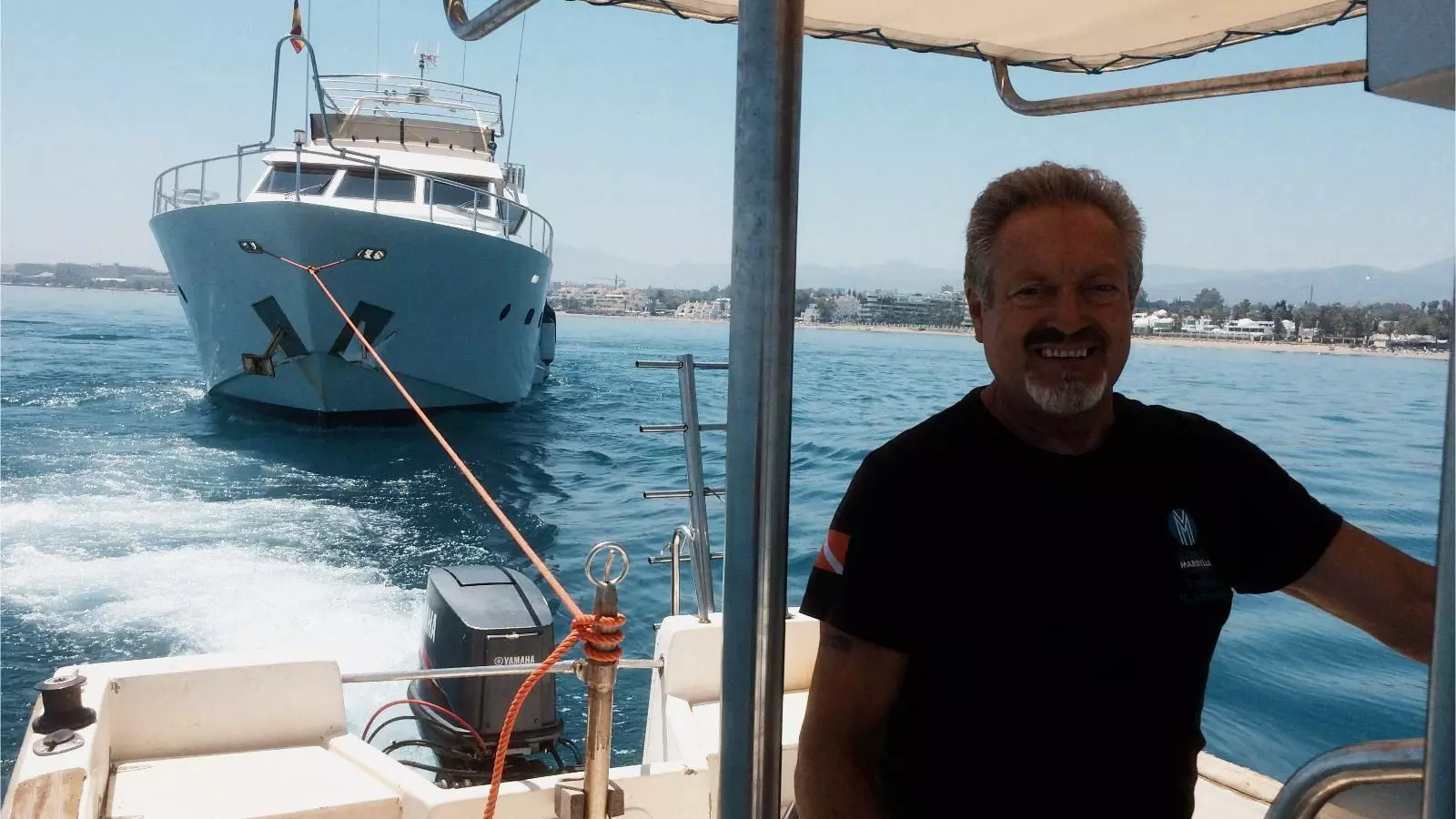
In Marbella, he is known as Pepe the Diver. Using the rods from an umbrella and a bicycle inner tube, José López made his first harpoon, and with a glass and the inner tube from a truck tire, he managed to make himself goggles. With such basic equipment, at the age of twelve, he dived into the sea to begin his life as a diver on the coast of Marbella.
–My family is from Coín, I was six years old when we arrived in Marbella. From a mountain port in Ojén I saw the sea for the first time, I thought it was a river. My father, who was a carpenter and bought the plot where he built the house, told me it was the sea.
I met Roberto Mazzara, diving with him off the coast of Portugal we found an anchor of mercy –which is much heavier and carried on board as a reserve, for emergency maneuvers and to anchor the ship– from a wreck that was transporting thirty-kilogram silver ingots. Mazzara, who had a diving center there, found several pieces, which were seized by the police, including a bell, which he didn't value much and stored in his van.
The galleon San Salvador, which sank in 1555 off the port of Buarcos, on the northern coasts of Portugal, was loaded with silver ingots and was transporting the bell.
–Once the ship was identified, through the Archive of the Indies, we confirmed that the wreck found was the galleon that was transporting the bell of the Santa María. In the cargo manifest of the galleon San Salvador, the items from Columbus's ship that were being transported to Spain are listed.
Along with a large amount of gold and silver was “the sign of the town of Navidad,” the bell of the Santa María, which Luis Colón, the navigator's grandson, claimed. The ship sailed from San Juan de Puerto Rico bound for Spain, a storm diverted it and it sank off the coast of Portugal.
–Columbus, upon reaching the island La Española and not finding the spices of India, deliberately ran the ship aground on the beach. With the timbers of the Santa María, he built Fort Navidad, where he left part of the crew, who ensured his return. The Taínos, the aborigines of present-day Haiti, razed the fort and burned it. On his second voyage, Columbus found the 39 crew members he had left dead. On this second voyage, Columbus designated Santiago de Cuba as the center of operations, where the bell, showing signs of having been burned, was stored in the warehouses of the Spanish navy. Until it ended up in San Juan de Puerto Rico. The bell has all the signs to believe that it is from the Santa María, as it has embedded soil from the island La Española and sand from Portugal. A carbon-14 test was conducted at the Oceanographic Museum of Monaco, which was directed by Jacques Cousteau, the analysis determined that it could be from the remains of the caravel, which was compatible with the notes from the cargo manifest document.
Through some lawyers from Acerinox, we were able to contact the Naval Museum of Madrid and we offered to gift the bell to the king. A meeting was held with the lawyer of the Royal House and the archaeologists of the Museum of Madrid, who had reservations and fear of being embarrassed. There was a precedent from the treasure hunter Mel Fisher, who gifted the king an astrolabe that was actually a replica. They told us that the bell had no historical value and that we should do whatever we wanted. Then, I dropped the subject. Roberto, with a Catalan company, organized the auction of the Santa María bell, which was scheduled for December 12, 2002, at the Ritz Hotel in Madrid. People interested from Sweden, the USA, England, or Russia were going to attend. Just before the auction began, the authorities seized the piece following a theft complaint filed by the State of Portugal, which claimed the piece as cultural property. The auction was canceled. Justice eventually dismissed Portugal's request to keep the bell. It was not considered a historical object and returned to Mazzara's hands to end up in Miami. The Catalan company demanded 300,000 pesetas from Roberto for the expenses caused by the aborted auction of the bell, which ultimately would have been sold to an American.
The bell of the nao Santa María, which has sparked media interest, led to a final year project at the Complutense University of Madrid. Students from the Department of Private International Law conducted a legal study years ago to determine the ownership of the bell. “The present work aimed to address the hypothetical case that the case of the Santa María bell arises at the current time,” justified its authors, who analyzed the latest legislation on underwater cultural heritage. The work received the highest honors.
–A diver does not need a hammer to drive a nail, you find a way, was the first lesson given to me by Esteban Pérez de Guzmán. An autodidact, with an extraordinary practical inventive capacity when it comes to solving problems and achieving notable successes. I remember when a marrajero boat, dedicated to fishing on the Saharan coast, had been seized by the authorities upon its return, remaining docked in the port of Algeciras for years without any maintenance. Its iron frame had sunk to the bottom of the sea and needed to be removed for the expansion of the port. The proposed solution was to cut it into pieces. Esteban came up with the idea of refloating it. To do this, truck tarpaulins were used to cover the holes in the boat. With two pipes, a water chimney was made at one end of the boat and pipes were also installed at the other end. On one side, by suction, a dredge removed the water, while the tarpaulins were adjusted to the hull, and on the other chimney, air was pumped in until the boat emerged.
On another occasion, an American deep-sea fishing boat, after a merry night for the sailors, ended up stranded on the beach, up to five meters from the shoreline, in an area difficult to access, being surrounded by reed beds and swampy grounds. A complicated and costly rescue was considered, with the assistance of a large platform, or otherwise they would lose the boat.
–I can get the boat out of there for one million pesetas, said Esteban.
They proceeded to dredge the beach to build a riverbed through which to navigate the boat that had no more than 70 centimeters of draft. Esteban had a keen eye for capturing and analyzing things. I have tried to learn from that perspective to solve problems.
Adolfo Boch Leria, El Fofi from Cádiz, with very little professional training, was one of the first 25 divers in Spain.
–I have met him, but I have not had any professional diving work with him. He came to have an archaeological collection of Phoenician pieces: amphorae, bronze columns, which he had accumulated over time, from the beach of La Caleta (Cádiz). At one point he had health and mobility issues. He spent months proposing to the administrations to hand over all the objects obtained from the sea in exchange for a janitor's job. In the end, they raided his house, arrested him, took everything, and he almost lost his home.
In September 1991, the Civil Guard, with an order from the Court of First Instance of San Fernando, appeared at Fofi's house, but found nothing, his collection was in a nearby warehouse. The agents ended up jumping over the fence to take the 913 archaeological pieces. Fofi, 79 years old and with a recognized disability of 45 percent, has been fighting with the justice system and administrations for 35 years.
–As a kid, I found a warship from the 18th century, the wreck El Fernando, in the area of San Pedro Alcántara, where there were cannons and projectiles in the form of balls, with cartridge belts and shoe remains. Many years later I collaborated with the Underwater Archaeology Center (CAS) of the Andalusian Government, to which we lent a boat, oxygen bottles, and the workshop to work. I also found a French ship, from the late 18th or early 19th century, sunk off the coasts of Marbella. This was transporting bricks, tiles, and lime in wooden barrels. The archaeologists from CAS are willing to study it, awaiting budgets.
For four years I served as the maritime rescue coordinator for the Red Cross of Marbella. I can't forget the case of an employee of the fish farm, who went to feed the fish one noon in very bad weather. He moored his boat, made of aluminum and six meters long, gave the fish food with shovels, in the middle of an easterly storm, then released the boat and jumped into the cage. The boat was found destroyed in the area of the Marbella Club. At seven in the evening, the colleague who relieved him alerted to the disappearance of the employee and the boat. It was winter and it had already gotten dark, we found him with half his body in the water clinging to the cage, in a state of hypothermia, in an extreme situation. I had José Luis Botella as second in command, who jumped into the cage and rescued the employee and took him to the boat. For ten years, that boy's mother brought us a cake every year to the Red Cross. Another time, we assisted a pedal boat, which had a sunken keel, where two girls were sunbathing naked. When we went to help them, they refused to get on the boat because they had lost their clothes. We had to lend them our shirts to carry out the rescue.
–In the army, I took the diving operations course, then others, on underwater explosives, instructor training, and professional diver, which allowed me to make diving my job. We specialized in port maintenance, repairing pontoons, moorings, and refloating boats.
I have transported boats from New Zealand to Spain, done professional fishing on boats from Marbella, and sailed all over the Caribbean, the coast of Africa up to Cape Verde, Senegal, Mauritania. A trip to the Canary Islands is high-seas navigation. Arriving at Alyadida (Morocco), a promontory jutting into the sea, where coastal navigation becomes difficult, with many waves that worsen the circumstances. The coast is lost from sight when navigating towards Mauritania or Senegal. The extreme is Namibia, where the Skeleton Coast is located, due to the number of shipwrecks that occur there.

Latest news





Upcoming events
12
Nov
El Desembarco, la traición de Viriato at La Caja Blanca
12
Nov
HOMER El Mero Mero at Sala Trinchera Málaga
13
Nov
Marbella Startup Lab – Innovate & Collaborate
13
Nov
Candlelight: Coldplay & Imagine Dragons at Sala Fundación Unicaja María Cristina
13
Nov
Candlelight: Tribute to Ludovico Einaudi at Anantara Villa Padierna
Similar News

Marbella Launches ‘Summer Youth’ Programme with 2,500 Free Places
Marbella

Premium Tourism Drives Marbella’s Hotel Profitability to Record Levels as Overnight Stays Exceed 291,000
Marbella

‘Machos Alfa’ seeks extras in Marbella for filming of its sixth and final season
Marbella
