


Andalusia Advances in the Approach to Chronic Lymphocytic Leukemia
Experts highlight the clinical achievements made for this pathology, whose paradigm has shifted, although they call for dedicated pathways for molecular studies and improved care coordination.
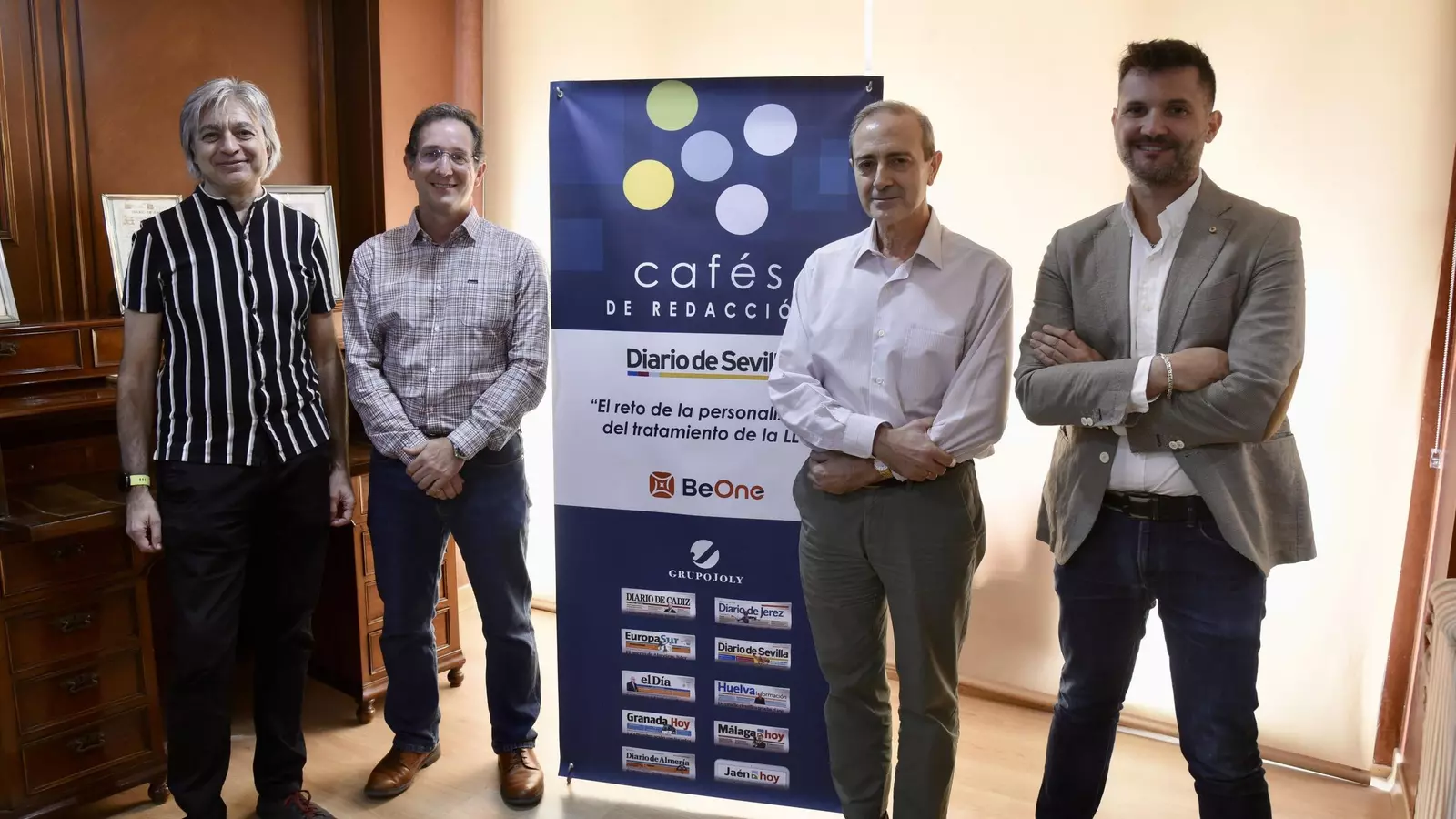

With the goal of analyzing how the paradigm of chronic lymphocytic leukemia (CLL) in Andalusia has changed, and how this has posed new challenges for personalizing its management, Grupo Joly, in collaboration with BeOne Medicines, brought together four leading hematologists in our community. The meeting 'The challenge of personalizing CLL treatment', held last Tuesday, also provided an opportunity to outline how the healthcare ecosystem in hematology is improving.
Sergio Ortegón, Hematology specialist at Hospital Virgen Macarena / Juan Carlos VázquezSergio Ortegón, specialist at the Hematology and Hemotherapy Service of Hospital Virgen Macarena, opened the meeting by emphasizing that “CLL is the most common leukemia in the Western world, and we have witnessed how new treatment avenues have opened up, with good tolerance and high efficacy, which have improved the quality of life and life expectancy of patients.”
Each year, between four and six cases are diagnosed per 100,000 inhabitantsAccording to José Manuel Puerta, director of the Clinical Management Unit of Hematology and Hemotherapy at Hospital Virgen de las Nieves in Granada, “the incidence of CLL clearly increases from the age of 65 or 70; it is uncommon in younger individuals.” As a reference, there are between 4 and 6 cases per 100,000 inhabitants per year, which can rise to 15–16 per 100,000 in those over 65–70. This high figure is not only due to new diagnoses but also because of “increasingly longer survivals,” Puerta recalled. “Previously, a patient had a life expectancy of 10 years; now we talk about 10 years of disease control. We have made significant progress in markers and drugs, and this increases the prevalence of CLL: there are more patients in follow-up because they live longer and better.”
José Manuel Puerta, director of the UGC of Hematology at Hospital Virgen de las Nieves / Juan Carlos VázquezFortunately, the early diagnosis of CLL is becoming more common. “The first suspicion is often incidental, during a blood test with lymphocytosis,” explained Eduardo Ríos, adjunct hematologist at the Hospital de Valme, Seville. “The hematologist, looking through the microscope, in 99% of cases already knows it is the disease, although it is confirmed with flow cytometry and laboratory techniques. Today, any hospital can suspect and confirm the diagnosis through cytometry and follow-up; moreover, patients arrive in better overall condition than they did 20–25 years ago.”
Dimensions and goals of personalization
Regarding the personalization of CLL treatment, experts agreed that it can have multiple dimensions. On one hand, “clinical guidelines incorporate biomarkers that stratify prognosis and response; we continue to add markers that will allow us to better adjust the treatment,” Ortegón pointed out. In this regard, Dr. Puerta asked to broaden the focus, since “personalization is not only genetic. The biology and the patient's context matter, as well as comorbidities, logistics, family support, or adherence to therapy.”
Andalusia still sends most molecular diagnostic tests outside the communityTherapeutic selection is based on molecular determinations. Regarding access, Puerta indicated that “the system allows requesting all necessary tests, although not all hospitals perform all techniques; we work in a network by sending samples so that the diagnosis is not compromised.”
This network, however, has pending challenges. “It is advisable to centralize techniques and avoid sending samples outside of Andalusia if we can resolve it here,” defended Ortegón. In the same vein, Puerta called for “creating Andalusian CLL diagnostic circuits” and improving clinical-laboratory communication between hospitals. According to the data provided, up to 85% of advanced CLL diagnostics are sent to other communities, reinforcing the need to consolidate an Andalusian route for personalized diagnosis.
Eduardo Ríos, Hematology specialist at Hospital Virgen de Valme / Juan Carlos VázquezA Comprehensive Approach
The meeting highlighted a shared premise: personalization is not possible without a comprehensive approach. “Cardio-oncology is already essential in these patients,” emphasized Guillermo Rodríguez, and he expanded the map of specialists involved beyond. “Multidisciplinary committees with Surgery, Radiology, Nuclear Medicine, Pathological Anatomy... are fundamental for interpreting tests, validating markers, and making decisions.”
Furthermore, Hematology nursing and hospital pharmacy emerged as key components. “Hematology nursing has a clinical eye that often surpasses that of the clinician; it's not just about administering drugs, it's about screening, prioritizing, detecting infections, and emergencies,” Rodríguez defended. For Puerta, the hospital pharmacy in CLL is crucial, both for selecting therapy and for addressing drug interactions, even alerting to herbal therapy that the patient does not mention and may conflict with the treatment.
Dr. Eduardo Ríos also referred to the social environment. “In older patients, communication with caregivers and family is important; their role is decisive,” he recalled.
The Role of Primary Care
Coordination with primary care was another sensitive axis. For Ríos, “coordination can always be improved, but much of the follow-up of patients with CLL falls on hospital Hematology due to the complexity and saturation of primary care.” For Rodríguez, “Primary could manage very stable patients, like those who go eight or ten years before needing treatment; it does not make sense to force 100-kilometer trips for a basic analysis and examination if there is quick access to doubts and shared protocols.” The telemedicine in hematology emerges in this area as a solution that “will arrive sooner or later out of pure healthcare necessity.”
Guillermo Rodríguez, Hematology specialist at Hospital Virgen del Rocío / Juan Carlos VázquezThe experts also referred to the social perception of chronic lymphocytic leukemia. “When you tell someone they have leukemia and we're not going to treat it right away, it's something that clashes with their idea of the disease,” Ríos described. Innovation has chronicized a once lethal disease, and it is necessary to also chronicize the patient's perspective, accompanying them over time.
The experts advocate for designing a uniform Andalusian protocolIn the field of clinical research in CLL, for Puerta, Andalusia offers “cutting-edge access to treatments in clinical practice, but is less represented than Madrid, Catalonia, or Valencia in clinical trials,” hence he called for “research platforms and institutional support.” Ríos clarified that “in academic trials we are well-positioned; in those promoted by the industry, less so.”
The discussion also served to highlight areas for improvement in the personalization of CLL treatment. For Puerta, it is very important that “diagnostic support and consultations do not delay the start of treatment” and requested a “uniform Andalusian CLL protocol that allows measuring health outcomes.” Ríos added the suitability of “more collaboration with primary care in very stable patients, for comfort and efficiency.” Ortegón emphasized the need for “minimum quality time to inform the patient and coordinate with other specialties.”
As recognition of Andalusian work, Ríos recalled that “when there was no national protocol, the Andalusian society of hematology already had one for CLL; today we align with the national, but that experience demonstrates our leadership capacity in hematology.”

Latest news





Upcoming events
12
Nov
El Desembarco, la traición de Viriato at La Caja Blanca
12
Nov
HOMER El Mero Mero at Sala Trinchera Málaga
13
Nov
Marbella Startup Lab – Innovate & Collaborate
13
Nov
Candlelight: Coldplay & Imagine Dragons at Sala Fundación Unicaja María Cristina
13
Nov
Candlelight: Tribute to Ludovico Einaudi at Anantara Villa Padierna
Similar News

Marbella Launches ‘Summer Youth’ Programme with 2,500 Free Places
Marbella

Premium Tourism Drives Marbella’s Hotel Profitability to Record Levels as Overnight Stays Exceed 291,000
Marbella

‘Machos Alfa’ seeks extras in Marbella for filming of its sixth and final season
Marbella
