


The Nerja Cave will create an immersive center on Prehistory: "Pepita's House"
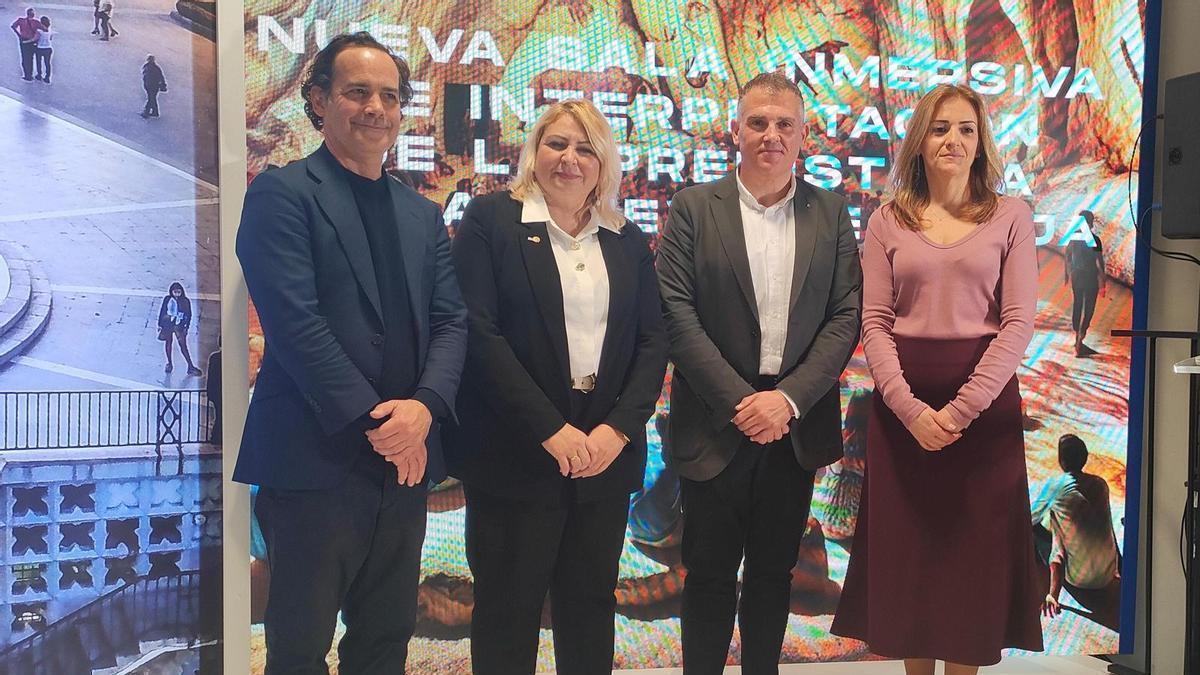

The manager of the Nerja Cave Foundation, José M.ª Domínguez, has presented the new project of the Nerja Cave, which will create a new immersive interpretation center of the Prehistoric period within the site, a space that will colloquially be called “Pepita’s House”, named after the epipaleolithic skeleton found in the Nerja Cave, which has been the highlight of the cave and its 2024 campaign.
This presentation took place at the joint booth shared by the Nerja Cave Foundation and the Nerja City Council. Domínguez was accompanied by the director of BEXR Technology, Esteban Baqués, an expert in this type of technological centers, and councilwomen from the Nerja City Council, Ángela Díaz and Ana M.ª Muñoz.
“Pepita’s House”, a room to immerse in Prehistory
As José M.ª Domínguez explained: “In ‘Pepita’s House’, which will be housed in the Nerja Cave, there will be an immersive interpretation center of Prehistory in a 500 square meter room. Thanks to immersive technology, visitors will be able to feel as our ancestors did and experience that era firsthand. Thus, the public will be able to feel the warmth of the fire, hear the sounds of hunting in the mountains, and see how cave paintings were made.”
With this new space, the visit to the Nerja Cave will become the most innovative in Spain in terms of technology and overall experience, as it adds to the visit to a Site of Cultural Interest, a privileged natural monument, and the virtual reality in the VR Room of the cave site, in 2026, this immersive center will be included.
In this space, up to 1,600 visitors per day can enjoy, distributed in groups of 40 people per session, lasting 15 minutes.
With all this, the Nerja Cave is going to lead a project of innovation at the service of Prehistory with an experience that will revolutionize historical interpretation in a high-level tourist context, which will boost the cultural tourism of the town of Nerja.
For the immersive experience, 3D projections and various technologies will be used to create an immersive effect that achieves an emotional connection with the audience, who will feel the same as their ancestors in Prehistory.
Pepita, our protagonist to understand Prehistory
Pepita, who will give her name to this new project, is a real character, named by the archaeologists so we do not know her actual name but we do know about her that she is one of the best-preserved skeletons from her era (the Epipaleolithic) in Europe. She was found in the Nerja Cave and is displayed in the Nerja Museum where she amazes visitors with her perfect teeth.
It is also known about her that she was left-handed, and although she suffered a severe infection in her left ear that left a scar on her skull, the cause of death cannot be determined with accuracy, with the most statistically likely cause being complications during childbirth or postpartum.
The latest dates obtained by Carbon 14 reveal that she lived around 9,900 years before present. Isotopic studies suggest her diet was primarily based on meat and gathered plant foods.

Latest news





Upcoming events
12
Nov
El Desembarco, la traición de Viriato at La Caja Blanca
12
Nov
HOMER El Mero Mero at Sala Trinchera Málaga
13
Nov
Marbella Startup Lab – Innovate & Collaborate
13
Nov
Candlelight: Coldplay & Imagine Dragons at Sala Fundación Unicaja María Cristina
13
Nov
Candlelight: Tribute to Ludovico Einaudi at Anantara Villa Padierna
Similar News

Imserso trips 2026-2027 in Málaga: bookings open on 14 September
Málaga

August still offers direct flights from Málaga for getaways from €34
Málaga
Six Málaga destinations rank among Spain’s most searched places for summer holidays in 2026
Málaga
