


Pedro Molina, the Marbella Painter Who Immortalized His Dog
Schoolteacher who taught reading through singing, singer-songwriter, wrote three children's books and went to China to become a third dan in tai chiCarmen Piedra, the designer from Marbella who dressed Arab princesses and showgirls
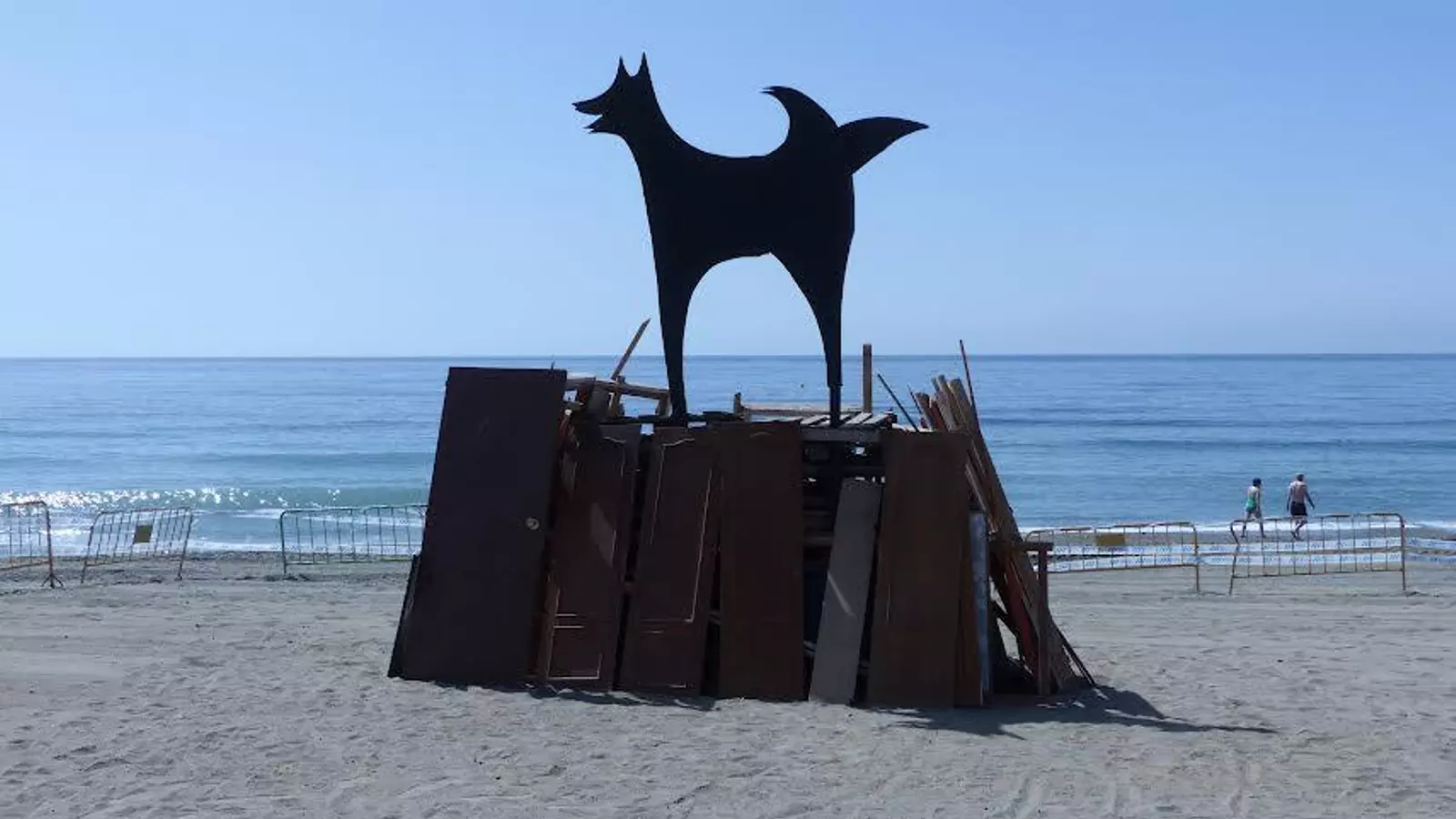

–My children wanted a dog, and a school friend brought us one, a mix of setter and cocker spaniel. I had a huge painting in the basement, and the dog peed on it. I thought: I'll either kill it or make it famous. I thought of everything a dog can do in a square. I started making dogs. I made sculptures out of steel plates I bought in Torremolinos. When I ordered the cuts, they thought the dog sculpture, with its sharp points, was a ninja star weapon. It was an exchange, I didn't make millions, but the dogs have taken me to Scotland, Portugal, France, Germany and Italy.
At the age of twelve, Pedro Molina visited Marbella for the first time in the early 1970s, when he arrived from his village of Andújar (Jaén) at his uncle's house.
‘I'll stay here,’ I said to myself, and I stayed for a year. I went back to Andújar to see my parents and stayed overnight in the mountains. The mountains are very beautiful, but I prefer the sea. In 1982–1983, I returned to Marbella as a teacher at the Los Olivos school. I painted, just for myself, doodles. I had a collection of paintings done in wax and Indian ink, and my colleagues encouraged me to show them. Juan Campos and Luis López opened the doors of the Popular University to me so I could present my first exhibition. A year later, I took a leave of absence and went to Seville to devote myself to painting.
With a handful of Signal and Adler, Nazi propaganda magazines that he had inherited from his grandfather, a house dealer, which included photos of naked women on their last pages, he made a living as a street vendor.
"I sold them all. The customers were the same people, very right-wing, on Sundays in the Alameda de Hércules and on Thursdays at the street market on Calle Feria. And at night I worked as a waiter at La Carbonería de Paco Liria.
The venue was more of a cultural centre than a tablao, hosting concerts, book presentations, poetry readings, theatre performances and flamenco recitals with Naranjito de Triana, Chocolate, Juana la del Revuelo and José de la Tomasa. Frank Zappa, Nina Hagen, Serrat, Las Virtudes and poets such as José Hierro, Félix Grande, Fernando Quiñones, Caballero Bonald and María Victoria Atencia all passed through there.
I did an exhibition, Antología de dos años (Anthology of Two Years), and only sold one painting. When I went to collect the paintings from the exhibition, two were missing. I felt proud that they had been stolen because it meant that people liked them, but when I went out onto the street, I found them broken in the rubbish.
At the weekends, I was there until two or three in the morning. I saw Julio Anguita, Lole y Manuel and Jesús Quintero passing by. It was a very bohemian atmosphere. There was an attic above the premises where singers or foreigners sometimes stayed for a few nights. There were Japanese and American girls who came to learn flamenco and paired up with the gypsies, who ended up as docile as lambs. Liria was a patron of the arts.
Bar El Estrecho, at the opening of its exhibition / Personal archive In 1985 and 1986, I was the curator of the painting exhibitions held at the venue. They called me Pedro Carpeta because I carried around some customised filing cabinets. A linguistics professor commissioned me to make 50 folders for a conference at 500 pesetas each. That night I came home with a bag full of coins.
I studied classical drawing and etching, which is very toxic. I didn't use it and replaced it with plastic, acetate, which allows fewer copies than etching plates. For the Museo del Grabado (Engraving Museum) I made drypoint copies on CD. Then I also studied homeopathy for two years, which was examined in Barcelona. I tried to study medicine but didn't get the grades. Being a teacher was my calling and it guaranteed me a steady income. When I returned to Marbella, I was assigned to the nursery class, which no one wanted. I took a 400-hour course in early childhood education. I developed an empathy with the little ones.
I worked in several schools in Fuengirola, Sabinillas and Marbella. I taught in a playful way, using songs. To teach pre-school children to read, I used a global method: images, phrases, words and syllables. We would see a rabbit in the school playground and make up a song about it, or about a yellow car on its way to Gibraltar, or when it was Halloween.
Much later, I published Pinchapapas, the result of the work I did from 1987 to 2016, which led to three books for grandchildren and grandparents. The character Pirulín is dedicated to my grandson and is for children aged three to ten. It tells stories of children's games from my grandfather's time, such as spinning tops and throwing stones into the sea.
In the Toro de Italia gallery. / Personal archive–Before going to Seville, I worked exclusively with wax, then I did oil paintings, watercolours and silkscreen prints. With Ricardo Alario, I learned how to do portraits.
First came the dogs, then the bulls and the bullfighters' costumes. I started with a collection of paintings from the Minotaurs series, which I exhibited at the El Estrecho bar. It was so successful with the public, people were crowding the street, that we had to repeat it.
I love the bull as an animal; it is beautiful. The bullfighter's costume is a metaphor; I see it as a suit of armour for fighting the bull, for fighting life. I don't mix the bullfighter's costume with the bull. I started with the minotaurs in the 2000s, and in the twenty years since then, I have had new ideas and have brought them to life.
I exhibited in a gallery on Calle Virgen del Pilar, where I became friends with the Quattro gallery in Leiria, Portugal, where I had two exhibitions of 1990s minimalism. I took the Minotauro exhibition to a place where they hate bullfighting. On the opening day, we found grease on the gallery door. I learned a lot, Portuguese and fado. I only sold one small painting.
Francesco Toro commissioned me to design the logo for his gallery. He is an Italian who has a contemporary art gallery in Sessa Aurunca, in Caserta, about 40 kilometres from Naples. It is a place with a Roman circus that is 200 years older than the one in Rome.
I made him a bull and he liked it. Then I said to myself: I can also reproduce it in sculpture, as I now have a herd of cattle. Although I have made some wooden sculptures, I am a painter before I am a sculptor. At the opening of the Italian gallery, I presented the exhibition Minotauros cambio de tercio (Minotaurs change of pace), I made a minotaur on canvas and burned a wooden bull. Then I took part in the Caserta Art Biennial.
In Marbella, I have been recognised as an artist and valued. I'm not going back to Andujar. I exhibited there once at my brother's bar, La Galeria. He is also a school teacher. I sold a lot. I was growing, until the woman who bought my work married my brother and then stopped buying from me.
Pedro Molina and his teacher Ying Ying Xu / Personal archive After starting to exhibit at the Popular University, I exhibited in bars in Istán, Estepona and San Pedro. For a while, I sold jewellery at the marina. I had some wooden dolls that I got very cheaply and some of my drawings. I wanted to live the nightlife, so I closed the beach bar and went to the bars. In Benahavís, I exhibited at the municipal jail, where I couldn't put nails in the walls, so I set up the exhibition on twenty easels. There I met Maffini, an extraordinary sculptor who played the flute very well.
In Marbella, I practised tai chi with my trainer Gabriel Killer, the brother of the Argentine footballer Daniel Killer. But I wanted to experience tai chi in China, so I went with my teacher, Ying Ying Xu, with whom I learned Chinese here.
In Beijing, I met Liu Li Chang, a traditional Chinese art district where there were shops selling paper and Chinese ink. I spent four days there in a workshop learning how to frame pictures. I learned sui mo huci, the technique of quick watercolour painting, which influenced my work. I visited the Forbidden City. From eight to eleven in the morning, I studied with my tai chi teacher, who was also my guide for twenty euros a day.
He treated me like family and I became a third dan in tai chi. The second year, I had a film director as a guide who made reports, videos and photos of my work.
Sometimes people were startled when I asked them a question in Mandarin and they didn't understand me because most of them spoke an old form of Chinese.
One day, as I was wandering around alone, without my teacher, two girls hit on me. I invited them to lunch, and they waited for me at the restaurant door. The streets were crowded, so they took me to an empty place called Lady Mary. I told them I didn't want sex, and suddenly everyone on the street was in the place. With thirty yuan, I bought everyone a round of soft drinks and left.
I was in Hou Hai, a park with a huge lake, which used to be a port with pedal boats. It was a place with lots of entertainment venues and a great atmosphere. I came across the Bar España, went in hoping to see a Spaniard, and found a Chinese man who had worked in bars in Puerto Banús.
‘If a Spaniard comes to my bar on a Sunday, I'll buy him a drink,’ he told me. He held discussions about Spain, had ham and Campo Viejo wine, and we started eating and drinking.
He is the creator of the art collective La Kavra, which brought together a group of painters with the aim of becoming activists in the defence of local heritage, archaeology, cable towers, thermal baths and Roman vaults. Based on a book of poems written by Manuel Peláez, around twenty artists took part in the “Quince meses” (Fifteen Months) project, which was praised by Luis Alberto de Cuenca for bringing together so many artistic works based on the lyrical story.
I also had a band. I played guitar alongside Rudy, a bagpiper, and Jores, a Dutchman who was a master of the transverse flute. We played at Tanguito and at private parties. At El Frutero, we recorded a live album, Pedro Molina y amigos, for which I wrote the lyrics and music. I still sing for children with the recording Pirulín, which can be found on the internet.
My teacher, who married into the Gambrinus brewery and left a widow, was called the black widow. She later married another millionaire. To keep up my language skills, I now practise Chinese with the man in the shop downstairs.
The art scene is very dry. There's little more than the exhibitions organised by Paco Sanguino at the Lima Hotel or the ones I did at the El Fuerte and Hapimag hotels. At the latter, I have been the curator of painting exhibitions and I am also the curator at the Cortijo de Miraflores, for which I am not paid, although we have not been able to organise anything since January.
Molina poses with his dog at the entrance to the Centre Pompidou in Malaga. / Personal archive In 2014, Molina was chosen to create the engraving commemorating the anniversary of the Museum of Contemporary Spanish Engraving in Marbella, and since 2016, four of his works have been part of the permanent exhibition at the Centre Pompidou in Malaga.

Latest news





Upcoming events
12
Nov
El Desembarco, la traición de Viriato at La Caja Blanca
12
Nov
HOMER El Mero Mero at Sala Trinchera Málaga
13
Nov
Marbella Startup Lab – Innovate & Collaborate
13
Nov
Candlelight: Coldplay & Imagine Dragons at Sala Fundación Unicaja María Cristina
13
Nov
Candlelight: Tribute to Ludovico Einaudi at Anantara Villa Padierna
Similar News
Paco Guerrero: From Taking Care of Pigs to Serving in the Main Luxury Hotels
Marbella
Caroline Schell: Painter and Sculptor in an Actors' Clan in Marbella
Marbella
Pepe Imaz, Djokovic's Emotional Coach
Marbella
