


Pakkito Ortiz, the DJ Who Started Spinning Records at an Ice Cream Kiosk in Marbella
Private party disc jockey, for the jet set, judges, nightclubs, hotels, or weddings. Has worked with José María Aznar or Mario Conde.
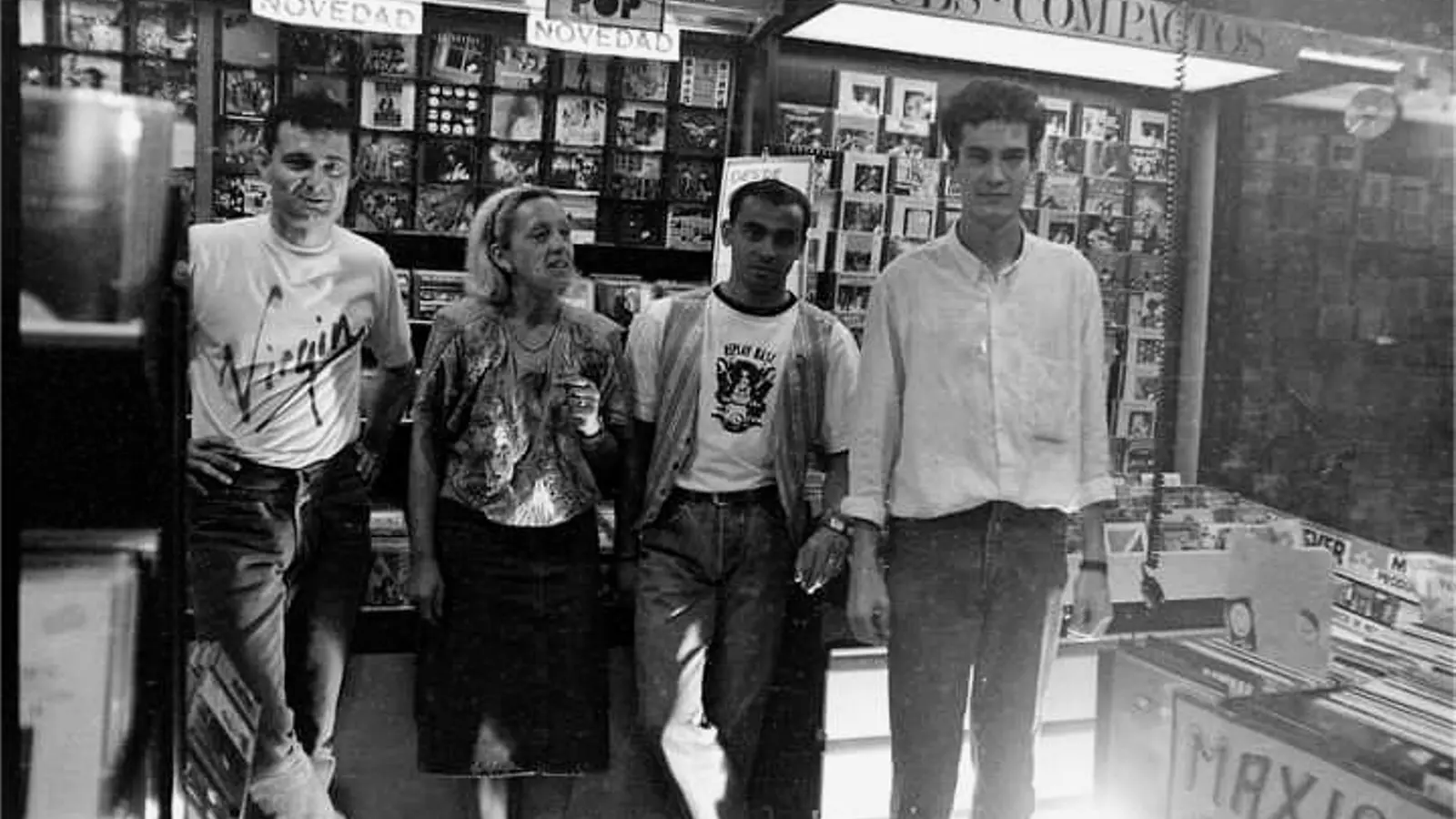

There was never a computer in the shop. He knew everything by heart. He knew every record just by glancing at the edges of the outer sleeve. Except for the dead ones, as Pakkito Ortiz calls classical music records. In the late 1970s, he was thirteen years old and sold ice cream at his mother's kiosk in front of the Lima Hotel. Armed with an amplifier and two record players, and without the need for a mixer, he learned how to entertain customers. He felt like a DJ at the kiosk, serving ice lollies and slushies, just like at the parties his friends organised.
"Customers would come in and I would play music for them on the record player. From the age of nine, I spent all the money I earned on music. I bought records at Discos 2000 and told María Castro, the shop assistant, that I wanted to work there.
I'll never forget 13 September 1984, when I went to the shop to buy the album The Street Life by the band The Crusaders, and María asked me if I wanted to start working there. She had told the owner about my interest. Of course I wanted to work, I was seventeen, but just thinking about it made me speechless.
When I was doing my military service in Malaga, my father fell seriously ill and I was able to get a transfer to the assistant's office in Marbella. On the mornings or afternoons when I had time off from the military, I worked in the shop.
The owner was Kristen Müller, a German woman from Cologne who had opened the record shop in 1979 on the ground floor of the San Cristóbal hotel on the main street in Marbella.
I didn't know London and my boss sent me there to bring back imported music from the eighties and nineties, which arrived in England via the United States. I went at least five times. I bought the maxi singles for the discos in Barcelona by phone. Just listening to a few seconds was enough for me to choose the records. Then everyone from the discos came to buy from us, from Gibraltar to Malaga. From Waves in Tarifa, who were also music distributors, to Oh Marbella and Pippers in Torremolinos. We opened up to the DJ world to expand our territory. We sold pop, jazz, everything. Selling is when the customer takes home a record they didn't intend to buy; the other thing is just clearing out stock.
One of our best customers was Mr Vázquez. He was a former soldier in Franco's army, missing a leg, and he came to the shop every Saturday. Félix Romero pulled Vázquez's cart, and he spent the whole morning with the classical music records. He came looking for new versions, and I couldn't have all the versions by every artist. He was a loyal customer and one of only two people the owner allowed to return records. The other was Marcos Sáinz, one of the architects who designed Puerto Banús and one of my best customers.
‘I went there on Saturdays, it was my weekly duty, I bought five or six jazz or contemporary music records. I took home a good selection of music recommended by Pakkito,’ recalls Sáinz.
"We had a local and foreign clientele. When I was in the shop, parents would come with their children to instil a taste for music in them. Some of them, I know, became big fans of the Beatles. On 31 December, we sold a lot.
One day, Claude Challe, the chill-out DJ who had done mixes for the Buddha Bar in Paris, came into the shop. When I saw him, I started looking at the records because his face looked familiar; I had seen it on a cover somewhere. Then he came over and said, “Yes, it's me”.
Challe, originally from Tunisia, had started out as a hairdresser in Paris before travelling to different places with the hippie migration. Back in Paris, he ran several clubs such as Le Privé, Le Centre Ville in Les Halles, Les Bains Douches, El Divino in Ibiza and the Buddha Bar.
Pakkito with Claude Challe / Personal Archive Pakkito OrtizThe French restaurant-club became a popular destination and gave its name to the compilations and mixes that Challe made for the Buddha Bar.
–Many restaurants made their own compilations, such as Oh Marbella. I thought Challe was a very nice guy who, at 80 years old, is still producing his own music and that of others on his record label. Rosario Flores was another artist who visited the shop and left us a dedicated album.
In the shop, we sold concert tickets in exchange for a commission. Between the mid-1980s and the 1990s, Marbella was visited by Prince, who performed twice, Michael Jackson, Elton John, Dire Straits, Tina Turner, Sade, Rod Stewart, Queen, and George Benson, who performed five times.
There were long queues to buy tickets, and so many were sold that there was no time to collect the money and put it in the till. So the money was put into bin bags. When Michael Jackson came, we put a television in the shop window showing the Thriller video. So many people gathered that the gallery collapsed and the clockmaker next door complained because his shop couldn't be seen.
Pakkito Ortiz has been a DJ at private parties at Gunilla von Bismarck's house and in the La Zagaleta residential complex, where marquees were set up to recreate the Seville fair, as Alfonso Hohenlohe's Marbella Club did in its early days.
–Luis Ortiz called me cousin because we had the same surname.
“You have to make me a USB stick with some music,” he would say.
'I used to go to parties with a pile of records to play, now I carry everything on a USB stick.
He is the official DJ for José Godino, the investigating judge in the Malaya case, the biggest urban corruption scandal that plagued the Marbella Town Hall for fifteen years. María José Santiago, the singer from Los Cantores de Híspalis, and a voice reminiscent of Rocío Jurado used to perform at these parties. At one of these gatherings, Pakkito met former banker Mario Conde.
Pakkito with Mario Conde. / Personal archive Pakkito Ortiz–He told me that he was also a DJ when he was young. He asked me for a song and was very nice.
At a private party in Guadalmina, organised by a neighbour of José María Aznar, the former president climbed into the DJ booth.
He congratulated me because he thought I played great music and it reminded him of the old days. There was a woman who was really annoying, asking for a song from the 1980s she wanted to hear. Her face looked familiar until I realised it was María Dolores de Cospedal.
At other parties, I bumped into Michael Robinson, Álvaro Escassi and Jesulín's sister.
It's a shame the CD got lost.
Vinyl, on the other hand, is back. For me, listening to music on vinyl is a ritual, it's touching the record, cleaning it, looking at the photos or reading the lyrics. For a year and a half, I went to work at El Corte Inglés, I knew more about music than the manager and he didn't like that. In 1997, I went back to Discos 2000. Dealing with the public is my passion.
One day I met Rafa Gas from Wave Tarifa (DJ and also producer at Tarifa Records, an independent record label he created in 2003 that became an international benchmark in promoting new electronic music artists) in Marbella. I had spoken to Rafa on the phone but we didn't know each other. He told me that we were the shop that had sold the most records from his label.
I got to meet Soledad Jiménez from Presuntos Implicados, who for me is the best voice in Spanish music. I also met Alan Parsons, who I got to talk to after a concert he gave at La Malagueta. I wasn't so lucky with George Benson, although I did once bring one of his albums to be used on the poster for his performance in Marbella. After the concert, I went to the Pantiles nightclub. His musicians were there, but he didn't go because he was tired. However, the organisers I left the album with managed to get him to sign it.
You DJ at parties that bring together more than a thousand people, such as one recently held at the La Concepción estate in Marbella
–In these cases, I ask to be able to attend the cocktail party to see the people who are attending, and at weddings, I ask for a playlist to find out the tastes of fifteen or thirty people. That way, I can know what music I'm going to play. I do this with Tidal, a music streaming platform that has a higher HiFi sound quality than Spotify. At weddings, I never recommend playing more than three hours of music, because after that time, many people are drunk and it doesn't usually end well.
With members of La Unión. / Personal archive Pakkito OrtizWhen I'm cleaning, I listen to Andalusian rock, Mezquita, Imán or Triana. I remember when I was little and couldn't go when Pirri organised concerts with these groups in the bullring. Prince's performance in that square was one of the greatest concerts ever held in Marbella; he spent four hours on stage, really enjoying himself. And the ticket sales point was my record shop.
For twenty years I've been selling classical, pop, jazz and flamenco music in the shop. That's why I can play music from the eighties and nineties without headphones because I know it all by heart and have a good ear. I play at weddings and whatever else people ask me to, but I don't play reggaeton because it's not music. I don't work with house music because you have to be very up to date. Young people today don't have a musical culture; for many, reggaeton is everything.
I don't have more than two hundred vinyl records. Once I went to DJ at a bar in the marina and left twenty boxes with about 3,500 records there. I was unlucky enough to have the place burgled and I lost them all. I had records imported from as far afield as Japan. Now I still buy records. I bought the first Pink Floyd albums. While looking at records at the flea market in Fuengirola, I heard someone say, “Don't take the vinyl out of the sleeve, you'll damage the record”. I looked and it was the photographer Pedro Jaén, who now buys and sells vinyl.
I'm also a film buff, I have over five hundred films on DVD to give away. I have a Blu-ray player for HD videos, I like old black and white films.
The arrival of El Corte Inglés and then Fnac affected our sales. I could see how we had fewer and fewer records in the shop, it was a shame. A friend of mine, who sold a building he owned six months after Discos 2000 closed, was interested in buying the shop and keeping me on so that it wouldn't be lost. But the timing wasn't right.
He remembers that at the Old Vic nightclub there were five Swedish women for every man in Marbella, and that at the Laser nightclub, the DJ booth was inexplicably facing away from the crowd, ‘it was crazy’. Meanwhile, Pakkito was DJing at his first nightclub, Le Tubo, at Willy Salsa and at Zimbawe. He then went on to play at the Ocean Club and the Hard Rock Hotel. Now, during the winters, he DJs at the Lodge in Sierra Nevada and in the summer at ‘more elegant’ hotels, such as Amare or El Fuerte. He also plays at the refurbished Lima hotel, opposite where his old ice cream kiosk used to be, where he began his career as a DJ.

Latest news





Upcoming events
12
Nov
El Desembarco, la traición de Viriato at La Caja Blanca
12
Nov
HOMER El Mero Mero at Sala Trinchera Málaga
13
Nov
Marbella Startup Lab – Innovate & Collaborate
13
Nov
Candlelight: Coldplay & Imagine Dragons at Sala Fundación Unicaja María Cristina
13
Nov
Candlelight: Tribute to Ludovico Einaudi at Anantara Villa Padierna
Similar News
Paco Guerrero: From Taking Care of Pigs to Serving in the Main Luxury Hotels
Marbella
Caroline Schell: Painter and Sculptor in an Actors' Clan in Marbella
Marbella

Pepe Imaz, Djokovic's Emotional Coach
Marbella
