


Cacho: parachuting acrobat, waiter, and Marbella paparazzi
He immortalized Camilo J. Cela in Puerto Banús hanging from a parachute. He wanted to be a flight attendant. He played Rocky Balboa in a nightclub. Pirri, the retired concierge from Marbella who demands a monument for Triana.


Jose Luis García, Cacho, has been a skydiving acrobat, a waiter at the Don Pepe hotel in the golden seventies, and for several decades a photographer of everything. He has made friends among the famous when being a paparazzi was a profession.
‘Tomorrow I'm going to go skydiving in Puerto Banús,’ Camilo José Cela told me on the phone. ‘I really like it and I've wanted to do it for a long time,’ he said.
Cela was a real character. I had been introduced to him by the businessman and shipowner Fernando Fernández Tapias one day when he was on his yacht moored in Puerto Banús. We talked a lot, he took a liking to me, and we became friends.
The day after that call, I was on a small boat with Cela, his wife Marina Castaño and the pilot. I couldn't stop looking around to make sure there were no other photographers. When I saw that man, who was nearly eighty years old and had won the Nobel Prize for Literature, strapping on his harness, I was shaking. He spent about twenty minutes in the air hanging from the parachute while I took photos of him.
Afterwards, he called me to thank me and congratulate me on the report. It was the best thing I ever did. The magazine Hola bought the exclusive rights and published eight or ten pages with the photos. I still have a copy. Camilo J. Cela parachuting in Puerto Banús. / CachoCacho went into the military.
He spent six years in the Air Force and Space Acrobatic Parachute Team in Alcantarilla, Murcia, where he performed extraordinarily well. He jumped with a parachute from a height of 4,000 metres, at a speed of over 200 kilometres per hour, and did more somersaults than required. He was bordering on reckless. That was until a heated argument with a colleague who was mistreating a soldier ended his military career. As he was leaving the military, an officer who knew him very well revealed to him: ‘You should be grateful for this incident, which has surely saved your life.’
He decided not to stray far from the skies and became a flight attendant, or air steward. This required knowledge of English, which he could acquire through an exchange programme, and basic hospitality skills, for which he enrolled at the Bellamar school in Marbella.
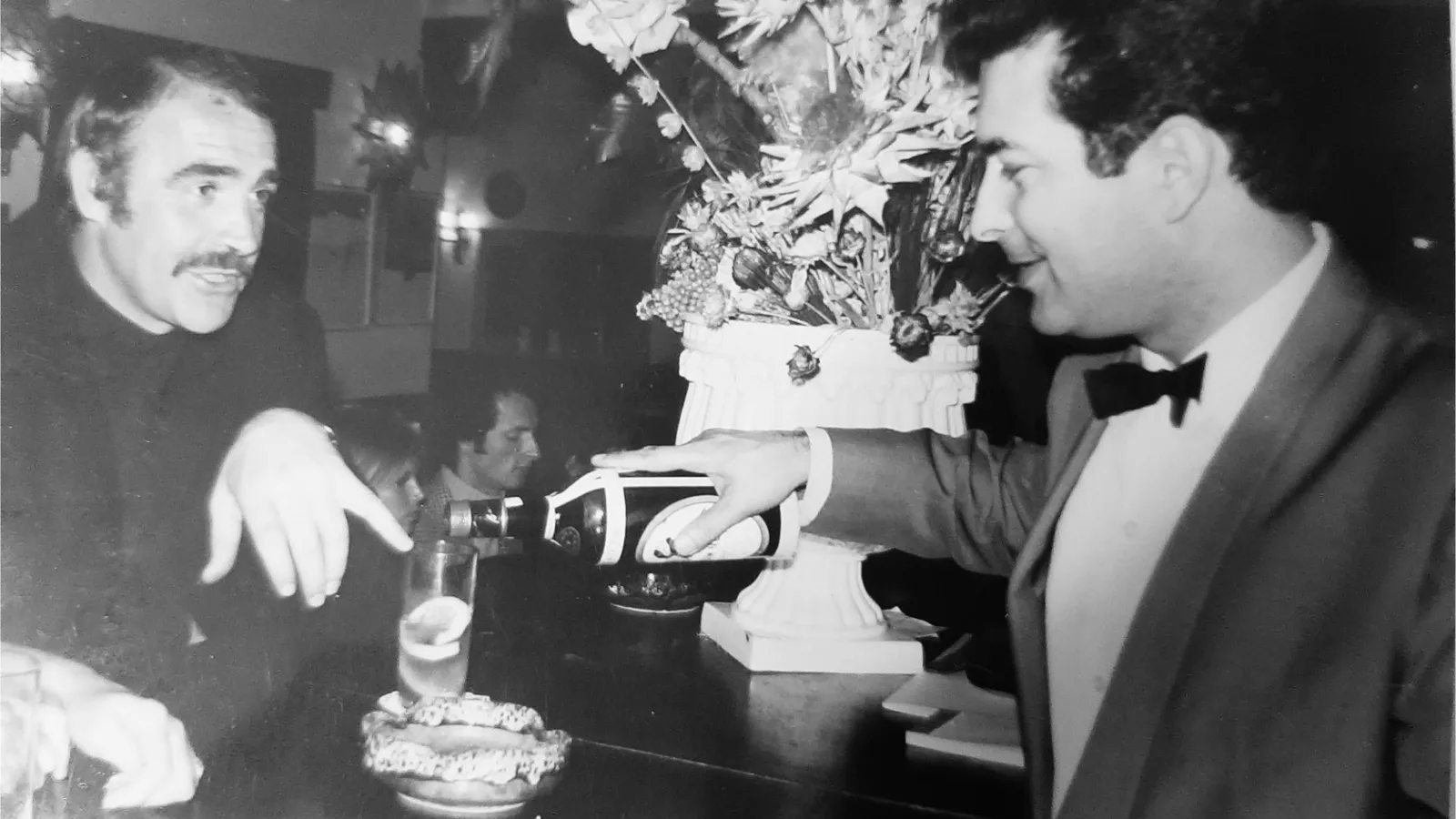
–I spent about seven months at the hospitality school until I met my wife and we decided to get married. I then started working as a waiter at the Don Pepe hotel, where I had a camera that I kept in my locker. Sometimes I would hide it under the napkin on my forearm. I took photos of Ladislao Kubala, Omar Shariff and Camarón, just for fun, for myself. My father had been a photographer and I inherited that hobby.
After nine years, I left the hotel and started studying photography with Lola Rudolphi, who suggested I take photos for Lecturas magazine with the journalist Esperanza Navarrete. My first report was on Isabel Pantoja on the beach in Fuengirola. She was with her mother and her son, who was no more than two months old. I remember her husband, Paquirri, arriving, shouting and in a very bad mood. Then there was another one at the beach bar owned by the father of Juanito, the footballer from Málaga, also in Fuengirola. That's how I started to meet famous people. I liked not only taking the photos but also the camaraderie.
As a waiter at the Don Pepe hotel. / Personal archive With photography, there was always work. If the winter was slow, I would call a famous acquaintance and suggest doing a photo shoot and splitting the fees.
I don't know when the paparazzi work ended. I made the change about twelve years ago when the agencies met in Marbella with the photographers and the gossip press to impose new criteria. I didn't agree and walked out of the meeting. I've never belonged to any agency, I've always been freelance.
Photography gave me the opportunity to share a table with King Juan Carlos in Madrid, thanks to Jaime de Mora, who was like an older brother to me and a tremendous support. He was in bed with his two little dogs and invited you to lie down next to him and chat. The bed was his office. A charming person, an angel.
He would say to me, “Be patient with children. When they're little, you want to eat them, and when they're twenty, you'll regret not having done so”. He was a very generous man; if you looked at something he was wearing, he would give it to you. He gave me a motorcycle helmet with his name on it, which attracted a lot of attention. I left it on my motorbike for five minutes and when I came back, someone had taken it. I was very sorry. I still have a pair of studded biker boots and a white patent leather shoe with a dedication, which he also gave me.
With Magrit and Jaime de Mora. / Personal archiveManolo Santana was playing tennis at his club at the Puente Romano hotel. I was on the court and a ball came flying straight at me. I caught it in the air and didn't throw it back, and after the match he signed it for me.
Gunilla and Luis Ortíz have been wonderful, they have worked hard for Marbella, they have brought the kings of Sweden, heads of government from Germany and many other personalities here. I have had a very good relationship with Los Choris, a group of golfers. One day on the beach, Luis said to me: “Take the child, his son, and bury him so that only his neck is visible”.
I took photos of the three of them, the child covered in sand and his parents standing there looking at him. I had a great friendship with Luis Ortiz. I have always greatly admired the independence of the Duchess of Alba. With all the noble titles that woman had, she did whatever she wanted.
When she didn't like how she looked in a magazine photo, she would say to me at Marisa's beach bar, in a low voice and with a grimace: ‘You're a bastard.’ Her daughter María Eugenia was also very nice; she would let me know when the Duke of Huescar was coming to Sotogrande. It was like being friends with the famous.
Fernandez Tapias called me on the phone once to tell me he was in the hospital, that he had had an accident at home and his leg was in a cast. So I went there, he came out of the hospital, threw his crutch on the ground and then picked it up to play around with me. Marisa, one of his partners, called me to tell me to take care of his photos, that they had to come out well. I went to her house so she could see the photos and choose them.
Once there was a beauty contest where the winners got to go on a trip to Gibraltar. Rappel, the psychic, was there, and so was a Thai girl that nobody knew. I suggested to Rappel that he stick close to her so I could take some photos of them together. They hit it off, so I took them to a jeweller I knew. I took several photos of them choosing wedding rings. In the magazines, it looked as if there was a romantic relationship between Rappel and Two Yupa. ‘It's all a lie,’ Gil once told me, and I remembered that phrase.
Fermín Muñoz was the manager at Don Pepe, but he left to go work at the Rocky nightclub. When the film with Sylvester Stallone came out and was a hit, I suggested to Fermín that we do a parody of Rocky Balboa. We painted my opponent with shoe polish and put a swimming cap on top of a wig with curls. The waitresses held up signs announcing the number of rounds in the fight. A few years later, some of those photos were published, and many people still believe that I was also a boxer.
In the boxing match at the Rocky nightclub. / Personal archiveOn one occasion, the president of the Andalusian Regional Government, José Rodríguez de la Borbolla, was invited to the gastronomic event organised by Santiago Domínguez at his restaurant. The chef was about to name him a member of the brotherhood and, to add solemnity to the event, he was going to appear brandishing a sword. He asked Cacho to give him the welcome greeting.
In the manner of the palpati, who according to legend were responsible for attesting to the pontiff's virility by feeling his genitals, Cacho put this custom into practice to greet his friends and acquaintances.
"I hugged him and grabbed his testicles, as I used to do jokingly, but perhaps I did it harder than usual, and Rodríguez de la Borbolla froze.
On another occasion, the effusive greeting clashed with the hieratic posture of a man wearing a suit and black tie, topped with a bowler hat. He was Ricardo del Cid, a Latin scholar, lover of the works of Sallust and Virgil, and at that time a delegate of the Ministry of Tourism.
The man couldn't believe Cacho's greeting. He stared at him and then said, “It's lucky you're with Don Santiago, otherwise I don't know how this would have ended,” recalls Santiago himself.
Julio Iglesias only wanted photos taken of his good profile. I insisted on turning him around and taking photos of the other side, which made him angry. He had a very bad temper.
Javier Basilio, the presenter on Televisión Española, once told me he was going to interview Isabel Preysler at the tennis courts in Puente Romano. I went and hid to take photos of him while he was interviewing her, until Isabel's son saw me and told on me. I had to come out and introduce myself.
Isabel Preysler and Miguel Boyer with Enrique and Tamara. / CachoOn another occasion, I spent two days on duty in front of Isabel Preysler's house on a pedal boat, waiting for her to come out. From 7:30 in the morning until 8:30 in the evening, I was about 150 metres from the house, pedalling on the pedal boat and being careful not to move away from my target. I stayed there, in the blazing sun, with no way to cool off, until finally, on the second day, she decided to leave at the last minute. There was another photographer nearby, swaying in a Zodiac, but I had the best position.
At one point, I went to live on the top floor of a building, and when I went out onto the balcony, I saw Antonio Banderas putting up a plastic fence on top of the wall to prevent people from seeing him. The local police chief, who had got me that flat, had told him that there was a paparazzi on the top floor. I have a very good relationship with Banderas; every time we see each other, we hug. At one edition of the Malaga Film Festival that I didn't attend, when he arrived with his ex-wife Melanie Griffith, there were more than a hundred photographers and Melanie asked, ‘Where's Cacho?’
Once, Marlene Moreau was walking with her boyfriend in Puerto Banús and I started taking photos of her. She told me not to, but I kept going. Her boyfriend picked up an empty wooden beer crate and threw it at me. I was lucky enough to dodge it. Afterwards, he apologised and we're still friends.
Cacho with members of the Yanomami community. / Personal archive Before companies started talking about corporate social responsibility, Cacho got the Puerto Banús casino to sponsor a trip to an indigenous community in the Amazon. This allowed him to join a group of local expeditioners who set out to bring aid and medicine to the Yanomami, one of the few tribes that, 500 years after Christopher Columbus' arrival in America, has remained isolated on both sides of the border between Brazil and Venezuela, to live with them for a month.
"I'm a new beginning. I don't bother anyone and I do my own thing. I've done everything, from celebrity gossip to newspapers to parties, and sometimes public relations.

Latest news





Upcoming events
12
Nov
El Desembarco, la traición de Viriato at La Caja Blanca
12
Nov
HOMER El Mero Mero at Sala Trinchera Málaga
13
Nov
Marbella Startup Lab – Innovate & Collaborate
13
Nov
Candlelight: Coldplay & Imagine Dragons at Sala Fundación Unicaja María Cristina
13
Nov
Candlelight: Tribute to Ludovico Einaudi at Anantara Villa Padierna
Similar News
Paco Guerrero: From Taking Care of Pigs to Serving in the Main Luxury Hotels
Marbella
Caroline Schell: Painter and Sculptor in an Actors' Clan in Marbella
Marbella
Pepe Imaz, Djokovic's Emotional Coach
Marbella
