


The concierge who created his dream factory in Marbella
Gabriel Moreno bought the rights to 200 movies in Hollywood and Cannes, had a car rental, a dental clinic, and has owned a luxury shoe store for 60 years.
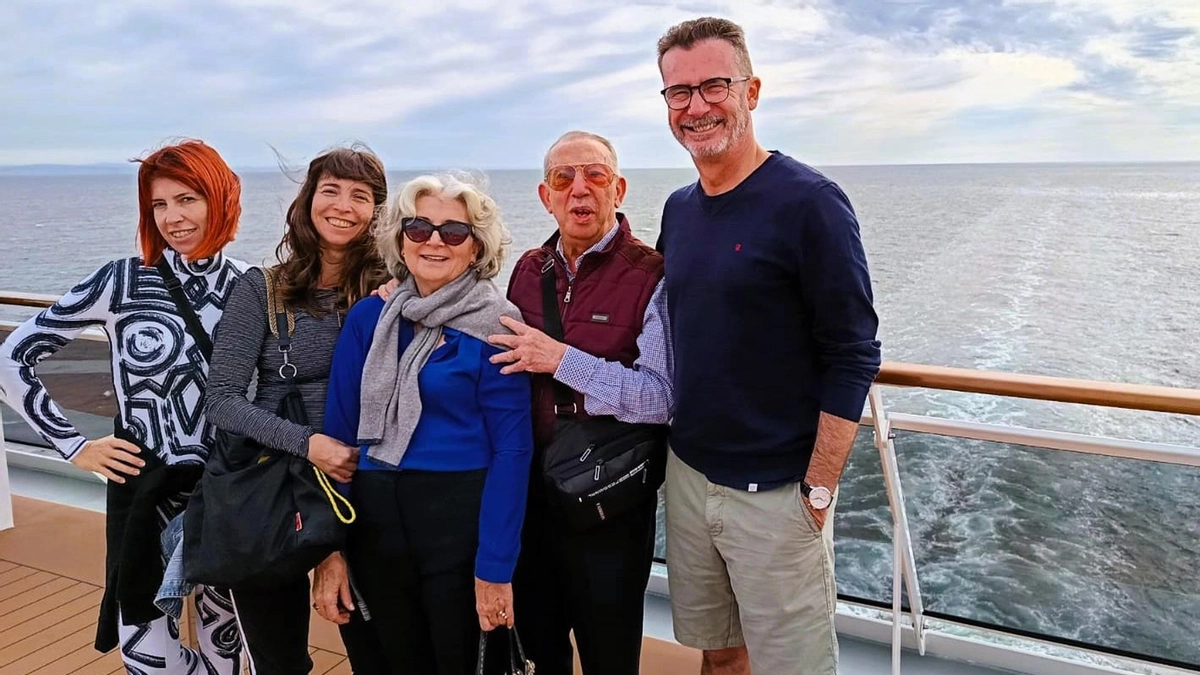

Gabriel Moreno has been running his shoe store in the same location on the main avenue of Marbella for six decades. He was 23 years old and earning two thousand pesetas a month as a concierge at the Don Pepe hotel when he discovered the building under construction that today houses his shoe store.
–I spoke with the sales manager and he told me that the place I was interested in had already been sold, however, he could put me in touch with its owners. They were two Colombian guys, one big and strong, and the other small and chubby. Very friendly. They asked for 16,000 pesetas for the rent, I was convinced it could work. I set one condition, that I would have the option to buy it after three or four years.
In the early sixties, Moreno lived in Granada, where he was born, and had a friend on the Coast who told him that the Don Pepe hotel needed people who spoke languages for the reception. He had a degree in social studies, but his mother insisted he study English and French, which would prove crucial throughout his life. He served his mandatory military service in Sidi Ifni, the Spanish Protectorate in Africa, where German, English, or French soldiers arrived, and he had to act as a translator to the Spanish military, guide them around the city, and sometimes take them out to dinner, during the reign of King Mohamed V of Morocco. His privileged role allowed him to live in the officers' residence and later teach English and French to the soldiers' children. In two months, he had fifteen students and no longer needed his parents to send him money because he had plenty.
–When I started at the Don Pepe hotel, I wondered what I could sell here. The idea of the store was an intuition, I had the idea to start a business that would improve my salary, I was looking for an economic outlet out of necessity.
Once he secured the location, he observed that in Marbella there was no shoe store, a business for which he had no knowledge.
DC9 that transported Moreno and his colleagues to Sidi Ifni in 1962.–I had a Lambretta then. I found out where the shoe factories were and went to Elda (Alicante) on the motorcycle. A shoe factory representative told me about others, with four I could complete a good range of shoes. They asked for a deposit to start working, which I got with a bank loan. I brought my two sisters from Granada to take care of the store, and I continued working at the hotel.
Remember that I was only about twelve years old, studying at the Salesian religious school and participating in theater performances. When a performance came up and I needed to arrange a costume, I turned to my mother for help. In the impoverished fifties, I noticed that in the cinema, before the movie started, a man with a tray full of goods would come out, ready to sell candies and sweets. I then had the idea to replicate this good idea during the performances that our group did in the theater to get the costumes for the performances.
–You handle that, the priest responded to his proposal.
The business worked very well. At least for a year, until the school director changed, whose name he still remembers, and he was forbidden to continue with the lucrative activity. He learned that to do business, you just needed something to sell. And that he was drawn to commerce, even though his father, a civil servant in Granada, preferred that his son pass a competitive exam and secure a lifelong position at the Bank of Spain.
Moreno receives the diploma from the concierge association, The Golden Keys.After a year of working at the Don Pepe hotel, he moved to Los Monteros. In this establishment, while working as a concierge, he envisioned another business. If his reception colleagues were satisfied with a small commission from rental companies, he went further and set up his own rent-a-car.
–I ended up having 77 cars. I am a born and true worker. I was not interested in Marbella parties and had no time. I dedicated everything to work, my wife, and my three children. I always found the hotel sector very complicated, its operation depends on many people, in Los Monteros I had seventy people in reception and concierge under my charge.
On one occasion, Ingrid, the Queen Mother of Denmark, as a client of the hotel asked Moreno to recommend a guide to tour the city of Granada incognito. The concierge knew his city very well and turned to a good friend to perfectly fulfill that mission.
–I made an effort, as we did with all clients, among whom there were also important people. The queen was very grateful for that visit and when she returned to the hotel, she asked for me. People were very kind and helpful back then, and that was essential for the development of tourism.
It was precisely in this hotel, where he worked for fifteen years, that a foreign client told him about videos.
–I didn't know what it was about, he told me that he was going to open a business in England with which he hoped to succeed as was already happening in America. The business consisted of buying the rights to movies. I traveled to Madrid and met Enrique Cerezo, who was already involved in the film business, then I started in the video business. We made some trips together, on one of them we shared a room and he kept me awake with his snoring. In Hollywood, I saw dozens of famous artists, like Deborah Kerr. Cerezo was already a film producer and today he owns more than 70% of the titles of Spanish cinema, with which he leads the country's film sector, in addition to being the president of Atlético de Madrid.
In the basements of downtown Marbella, Moreno set up a film duplication bank. With the rights in his pocket, he had more than 200 movies dubbed into Spanish in Barcelona and Madrid. He created a real film factory, where work was carried out in three shifts around the clock. The tapes of the movies were copied to VHS, Betamax, and Phillips video 2000 formats. The cassettes were sent to three distribution centers, which Moreno had strategically placed in Barcelona, Madrid, and Seville, covering the north, center, and south of the entire national territory.
Gabriel Moreno in his old film factory.From the eighties, video clubs acted as the first analog cinema platform. To rent a movie, one had to be a member of a video club. Among the different formats, VHS prevailed, in the United States they were the most used and it was the format that the Hollywood industry imposed for the dissemination of its movies.
–The video phenomenon had an exponential rise for a period of seven or eight years and then a steep fall, explains Moreno in the old dream factory that still stands, frozen in time. The logo of a snail with stripes in blue, green, and red – the three colors that when mixed result in all the tones of the spectrum – presides over the entrance.
–It is the only animal capable of walking on glass and I chose the colors that best adapt to the television screen, points out its creator, who still keeps dozens of the devices with which the movies were copied and hundreds of dusty Sony cassettes, perfectly arranged on the shelves.
During the frantic years in which he developed this activity, he made continuous trips to Hollywood, Milan, or Cannes to acquire the rights to the movies he dubbed and packaged in cassettes. He had Spanish Television as his main client in addition to the thousands of video clubs spread throughout Spain. Major Hollywood film producers, like Metro Goldwyn Mayer or Twentieth Century-Fox Film Corporation, invited clients to the cocktails they organized, where actors attended, but Moreno was more focused on the tangible, the negotiation, than on the film stars.
–It was a very good business until private televisions arrived. I had a very good distribution with more than 70 delegates in all the provinces. If the first year I invoiced 250,000 pesetas, the second were 85 million pesetas and the next more than one hundred million. The movie Scarlet and Black starring Gregory Peck was a success.
Set in World War II, it tells the efforts of a monsignor played by Peck to save Jews, prisoners of war, and Allied airmen as the Nazis invaded Rome.
–There were other movies that were also successful, like those starring Chuck Norris, although I didn't like them. They had a lot of action and that sold.
Moreno's luxury shoe store, which offers crocodile leather shoes close to a thousand euros, has had clients from Imelda Marcos and her husband, the Filipino dictator Ferdinand Marcos, to various princesses of the Saudi royal house. On these occasions, the limousines, watched by the municipal guard, parked at the door of the store which was closed to the curious. Imelda, always fond of shoes – she treasured a collection of more than three thousand – bought them seven pairs at a time.
–When it came time to pay, she never touched the money, her secretary did it. She came here because in the Los Monteros urbanization she had a house Pitita Ridruejo and her husband (José Manuel Stilianopoulos, who was the ambassador of the Philippines to the United Kingdom from 1977 to 1982).
Moreno, who also founded and owned a dental clinic, devotes some time to his passion for painting. He has always liked to read and has been interested in art. He is a very special bibliophile. He collects art books, ranging from Fernando Botero's Via Crucis to the Cantigas of King Alfonso X The Wise or the facsimile of the Apocalypse. Valuable publications that also represent a form of investment for the former concierge.

Latest news





Upcoming events
12
Nov
El Desembarco, la traición de Viriato at La Caja Blanca
12
Nov
HOMER El Mero Mero at Sala Trinchera Málaga
13
Nov
Marbella Startup Lab – Innovate & Collaborate
13
Nov
Candlelight: Coldplay & Imagine Dragons at Sala Fundación Unicaja María Cristina
13
Nov
Candlelight: Tribute to Ludovico Einaudi at Anantara Villa Padierna
Similar News
Paco Guerrero: From Taking Care of Pigs to Serving in the Main Luxury Hotels
Marbella
Caroline Schell: Painter and Sculptor in an Actors' Clan in Marbella
Marbella

Pepe Imaz, Djokovic's Emotional Coach
Marbella
