


The Life of Javier Soto: From Bodyguard for Hohenlohe at Marbella Club to Discovering Bones Over 1.2 Million Years Old
He rejected Adnan Khashoggi, was a hotel bellboy, sailor, commercial agent, and explorer; he saved the lives of about fifteen people as a speleologist.

For three years, Javier Soto was Alfonso de Hohenlohe's bodyguard at the Marbella Club.
-I was 26 years old at the time and as strong as a bull, I would stand at a table behind them to keep him and his wife, Jocelyn Lane, out of their way.
At charity galas to raise money for the fight against cancer, people would sneak in. The rich, well-dressed, would sneak into the pool area. About 300 people would gather and there were no places for those who had paid. Alfonso told me: you mustn't let anyone in who didn't pay. I spoke to the Guardia Civil at the El Ancón barracks and they assigned two officers to guard the entrance on the beach, I would do it at the top with the car guards.
You don't know who I am," Franco's son-in-law told me.
-The one who doesn't know who I am is you," I replied to the Marquis of Villaverde.
He had come accompanied by a nephew. I asked them for tickets, they didn't have any, and I didn't let them pass.
He sat on the wings of the Rolls Royce until at one point he told his nephew to go to the house for the invitations. They came back with the tickets and were allowed in.
Javier Soto, on the right, with a colleague / Personal archive
At three o'clock in the morning the Marquis of Villaverde came out on Alfonso's arm and when he saw me he said: "I never want to see him again in my life, he's been a pain in the ass".
-He is the best employee I have and he will remain here," said Hohenlohe.
After a while, the marquis came back and said to me: "Good night, Don Javier".
In the navy I learned not to be pushed around. If they step on your toe, they eat you.
One night Adnan Khashoggi and his wife Soraya were at the Marbella Club. She lost a one-tonne bracelet. I asked the waiters and they said they didn't know anything. Before the end of the shift I went to where they kept the lockers until one said he found it. I told him I had the bracelet and Khashoggi sent a Japanese man to pick it up. He gave me a thousand dollars.
Khashoggi had four bodyguards, two Yugoslavs as armourers, armed with Israeli Mini Uzi machine guns and two Japanese with pistols. Each of the four stood in a corner of the room where his boss was.
Jaime de Mora suggested that I go to work with Khashoggi, that he was going to pay me three times what Hohenlohe was giving me.
-I told him: "I'm not going, just as he wants me now, another day he'll leave me stranded in the Bahamas. Later, with the electricity company, we installed the system in his finca in La Zagaleta.
In 1977 there was a lot of cocaine. I told Hohenlohe that I was leaving my job as a bodyguard and he offered me to be the manager of the discotheque. I told him: "If I stay here, I'm in trouble with the coke and the money. I'm leaving, I have a wife and two children.
With Juan Alcalá Zamora, on the right, grandnephew of Niceto Alcalá Zamora / Personal archive
‘You know when you enter but not when you leave’, read a sign hung by the employees of the Don Pepe hotel, where Javier Soto worked for a few seasons under his father's guidance from a very young age.
Twelve-hour days were the norm, and three or four times a week they were extended to fourteen or sixteen hours. If clients arrived at nine o'clock at night, the welcome protocol lasted about three hours and they gave you twelve o'clock. You left at midnight and came in at nine o'clock the next morning.
It was the years of the tourism implosion when in 1967 a strike was organised.
-The staff stood in the hotel office, maitre d', waiters and waitresses, all standing firm. The director, Don Mateo Bosh, came down and looked at everyone and asked: "What's going on here?
-You see," one of them began to speak. Bosh interrupted him and said "you're fired", and so he did with up to fifteen guys who dared to open their mouths.
-If you're not here, I'll work it out with the technicians and other staff," he said. That was the end of the strike. That was the way it was. Unions didn't exist.
My father was a sommelier, he rested on Mondays, when he went to Malaga to collect the commissions for the wines he sold. For his work he was awarded the tourist merit medal. At first it was silver, until later they told him that they had made a mistake, that his would be bronze and the silver would go to the parish priest Rodrigo Bocanegra. Some time later he met Manuel Fraga (Franco's Minister of Information and Tourism) and told him:
-I'm happy if they give me a chorizo Revilla badge.
‘The navy is calling you’, was the advert, which he saw in 1967 and led him to leave the hotel.
-I was a good student, I preferred to try the navy. There were several trades you could learn and I opted for electronics, I spent a year in Vigo.
Javier Soto's father serves wine at Menuel Fraga's table / Personal archive
In Ferrol, during a search of my belongings, they found a book by Mikhail Bakunin (an anarchist philosopher) and another by Carl Marx, they accused me of being a communist and put me in the Carranza military prison.
My father was a sommelier, he rested on Mondays, when he went to Malaga to collect the commissions for the wines he sold. For his work he was awarded the tourist merit medal. At first it was silver, until later they told him that they had made a mistake, that his would be bronze and the silver would go to the parish priest Rodrigo Bocanegra. Some time later he met Manuel Fraga (Franco's Minister of Information and Tourism) and told him:
-I'm happy if they give me a chorizo Revilla badge.
‘The navy is calling you’, was the advert, which he saw in 1967 and led him to leave the hotel.
-He was a good student, he preferred to try the navy. There were several trades you could learn and I opted for electronics, I spent a year in Vigo.
Javier Soto's father serves wine at Menuel Fraga's table / Personal archive
In Ferrol, during a search of my belongings, they found a book by Mikhail Bakunin (an anarchist philosopher) and another by Carl Marx, they accused me of being a communist and put me in the Carranza military prison.
-I have never been a communist in my fucking life, the books were left to me by a teacher who told me, you will like them. And I took them with me to read them in my free time. They packed me in for 18 years. In the end I was punished with the minimum sentence of six months.
In 1970 my father died, aged 45, of leukaemia. I decided then to graduate from the navy.
My father was a good salesman. He formed a good relationship with the future King Juan Carlos, who offered him a job in the wine cellar at La Zarzuela. For six or seven years, we received congratulations from Juan Carlos and Sofía every year-end. My father had a whole future ahead of him and my mother was left in a very bad situation.
I went back to Marbella by hitchhiking and sneaking on trains. When I got home, my mother didn't recognise me. I had lost 25 kilos in prison. I went back to work at the Don Pepe, I was there for about ten months and I couldn't take it anymore. Customers called me from the tables to express their condolences for my father.
In 1976, with a friend, I set up an electricity company for boats in Puerto Banús, and then we went into housing. I was also a salesman at Viuda de Brown, an industrial catering machinery company to supplement my salary, and I also did some marketing courses in Malaga.
One day a friend of mine said to me: "I saw your photograph in the newspaper". He showed me an advert for a sales manager, I found out it was for the Banco de Andalucía. I went to the director and told him: "I'm the best man for the job you're offering".
-You don't have a grandmother," he replied, laughing.
-No, what I don't have is a grandmother with fifteen million pesetas, otherwise I wouldn't be here.
I was there for ten years, while I went in the afternoons to the electricity company I had set up, where I stayed until eleven o'clock at night to take the papers.
I thought that the banks paid well, but I could see that with my salary I couldn't even buy a drink for a client in Puerto Banús. I went back to Viuda de Brown as a salesman in the evenings.
At Christmas 1982, the 182 safety deposit boxes of the Banco de Andalucía, where Javier worked, were robbed.
-They accused me of having done it. The police detained me for 72 hours. Five policemen interrogated me. That Christmas I had been in Cazorla until the first of January and the robbery took place on 25 December.
-You tell me who your colleagues are, I get a medal and you go to the street," a policeman suggested to me.
I maintained that it wasn't me and in the end I was released.
A few days later the Guardia Civil squad knocked on my door and told me that I had to accompany them to the Leganitos barracks. I asked them to let me finish eating. I get there and they tie me to a chair.
-Here you are going to sing soleares, they tell me and roll up their sleeves ready to beat me. Then a lieutenant came in and said: "What the hell is this?" And turning to me he said:-Nothing happened here, go home. I was scared to death.
Eventually I found out that it was the bank manager, a fool, who reported me.
It was presumed that the thieves had a contact inside the bank to commit the robbery.
-I know who he is, he's a young man who runs an electronics workshop," he said to point me out to the police.
An Italian man and a very good-looking woman frequented the manager. She told him that she had some of her mother's jewellery and wanted to know if it was safe to leave it in this bank.
-The tellers are very safe, even if the alarm sometimes doesn't work," she told them.
The burglars had to cut their way into the basement of the bank to gain access to the safe deposit boxes. The same director, a poor wretch, had rented the Italian a villa for two months.
In Italy, with the collaboration of the Spanish police, they caught up with the thieves.
-Some of the loot had disappeared and the precious stones had been dismantled. There was the case of a client who died of a heart attack when he saw his safe deposit box empty. Jaime de Mora lost his mother's jewellery.
-My fate is to be penniless, but I would have liked to leave the jewellery to my wife," he said, and he didn't even flinch.
In some safe deposit boxes for rent there were 40 million pesetas, some of which contained photos of his wife with her lover, in the middle of money and jewellery. Some customers considered the bank's security measures to be inadequate, and the police themselves considered them to be weak. Some foreign customers were suspected of having jewellery, coin collections and valuables brought from their countries without authorisation and others of keeping dirty money in the safety deposit boxes.
Eudald Carbonell, Javier Soto and Santi. / Personal archive
Explorer, speleologist and lover of prehistory, Javier Soto founded the Marbella Speleological Section fifty years ago with a group of friends, with whom he went to the rescue of hikers lost in the province's caves on many occasions. The most memorable action was in 1976, when he saved the lives of five speleologists lost in the Cueva del Gato.
-I pulled fifteen people out of the caves alive and three dead.
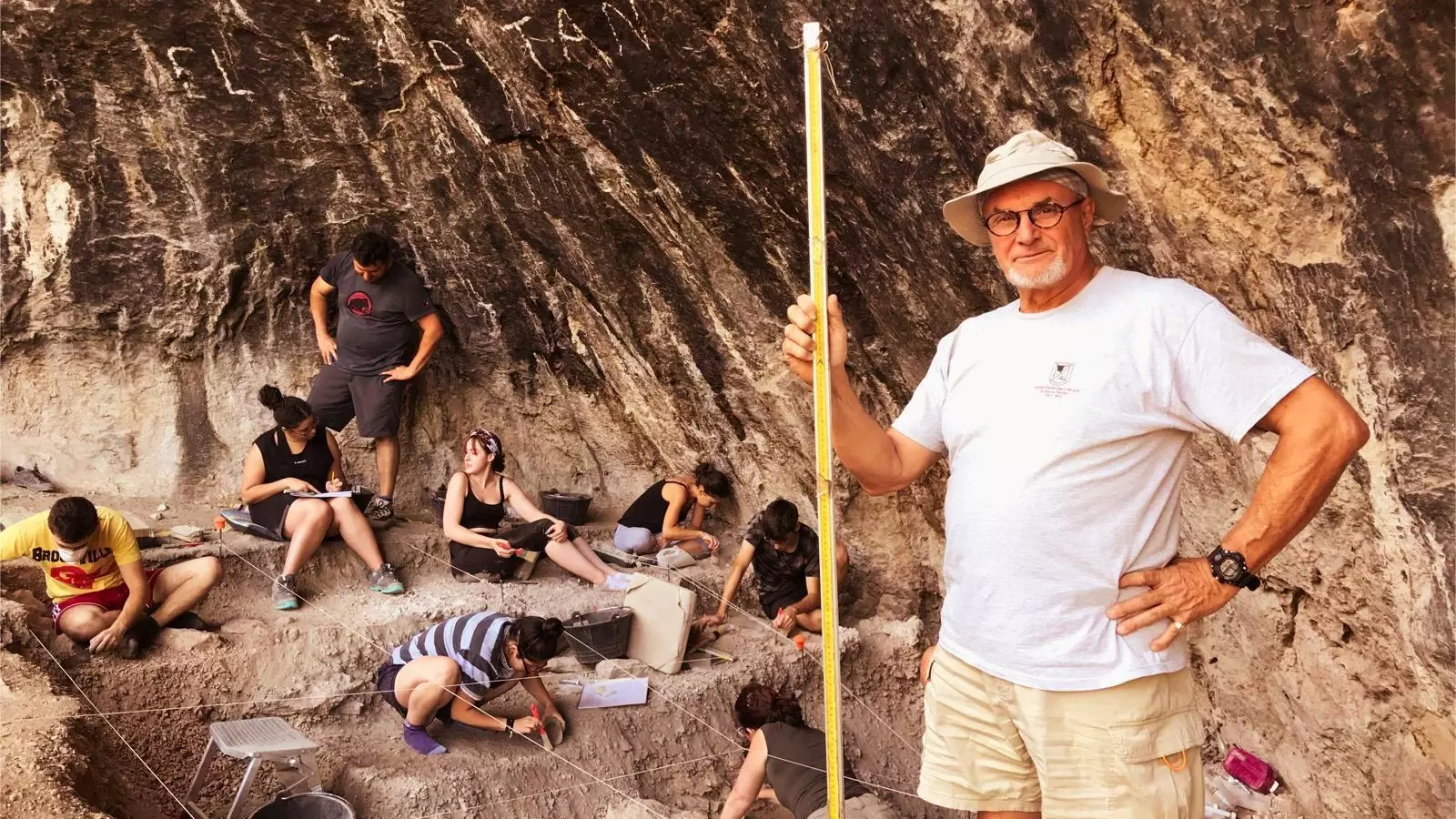
A fan of archaeology and palaeontology, he participated in excavations at the Atapuerca site for 14 seasons in search of 1.4 million-year-old hominids. He searched for Neanderthals in the Horada Cave in San Roque (Cádiz); in Zamborino (Granada) or in the Peñón de la Reina and Los Millares, in Almería.
A collaborator of the Museum of Human Evolution in Burgos, he was part of the team that discovered in the Elephant Cave the fossil remains of a 1.2 million year old molar and a chin, considered one of the oldest in Europe.
In Sierra Blanca they found the remains of a parietal and a molar of a preneanderthal, which lived more than 600,000 years ago and lasted at least until the middle of the Pleistocene. They were examined by the directors of Atapuerca, Eduald Carbonell and Bermúdez de Castro, and are kept in the Department of Anthropology of the University of Granada.

Latest news





Upcoming events
12
Nov
El Desembarco, la traición de Viriato at La Caja Blanca
12
Nov
HOMER El Mero Mero at Sala Trinchera Málaga
13
Nov
Marbella Startup Lab – Innovate & Collaborate
13
Nov
Candlelight: Coldplay & Imagine Dragons at Sala Fundación Unicaja María Cristina
13
Nov
Candlelight: Tribute to Ludovico Einaudi at Anantara Villa Padierna
Similar News

Marbella Launches ‘Summer Youth’ Programme with 2,500 Free Places
Marbella

Premium Tourism Drives Marbella’s Hotel Profitability to Record Levels as Overnight Stays Exceed 291,000
Marbella

‘Machos Alfa’ seeks extras in Marbella for filming of its sixth and final season
Marbella
