


End to Slipping Due to the Anti-Wax Solution During Holy Week in Málaga: Here is the Solution
Professors from the Chemistry Department at UMA have developed a product that creates an anti-slip film on the pavement of the historic center. Málaga rules out anti-slip strips for Holy Week.
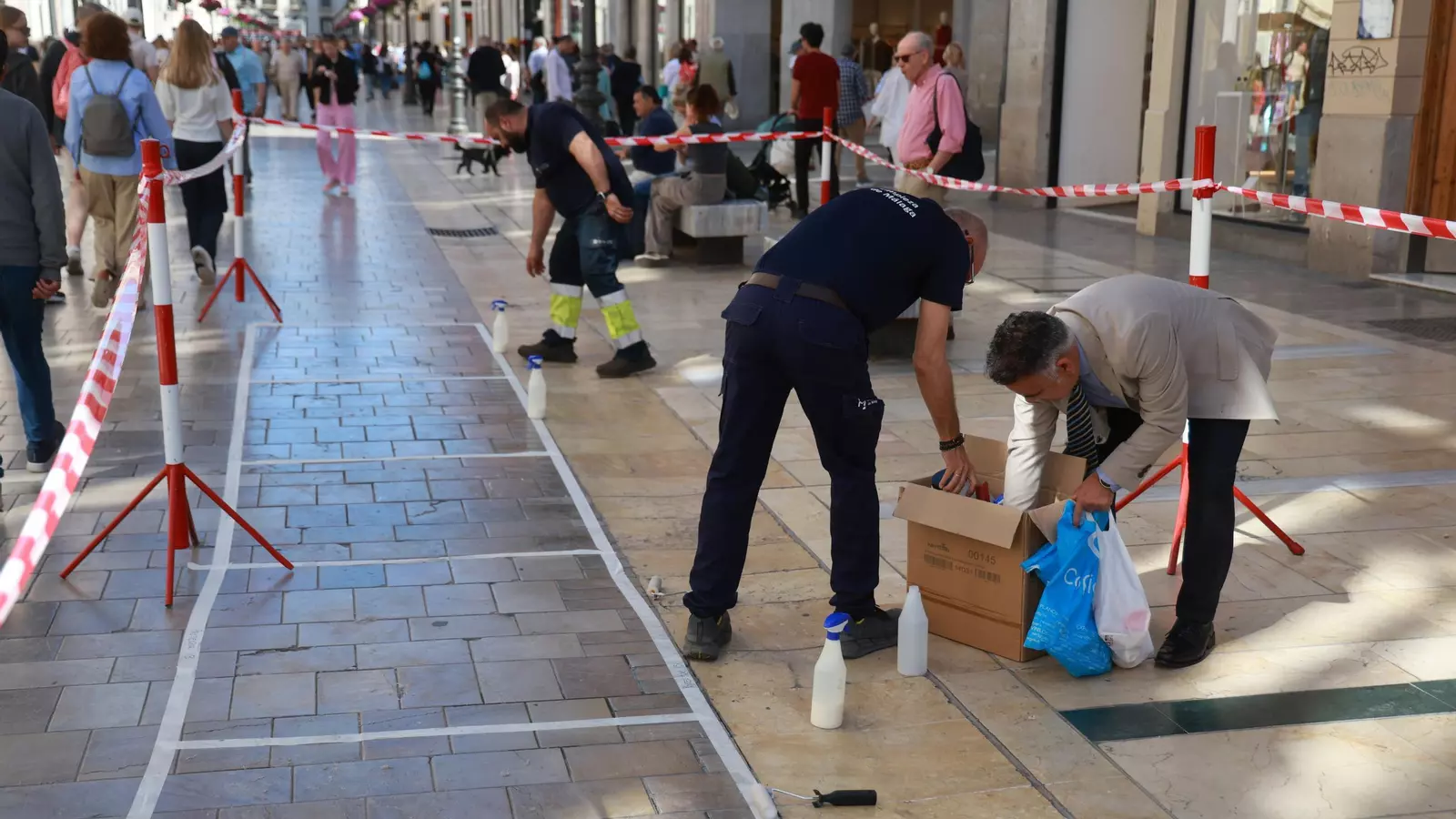

Málaga/The issue of slips due to the anti-wax liquid during Holy Week in Málaga seems to be resolved (at last). A group of professors from the Department of Inorganic Chemistry, Crystallography, and Mineralogy at the Faculty of Sciences of the University of Málaga (UMA) has found a product that creates an anti-slip effect on the rock pavement of the historic center of the capital, a floor that, due to its characteristics, becomes very slippery when the liquid used by Limasam on the streets to clean the wax drips left after the processions is applied, which has already caused more than a scare.
The City Council of Málaga and the aforementioned Department of Chemistry at UMA tested this product on Tuesday on the pavement of Calle Larios and the result was successful. "We were very surprised because we found a product that generated a very powerful anti-slip effect," said Professor Francisco Ignacio Franco, who adds that the formula found could even work with rain, so that the pavement of the urban center stops being slippery when wet. "In the end, the anti-wax liquid is no more or less slippery than rainwater, because it is mostly water," he explained.
The created product is a kind of water-based protector, which dries in 10 minutes and, by adding a grain, creates a film that leaves a rough surface. This is how greater friction and the desired braking, anti-slip effect is achieved. Another plus is that it does not contain toxic chemical elements, which means it poses no danger to the workers applying it. "I applied it on the floor of Calle Larios with a roller, without gloves or a mask, so it is not dangerous," says Franco.
They received the assignment from the City Council before last year's Holy Week, and since then they have been working on two parallel research lines. One of them consisted of trying to modify the physicochemical characteristics of the anti-wax liquid used by Limasam, so that without losing effectiveness in removing wax, it would stop being slippery. The second line - which turned out to be the definitive solution - was the creation of a protective product for the rock that generates an anti-slip effect on it.
Finding this formula took them a year. A record time, according to the professor: Considering that projects requested by the Andalusian Regional Government or ministries usually last three or four years, in this case, following the scientific method, we tried to move quickly to be on time and we succeeded". A "milestone," emphasizes Franco, because it solves two problems: slips with the anti-wax liquid, and the problem of the slippery characteristics of Málaga's pavement when it rains.
The formula was found by addressing the origin of the problem, which is the type of material that the streets of the historic center of Málaga are made of: mostly limestone, but also granite and serpentine.
The limestone gets polished by the passage of pedestrians, creating a smooth surface that makes the floor slippery when in contact with water or the anti-wax liquid, which generates the same effect as rain. "With this protective layer, what we have achieved is not only to protect the rock from atmospheric pollutants but to create an anti-slip surface so that even if it rains or anti-wax liquid is applied, the surface of Málaga is safe," says Franco.
How it will be applied during Holy Week
Regarding the method of application, the professor leaves that to the municipal officials, but suggests that for example it could be applied in the mornings, before the processional exits. As for the durability of its effects, Franco says that for now it is "an unknown". "This film will wear off with the passage of the penitents and the processions. We do not know if it will need to be applied every day or if once will last the entire week," he indicates. Likewise, the expert notes that it will be up to the City Council to decide whether to apply this product on all the streets of the official Holy Week route, or only at the most problematic points.
Another advantage of this product, according to Franco, is that its cost is not high, and that they have used commercial products that Limasam can access "quickly". "It would be useless if I created a very innovative technological product if it is now not sold in any store; that's why the premise we were working with was to use products that are easily available," he argued.
On the other hand, this discovery opens the door to other uses beyond Holy Week, in other celebrations or simply as a preventive method during rainy periods. "It would have to be studied," comments the professor from the Department of Chemistry at UMA, who indicates that "if it is seen to have a monthly durability, for example, and it is worth the economic cost to keep applying it to have safer streets...". However, he emphasizes that those tests have not yet been conducted.

Latest news





Upcoming events
12
Nov
El Desembarco, la traición de Viriato at La Caja Blanca
12
Nov
HOMER El Mero Mero at Sala Trinchera Málaga
13
Nov
Marbella Startup Lab – Innovate & Collaborate
13
Nov
Candlelight: Coldplay & Imagine Dragons at Sala Fundación Unicaja María Cristina
13
Nov
Candlelight: Tribute to Ludovico Einaudi at Anantara Villa Padierna
Similar News
Classrooms move to the sea: hundreds of schoolchildren take to the port of Caleta de Vélez by catamaran
Vélez-Málaga

Raule, a tribute to Manuel Carrasco and Óliver Gil, headline the San Juan Night in Torre del Mar.
Vélez-Málaga

Vélez-Málaga organizes a free female self-defense workshop against gender violence
Vélez-Málaga
