


Fifteen spectacular places to discover along Málaga’s Coastal Path
Cliffs, lighthouses, Roman archaeological sites, ancient watchtowers, marinas and protected natural areas line a route that reveals the Málaga coastline far beyond its beaches.
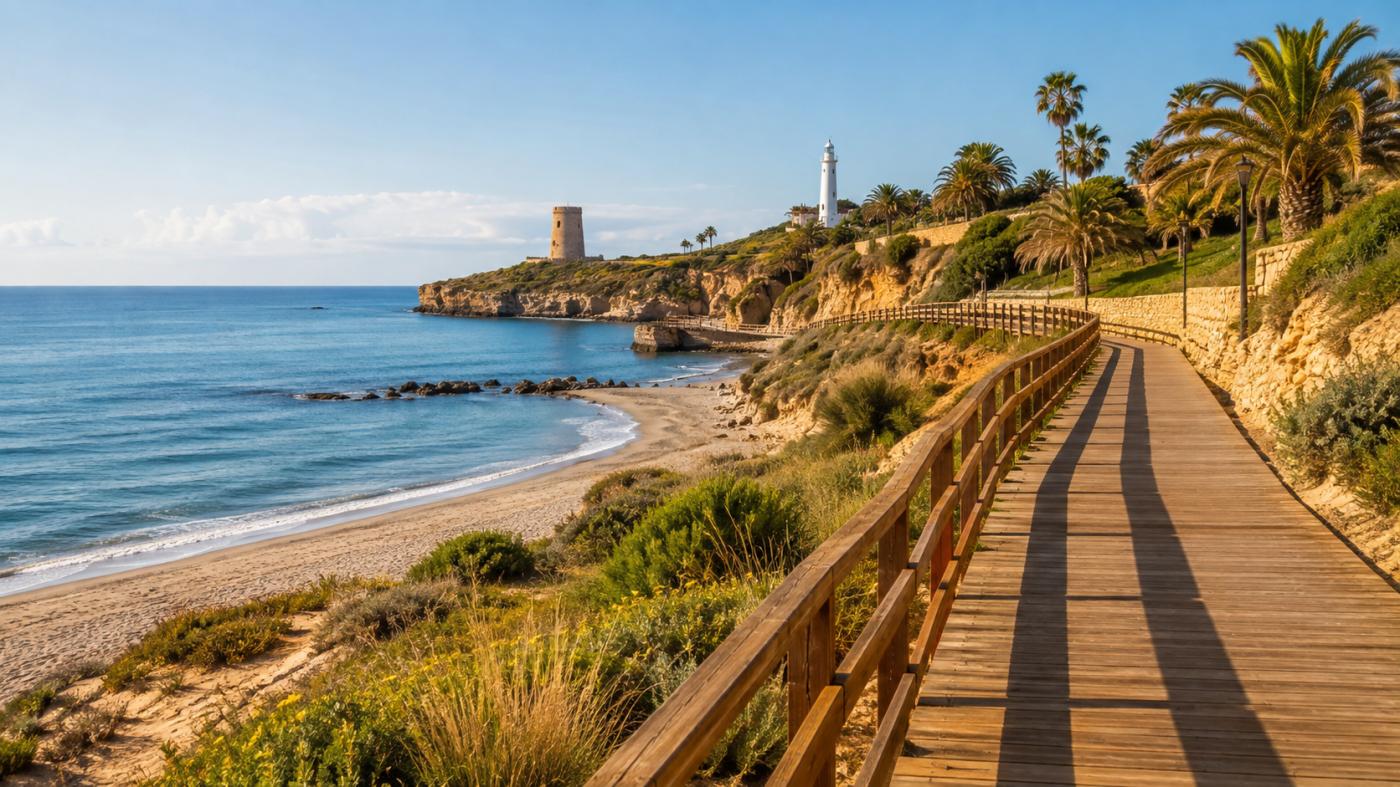

Exploring Málaga province beside the Mediterranean involves much more than moving from one seaside promenade to another. The Senda Litoral, or Coastal Path, has become an invitation to discover the historical, natural and maritime heritage of the Costa del Sol from a different perspective—whether on foot, by bicycle or by stopping at some of the coastline’s most remarkable locations.
The project is designed to connect approximately 180 kilometres of coastline between Nerja and Manilva, passing through all 14 coastal municipalities in Málaga province. Along the route, visitors encounter wooden walkways, urban beaches, cliffs, river mouths, watchtowers, archaeological remains and ports reflecting the diversity of the region’s landscape.
Here are 15 places worth stopping at along the way.
1. The Maro–Cerro Gordo cliffs
At the eastern end of the province lies one of the most spectacular landscapes on the route. The Maro–Cerro Gordo Natural Area extends for around 12 kilometres, with dramatic cliffs, hidden coves and viewpoints overlooking the Mediterranean.
Its natural richness continues beneath the surface. The seabed supports considerable biodiversity and attracts diving and snorkelling enthusiasts. The area has been designated a Specially Protected Area of Mediterranean Importance.
2. Nerja’s Balcony of Europe
In the heart of Nerja, the Balcony of Europe is one of the eastern Costa del Sol’s best-known viewpoints. From its promenade, visitors can admire the Mediterranean, the beaches on either side and the mountains surrounding the town.
Its central location also makes it easy to combine the coastal route with a visit to Nerja’s historic centre, where pedestrian streets, terraces and small squares preserve the traditional atmosphere of this Axarquía town.
3. Torrox Lighthouse and Roman archaeological site
The area surrounding Torrox Lighthouse brings coastal scenery and archaeology together in one location. Beside the lighthouse are the remains of a Roman villa, a fish-salting factory, pottery kilns, baths and a necropolis.
The settlement was active between the first and fourth centuries and has been identified with the ancient city of Caviclum. Its position beside the sea illustrates the importance of fishing, farming and maritime trade during the Roman period.
4. The Phoenician necropolis of Trayamar
In Algarrobo, the Trayamar necropolis is one of the most important surviving examples of Phoenician presence in the western Mediterranean.
Dating from the seventh century BC, the archaeological site is a reminder that this stretch of the Málaga coast formed part of commercial and cultural routes long before the arrival of the Romans. Its proximity to the shoreline makes it an ideal historical stop while exploring the Axarquía.
5. Caleta de Vélez fishing port
The Coastal Path also offers an insight into the province’s maritime identity. One of the clearest examples can be found in Caleta de Vélez, where fishing continues to shape the rhythm of everyday life.
The harbour, fish market, boats and seafood restaurants create a setting closely connected to the traditional character of the eastern Costa del Sol. It is also an excellent place to stop and enjoy local cuisine.
6. El Cantal tunnels and the cliffs of Rincón de la Victoria
Between La Cala del Moral and Rincón de la Victoria, the route passes through the former El Cantal railway tunnels, now incorporated into a seaside walking path.
The route combines cliffs, small coves and historic defensive towers. Nearby are also the Cueva del Tesoro and Cueva de la Victoria, two caves containing important geological and prehistoric remains.
7. Peñón del Cuervo
Before reaching central Málaga, the route arrives at Peñón del Cuervo, a beach easily recognised by the large rock formation rising from the sea just offshore.
The area retains a more natural character than many other parts of the city’s coastline and offers spaces for resting, walking or watching the sunrise. Nearby are the prehistoric sites of La Araña, where evidence of human occupation dating back to ancient times has been found.
8. Baños del Carmen
The historic Baños del Carmen bathing complex is one of Málaga’s most evocative coastal landmarks. Its promenade, gardens and views across the bay make it one of the city’s favourite places to watch the sunset.
From here, the route continues towards the city centre through the beaches of Pedregalejo and El Palo, two neighbourhoods that retain strong links with maritime traditions and Málaga’s famous grilled sardine skewers.
9. La Farola and the Port of Málaga
The approach to central Málaga is marked by La Farola, one of the few Spanish lighthouses traditionally referred to using a feminine name. From here, the route continues alongside the port, the Palmeral de las Sorpresas and Muelle Uno.
The Port of Málaga combines commercial activity, cruise traffic, leisure boats and a wide range of restaurants and entertainment venues. Its integration into the city allows visitors to walk beside the sea just a few minutes from the historic centre.
10. The Guadalhorce river mouth
At the western edge of Málaga city lies the Guadalhorce river mouth, one of the most important wetland areas on the province’s coastline.
A large pedestrian bridge crosses the river and connects Málaga’s promenade with the sections continuing towards Torremolinos. The area is also a notable location for birdwatching, particularly during migration periods.
11. Punta de Torremolinos
The Punta de Torremolinos separates the beaches of La Carihuela and El Bajondillo. This small headland forms part of a geological structure of travertine rock that has created caves and other formations of considerable scenic interest.
The route provides views of two contrasting environments: the fishing and culinary traditions of La Carihuela and the more urban atmosphere of El Bajondillo’s promenade.
12. Puerto Marina and the Los Molinillos archaeological site
Puerto Marina, in Benalmádena, is one of the most recognisable stops along the western coastline. Its distinctive architecture, boats and extensive leisure offering have made it one of the Costa del Sol’s leading marinas.
The nearby Los Molinillos archaeological site contains evidence of Roman activities connected with olive oil production, fish salting and the manufacture of ceramic containers.
13. Sohail Castle in Fuengirola
At the mouth of the Fuengirola River stands Sohail Castle, built on a hill around 38 metres above sea level.
Its strategic position attracted several civilisations from ancient times onwards. Today, the fortress is also an important cultural and musical venue, while the surrounding area connects Fuengirola’s promenade with green spaces and river walkways.
14. The walkways and watchtowers of Mijas
The Mijas section of the Coastal Path runs beside beaches, coves, rocky areas and ancient defensive towers. Its wooden walkways allow visitors to walk very close to the water and form one of the most popular parts of the route.
In La Cala de Mijas, the Watchtower Interpretation Centre explains the role these structures once played in protecting the coastline. The Mijas route has also received official Blue Trail recognition.
15. The Artola Dunes and Torre de los Ladrones
In Marbella, the Artola Dunes Natural Monument preserves one of the last remaining dune systems on Málaga’s western coastline.
Wooden walkways cross a landscape of sand and vegetation adapted to the marine environment before reaching Cabopino beach. Nearby stands the Torre de los Ladrones, an ancient defensive tower officially protected as a Site of Cultural Interest.
A route revealing another side of the province
The Coastal Path does not have to be completed from beginning to end. Its length allows visitors to divide it into shorter routes and adapt each outing according to the time available, physical ability or personal interests.
Some sections cross fully developed urban promenades, while others pass through dunes, river mouths, cliffs or wooden walkways. This variety makes the route a different way to experience the Costa del Sol and discover that beyond its beaches lies a heritage shaped by ancient civilisations, protected nature, defensive architecture and maritime traditions.
The route continues west through Marbella, Estepona, Casares and Manilva, where other notable landmarks include Puerto Banús, Torre de la Sal, La Duquesa marina and its castle. The official Costa del Sol guide features almost 200 places of tourist interest connected with this extensive coastal corridor.
Information sources: Diario SUR, the official Senda Litoral portal, Málaga Provincial Council and Turismo Costa del Sol’s Senda Azul guide.

Latest news





Upcoming events
12
Nov
El Desembarco, la traición de Viriato at La Caja Blanca
12
Nov
HOMER El Mero Mero at Sala Trinchera Málaga
13
Nov
Marbella Startup Lab – Innovate & Collaborate
13
Nov
Candlelight: Coldplay & Imagine Dragons at Sala Fundación Unicaja María Cristina
13
Nov
Candlelight: Tribute to Ludovico Einaudi at Anantara Villa Padierna
Similar News
Rural Houses in Málaga from €25 per Person: Where to Find the Widest Choice
Costa del Sol
Málaga Opens Its Heritage Sites with 28 Free Tours and Activities in October
Costa del Sol

What to do this weekend in Málaga and on the Costa del Sol: 12 plans from 25 to 27 September
Costa del Sol
