


A support network to navigate the path of ALS with dignity
The ALS diagnosis changed the life of Francisco and his family, who now find support in understanding and managing the disease through the psychosocial care team at San Juan de Dios in Aljarafe. The project offers psychological support, emotional companionship, and home care to people with advanced diseases and their families.
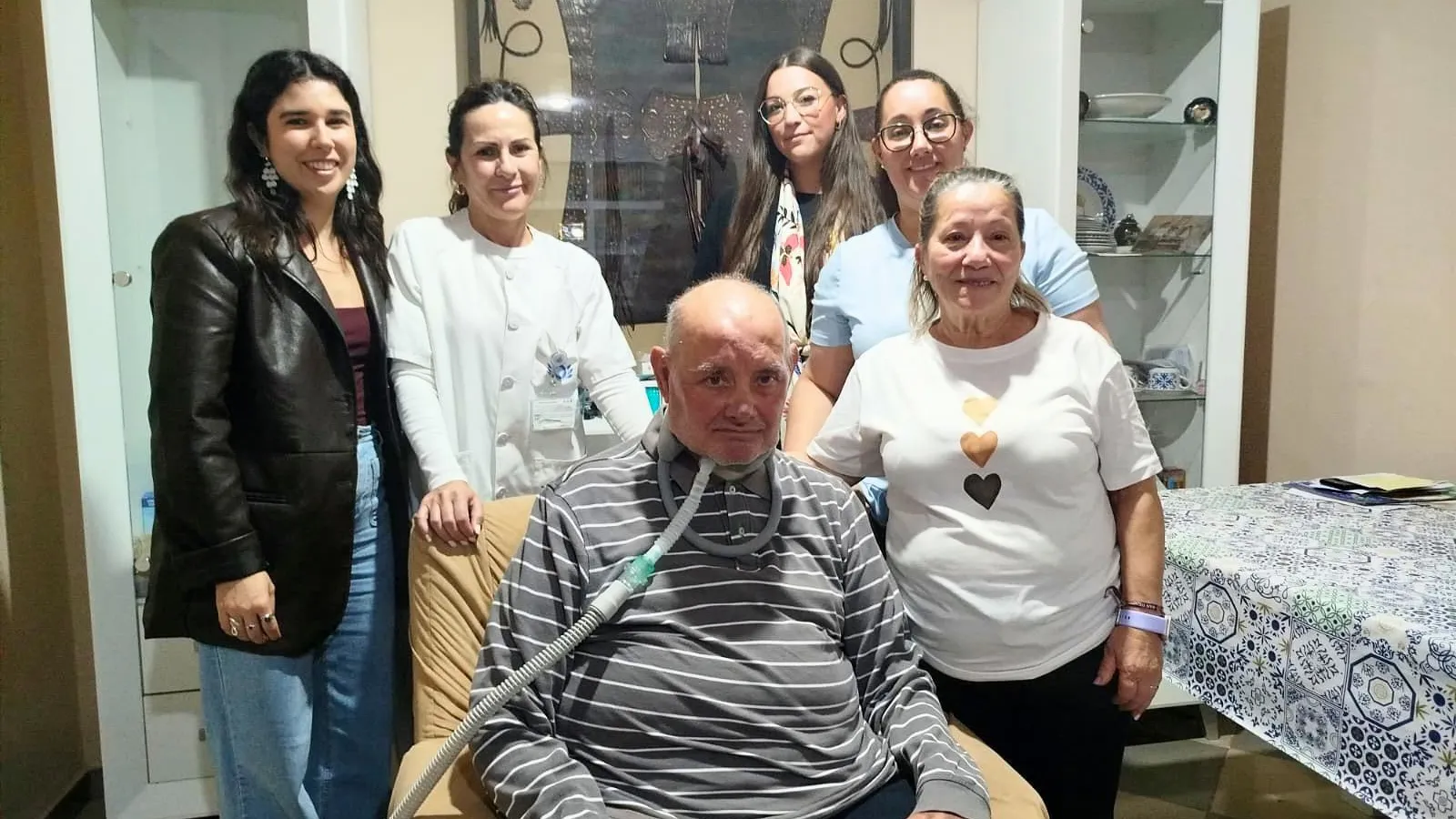

ALS caught Francisco by surprise one summer day in 2022, in his field, with a fall that resulted in a fracture of several vertebrae for this 70-year-old master bricklayer from Pilas, who was retired and devoted to his two great passions: his family and the countryside. At that time, no one thought that the cause of the accident could be amyotrophic lateral sclerosis, better known by its daunting acronym, a degenerative disease of the nervous system that causes progressive loss of muscle control and thus basic functions such as eating, speaking, or breathing. It was not until two years later that Francisco and his family found an answer to the cause of that fall, with the definitive diagnosis of ALS.
Since then, his life, his home, and his family have completely changed. Francisco can hardly speak or move, requires specialized medical care, continuous care, constant help, and a reorganization of the home that has required modifications to adapt to his new needs. The anguish over the disease, both for him and his family, adds to the worry and difficulty of his wife and three children to care for him twenty-four hours a day, seven days a week, giving up their own lives and neglecting other family, personal, or work obligations. And to all this is added the great unknown of ALS and the lack of support resources, which increases the feeling of loneliness and helplessness in the face of a taboo like ALS.
“The hardest part was coming to terms with the disease and understanding what comes next” — Gema - Daughter of Francisco, ALS patient.“The hardest part was coming to terms with the disease and understanding what comes next,” says Gema, the middle daughter. “When a disease like this arrives, you feel abandoned. You don't know about the pathology, the progression, the care your loved one needs, and no one prepares you: you find out little by little on your own.”
Amidst this storm, Francisco and his family have found unexpected help from a team of people who, for a year now, have been present in their lives to help them navigate the path of ALS with dignity. This is the psychosocial care team of Hospital San Juan de Dios del Aljarafe, which since 2025 offers psychological support, emotional support, and home care to people with advanced diseases and their families. It consists of a psychologist, Carmen Jiménez Cantalejo, a social worker, Ane García Mena, a nursing assistant, Susana Montaño Díaz, and four trained volunteers who provide support to hospitalized individuals and those in the final stages of life.
This project, driven by the hospital's Social Work and co-financed by the La Caixa Foundation, served 91 patientsThis project, driven by the Social Work of the hospital and co-financed by the La Caixa Foundation, served 91 patients and their respective families, totaling 410 people in 2025. Its goal is to respond not only to physical and biological needs but also to their psychological, emotional, and spiritual concerns, through a comprehensive approach to humanizing care. A support network that the hospital team activates thanks to its close coordination with the palliative care team of the Aljarafe District, and the collaboration of social services from the municipalities of the region and patient associations.
The program includes a series of interventions that encompass individualized psychological attention, designed to address the specific needs of each patient, and constant emotional support, allowing beneficiaries to express their feelings, manage stress, and face the various stages of the process they are going through with greater strength.
“The psychological work is essential,” says Carmen Jiménez Cantalejo, the team's psychologist, “because it turns suffering into something that can be understood, accompanied, and sustained, so that people do not feel lost and can validate and understand what they are experiencing, without having to face it alone.”
Her work with patients and families focuses on helping them understand what is happening to them and providing them with tools to express their emotions and manage their reactions, so they can continue to face the situation without burning out along the way. This is a help that families need and demand, after receiving a diagnosis that shatters their life and family organization.
“From the beginning, we sought psychological attention, mainly for my father,” says Gema, the middle daughter. “Now Carmen is the support of the house, not just for my father. She has managed to get him out of the depression he was in and, even aware of his limitations, he can have moments of peace and even enjoy them. She has helped us all to live in the present and understand that there can still be good moments, if we know how to see them, even if they are not like before. The good moment now is an afternoon with the whole family having snacks in the living room with him, with the grandchildren playing around.”
“Now we have learned that we are not superheroes"
Caring for the caregiver is one of the pillars of this project, so the psychological work is also directed at family members and caregivers. “At first, it was very chaotic: the fear, the disorganization, the tensions among us...”, continues Gema, “Now we have learned that we are not superheroes, that we can allow ourselves to feel bad and that it is important for each of us to express our emotions and respect those of others. Before, I couldn't go out to eat without feeling bad because my father couldn't; now I can do it, to continue living and not just surviving.”
However, the heaviest burden is carried by Consuelo, his mother, married to Francisco for 41 years. “My father's disease is also the disease of a marriage that does not break, but must learn a new way to live their relationship. There is no affection, no hug, he talks less and less. There is a wear and tear on the couple, it affects the family, but especially the person who is here all day.”
“He is not the same, I ask him where he is, that I can't see him,” says Consuelo, Francisco's wife. “I perceive his coldness and it hurts me a lot. I take his change of attitude and his bad responses badly. I understand, but it hurts.” The psychological help from Carmen helps her manage that frustration and take care of her emotional well-being. “I have managed to accept that my life has changed and enjoy the moments with him, even though it is not the same as before. He has always been very active and fun-loving, and we want him to continue experiencing things that can still make him happy.”
Grief preparation is a critical element of the psychological work, with death being the final stage of the ALS process. “We did not accept that our father was going to die and did not allow him to talk about sedation. Little by little, we have learned to put ourselves in his place and to accept that the decision has to be made by him, that he has to allow himself to be alive until he wants or can. We will accompany him respecting his decision.”
Involvement and training of family members and people in the environment
The family describes the arrival of the San Juan de Dios team as “a before and after”, not only in terms of psychological attention, but also in the organization at home and the care. The involvement and training of family members and people in the patient's environment is another key to the project, which also includes specific training in personal care techniques and symptom management. “Susana —the nursing assistant of the team— has saved my mid-days,” says Gema, “she takes care of feeding him three times a week, changing him, and putting him to bed. Additionally, she has taught us how to care for and change him properly, as it is not the same to change a baby's diaper or that of a 70-year-old man.”
In Francisco's case, thanks to the cohesion of his family, it has not been necessary to incorporate the volunteer staff into the team that attends him, who in other cases perform an essential role of accompaniment, active listening, and presence, both for the patients and their families, contributing to reducing the feeling of loneliness and creating a trustworthy environment in a particularly vulnerable moment. On the other hand, the work of the social worker provides guidance and information about available resources, coordinating the various entities and administrations involved in the process.
“I wish this project could reach more families in need, because resources are slow to come and in the meantime, the patient and family burn out,” concludes Gema, gratefully, as Francisco smiles and looks at her filled with pride. When asked if he feels well cared for, he smacks his lips, looks around, and nods, uttering in a low voice three meaningful words: “Thanks to them.”

Latest news





Upcoming events
12
Nov
El Desembarco, la traición de Viriato at La Caja Blanca
12
Nov
HOMER El Mero Mero at Sala Trinchera Málaga
13
Nov
Marbella Startup Lab – Innovate & Collaborate
13
Nov
Candlelight: Coldplay & Imagine Dragons at Sala Fundación Unicaja María Cristina
13
Nov
Candlelight: Tribute to Ludovico Einaudi at Anantara Villa Padierna
Similar News

Marbella Launches ‘Summer Youth’ Programme with 2,500 Free Places
Marbella

Premium Tourism Drives Marbella’s Hotel Profitability to Record Levels as Overnight Stays Exceed 291,000
Marbella

‘Machos Alfa’ seeks extras in Marbella for filming of its sixth and final season
Marbella
