


Jiménez: the auditor of the bank that suffered the biggest heist in Marbella
The theft of the safety deposit boxes affected millionaires and jet set figures. Juan Antonio Roca, the urban planning advisor for Gil, gave him his Law notes and exams so that he could pass the degree.
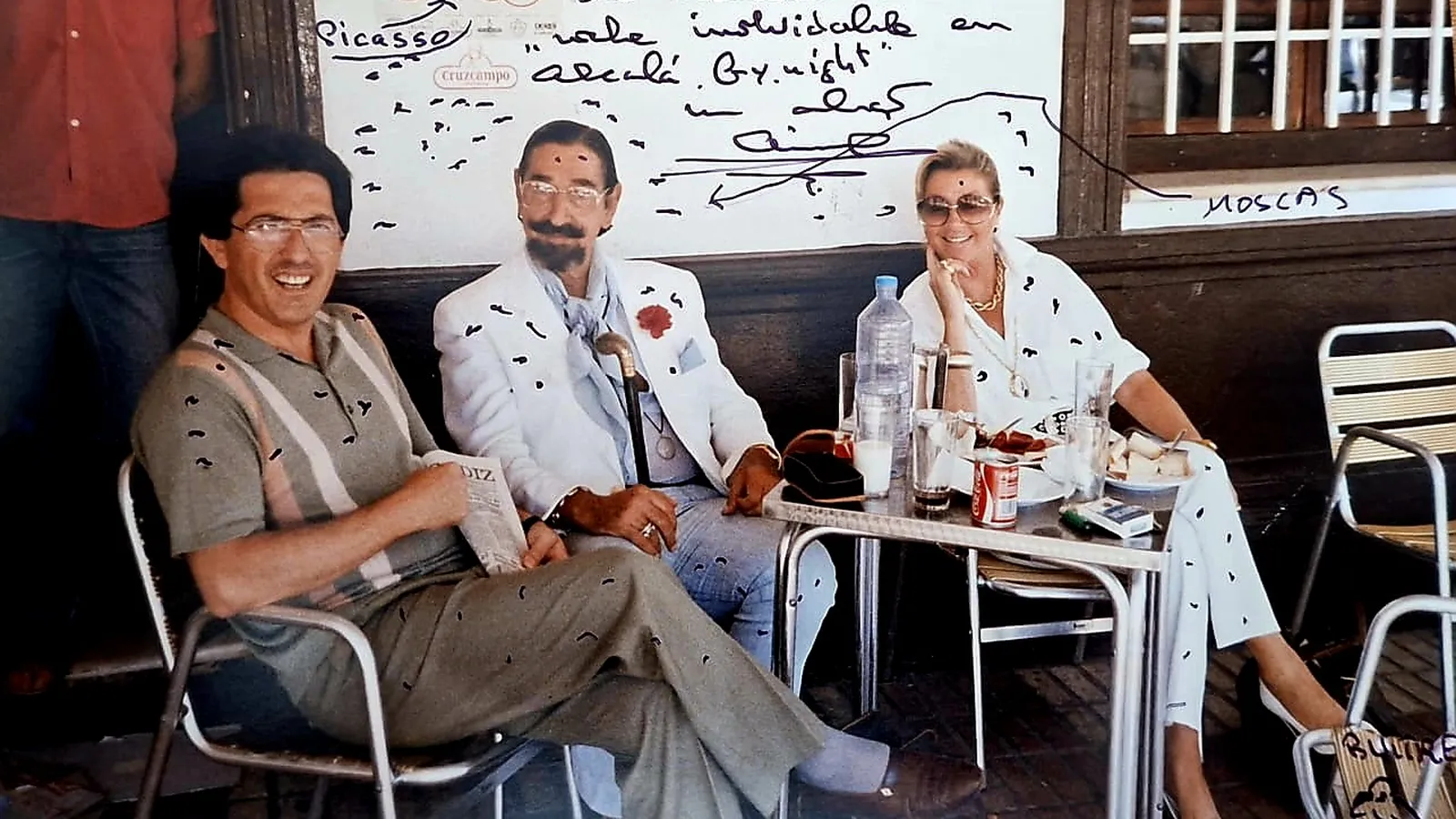

When I arrived in Marbella, I had been with Banco de Andalucía for four years and had worked in five different branches. Here was the crème de la crème of international society. For someone from a small town in the province of Cádiz, it was a heady time. The parties that took place had a less self-serving atmosphere than those of today. People were more honest, sincere and genuine. After six months, my wife said to me: ‘We’re not moving from Marbella’. Curro Jiménez, a lawyer and former bank auditor, recalls this.
If the bank ran out of money, he would ring the offices of other banks in Marbella. He would take my bank’s payment authorisation letter and bring me three million pesetas in a bag from El Corte Inglés. There was no security van. The money was transported by a taxi driver. He would cash the cheque at the Bank of Spain and distribute the money from Málaga to Estepona. Nothing ever happened, not once. One day there was a transaction for 120 million pesetas that we had to pay in cash. The taxi driver brought the money. The client cashed the cheque at our bank and we opened the safe deposit box so he could put the money in there.
The bank robbery was the saddest thing I’ve ever experienced. It happened at Christmas 1982, when they broke into the safety deposit boxes. Back then, bank alarms went off very frequently; people paid no attention to them. I lived opposite the bank; whenever that happened, I’d go over, turn it off and turn it back on. But that Christmas, the alarm went off at midnight, when everyone was having dinner. The people who heard it paid no attention. The thieves smashed the alarm control panel so they could work undisturbed. With Marisa Molina, Elena Serrano and Robin Rowles. / Personal archive On the first working day after the long weekend, when the two authorised representatives arrived, we saw that the safe hadn’t been touched. I immediately thought of the rental safes. We found a black plastic sheet covering the area from ceiling to floor; we lifted it and, on two small steps, were the tools they’d used to make the hole: pressure gauges, gas cylinders and torches. The sheet prevented the flashes they were causing from being seen from outside. On the first floor of the building were the management office and a reception area. The rest was an open-plan space, which did not belong to the bank, accessed via the building’s front door and featuring a metal-panelled door. It looked like an easy way in; they made a tiny hole in the wall, slipped in a small camera, saw what was there and realised they could get in that way.
I felt a pain in my chest. Dr Cristóbal Medina Galán, who lived opposite the bank, said to me: “Don’t worry, what goes in must come out; in six months you’ll be back to normal.” On the floor were cardboard jewellery boxes, piles of documents, and papers strewn everywhere. They weren’t interested in the documents, letters, cheque books or cheques that had been filled in and signed; nor did they take the credit cards. We found photographs of a naked woman, who was being blackmailed, or complete files on the P2 Masonic lodge; two days later, someone came to collect these. We sorted through all the paperwork.
The police were taking notes; in the afternoons they would meet with us and interview us. One afternoon, the head of the investigation, who had an exceptional team, asked each of us who the culprit might be, in order to identify a client with whom we had a close relationship. One executive then recalled Silvana Zito, the daughter of the horse painter Rodolfo Zito, who had recently held an exhibition at the Puente Romano hotel. The woman came to the bank to rent a safe deposit box, and as she owned a jewellery shop, she was concerned about keeping her valuables safe. The manager who attended to her told her that we had an exceptional security system, and from that meeting she gathered the information she needed. Safe deposit boxes following the robbery at the Banco de Andalucía. The investigation established that the gas cylinder had a pressure gauge sold only in Granada and the huge opaque black curtain was available only at El Corte Inglés. They confirmed that both purchases had been made by some young, handsome men with Italian accents. Silvana’s brothers belonged to an Italian far-right group, which had been involved in a high-profile attack, alongside a Belgian and a Frenchman. When the police had tracked them down, they crossed the border and escaped. The Spanish police travelled to Rome, where Silvana had her boutique on Via del Corso [a major street in the historic centre]. They managed to find out the day the gang was due to meet to divide up the loot. When they were all there, the Spanish and Italian police raided the premises.
They caught them red-handed. Many items that had been in the rental boxes were missing: drugs, money or diamonds. They had removed the diamonds from all the jewellery. Silvana’s boyfriend, the gang leader, had taken them. Everything found was seized. The Spanish police were prudent enough to photograph and film what they had seized and then show it to us. A year and a half later, the jewellery arrived from Italy at the court in Marbella. Not even half of the jewellery that had been held in custody by the Italian police was there.
I felt very sorry for a client of mine, a very important figure in Morocco, connected to the government there, and a close friend of mine. He took a five-page list to the police, detailing the diamonds he kept in the bank, their provenance, carat weight and identification.
‘How much do you value them at?’ they asked him.
‘This has no value.’
‘For statistical purposes,’ insisted the policeman.
‘It has no value, not even for mere statistical purposes.’
His wife had a ring with an oval diamond. The jewellers Gómez y Molina advised her not to show the diamond in public, to hide it between her fingers, reminding her: ‘With this diamond alone, you can buy the finest house in Nueva Andalucía.’ None of the items on the list turned up. With colleagues from Antonio de Fortuny’s law firm. / Personal archiveJaime de Mora had a collection of 16 watches; one was a diamond, the size of a watch, split in half with the mechanism embedded within, which had been given to him by the King of Saudi Arabia. I’ve never seen anything like it in my life. When Jaime needed money, he would sell a watch to Don Eduardo, the bank’s lawyer, who kept them in his safe deposit box. When they were robbed, they took both their watches. Jaime also lost a small painting by Michelangelo. Among the clients were Alfonso de Hohenlohe, the Count of Perlac, the French actor Gérard Barrayand his wife, the flamenco dancer Teresa Lorca.
The bank returned what had been recovered; everything was handed over. Over time I heard that there were even pistols in the safe deposit boxes. People would come with a bag; I didn’t know what they were bringing. They’d leave it and I’d lock it away. The Italians were sentenced in Italy to a year in prison, which they didn’t serve. They got off scot-free.
As the bank manager, I used to open the bank at eight in the morning. One day, the mayor, Alfonso Cañas, was waiting for me. It was the most surprising thing.
–Come in and I’ll sit with you, he said.
He sat down and placed a square parcel, wrapped in newspaper, on the table.
–Yesterday, someone very important from Spain came to see me; he wanted the master plan to give special consideration to an urban development project in Sierra Blanca. When they left, they left this package behind; I mentioned it to them and they told me it was for me, that it was a radio. I’ve brought it here so we can have a look at that radio. Open it, I haven’t done so. At a swearing-in ceremony for lawyers in Marbella. / Personal archive We opened it; instead of a radio, there were ten million pesetas.
–Alfonso, what shall we do with the money?
–What do you think?
–Let’s send it to one of the delegation who visited you and who we know well. I wrote a bank cheque for ten million pesetas, made out to Alfonso de Hohenlohe, who had introduced the mayor to the two high-ranking figures who had visited him. Two or three days later, the recipient deposited the cheque into his account and cashed it. I think the money was provided by one of those who had come with him. I don’t know what he did with the money; perhaps he returned it to those who had given it to him.
Alfonso Cañas died, not in poverty, but almost. I remember him saying to me: “See if you know anyone at a newspaper where I could write an article to supplement my meagre pension.” There were honest people. We’ve had many examples of honesty, such as the mayor José Luis Rodríguez. People said he was the best mayor Estepona had ever had, because he wouldn’t allow buildings of a certain height to be built [and investment consequently went to the neighbouring town]. In the end, he left with nothing but the clothes on his back.
My lifelong dream was to work in a bank and be a lawyer. I was a chartered accountant and, as such, I passed the competitive exams for the bank. In Algeciras, I enrolled at the Open University (UNED); the bank sent me to Marbella, but there was no UNED here. When the UNED was established here, I studied Law, completing the courses in five years without any problems. I’m a lawyer by utopia.
One day I received a phone call:
–I’m Juan Antonio Roca Nicolás, I’m studying Law, and I’ve been told you’re the one with the most notes and exam papers. Would you mind if I told you the subjects I’m sitting and you gave me the information you have?
At the time, he was working on a housing development. For three years, without ever meeting him, I’d leave the notes with the caretaker at Marbella House, where Roca lived. Whenever he passed an exam – and he passed them all – he’d ring me and tell me how it had gone. I even gave him my Labour Law assignment. We went all that time without ever seeing each other. When he’d been at the Town Hall for a year, I rang him and said:
–I’m going to be passing by the Town Planning office; I’d like to say hello, meet you, meet you, for goodness’ sake!
–You come here and tell the receptionist you won’t be waiting.
There were some very important people sitting there, waiting. He came out and made a scene. He told the receptionist: “This man, when he comes here, doesn’t wait, and here’s the fridge.”
A month before he was arrested, I was in his office; I saw some impressive bronze deer figurines that had been given to him as a gift. He had the eleven mobile phones he used there. Jesús Gil rang one of them. Lunch with colleagues from Banco de Andalucía. / Personal archive – “Look, Juan Antonio, they’re going to arrest you soon, you know that. You’ve got the money to pay for the best lawyer in the world. But if you want a lawyer who’ll look after you, you’re going to have to call me.” What happened, happened, and two weeks ago I saw him on the seafront promenade. He gave me a huge hug and his wife said: ‘I didn’t know you were so close to this man.’ I hadn’t seen him since that visit.
For 17 years I’ve taught on the Master’s in Law programme and I used to tell my students two things: you have to charge, and charge a lot. The best lawyer isn’t the one who gets you out of prison, but the one who charges the most. King Juan Carlos’s daughter’s lawyer lost, but it cost them a fortune. The same happened with Iñaki Urdangarin and Mario Conde; they didn’t win their cases, but it cost them a fortune.
You’ve been very clever, I said to Roca. Because he asked for a court-appointed lawyer, who’s just as good as the one you pay the most for. He was able to direct the court-appointed lawyer, because he didn’t finish his degree, but he’s practically finished it. That he’d be convicted, he’d anticipated. What he didn’t anticipate was that he’d spend so long [twelve years] in prison. He told me he’s served his sentence in nine or eleven prisons.

Latest news





Upcoming events
12
Nov
El Desembarco, la traición de Viriato at La Caja Blanca
12
Nov
HOMER El Mero Mero at Sala Trinchera Málaga
13
Nov
Marbella Startup Lab – Innovate & Collaborate
13
Nov
Candlelight: Coldplay & Imagine Dragons at Sala Fundación Unicaja María Cristina
13
Nov
Candlelight: Tribute to Ludovico Einaudi at Anantara Villa Padierna
Similar News

Marbella Launches ‘Summer Youth’ Programme with 2,500 Free Places
Marbella

Premium Tourism Drives Marbella’s Hotel Profitability to Record Levels as Overnight Stays Exceed 291,000
Marbella

‘Machos Alfa’ seeks extras in Marbella for filming of its sixth and final season
Marbella
