


Hundreds of pilgrims 'crown' Mount Calvary on Good Friday in Málaga:
In the renowned Stations of the Cross, lemon stands are interspersed.
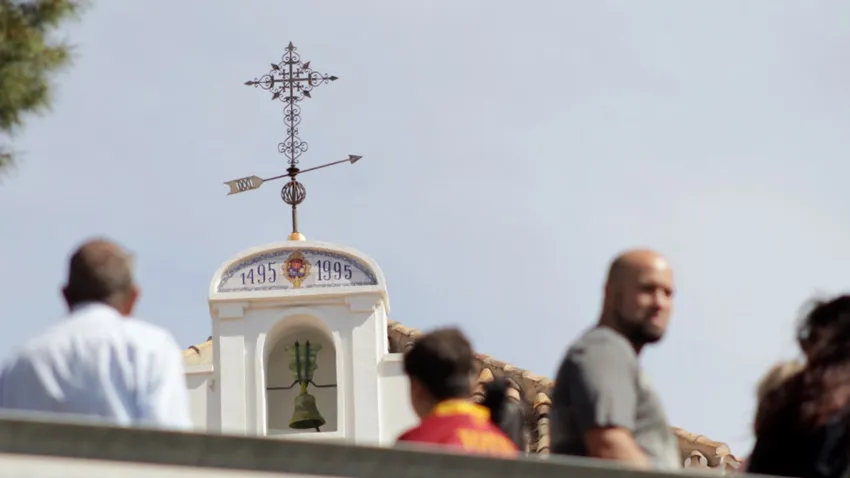

From the Hermitage of San Lázaro to the Chapel of Calvary, hundreds of pilgrims have taken advantage of the early hours of Good Friday in Málaga to carry out their traditional Stations of the Cross and reach the summit of Mount Calvary. Step by step, people of various ages have embarked on an uphill route of about four kilometers (round trip) to visit the Holy Christ Yacente of Peace and Unity. This image was later moved to be part of a procession, inviting everyone to relive, at each of the 14 crosses, the Passion of Jesus in a Holy Week atmosphere with stalls selling "cascaruos" lemons and sugar canes.
Ermita del Calvario / Ana JiménezEven uphill, many families with pets; young people; older adults and people with disabilities have been encouraged to make the journey. Such is the case of Laura Fernández, a pilgrim, who returned after visiting the temple with a tradition that started "from a very young age": "I came with my family and now with my friends. We stopped at each cross and reflected on the Gospel. It was more emotional than physical and, well, in the end, the path is quite short, and the nature is relaxing," she highlights to this newspaper.
Laura Fernández y Raquel Ramírez, pilgrims on Mount Calvary / Ana JiménezAlongside her and her dog Bruna, who has been a pilgrim for at least 15 years, was her friend Raquel Ramírez who, on the other hand, acknowledged that it was "my first year" participating in the experience where it is customary to leave a stone at the foot of each cross as a symbol or request. "I also placed it to leave a record and that small reflection. I had wanted to do it for a long time, walking and seeing everything full of nature, the trees, the breeze," she recounts.
A family tradition, lemons, and "passion"
"It's a tradition that came from my husband's family. This year there are eight of us, and we leave stones at each cross. For me, it means to ask for something and, once the journey is over, to kiss the saint's feet and spend a little time there, hoping that what I asked for can be fulfilled or achieved," explains Virginia Granados, who was heading to the Ermita del Calvario after knowing the path for 30 years.
Candles inside the Calvario / Ana JiménezMeanwhile, Alberto, maintaining the same essence and upon leaving the temple, shares how he ascended with a group of children and found the path "bearable, where the little lemon also has its charm," but what he emphasizes most is "reaching the top": "I made a promise to Christ. Also, leaving the little stones is like living the moments of Jesus in his penance," he narrates.
Alberto, pilgrim on Mount Calvary with children from his family / Ana JiménezOn the other hand, a young woman named Virginia who was descending the final steps claims to have climbed the mountain for 16 years and continues to do so "in memory" of her grandmother. "She was the one who started it and it has continued for many years. Leaving the stones is like making that journey with her. Now it's just my mother and me, but we like it. It always feels very familial, with many older people, and the sun and nature greatly encourage making the journey," she shares, holding carnations in her hands, dedicated to her mother for "when she cannot climb" and to her grandmother, who receives them at her grave as they were "her favorite flowers."
Virginia, pilgrim of Mount Calvary / Ana JiménezWith this, and as part of the ascent that starts just meters from the Sanctuary of the Virgin of Victory, there is also the custom of eating "cascaruos lemons and sugar canes" at the stalls distributed among the fourteen crosses, young Virginia recognizes that they also "take them before returning home," as part of the tradition. Just like Granados, who also admits to "buying them at the top," when they have followed the different stations of the Stations of the Cross.
Meanwhile, Encarni, 68 years old, who was in line to see the image of the Yacente, along with her husband, also reveals that for her it is part of the ritual: "What we like is to see the image, go up, the people, and then eat a lemon. I climb every year, even in the rain. Now it's a bit hard, but it's fine," she distinguishes.
Marco González, at his stand of "cascaruos" lemons / Ana Jiménez"I've been here about five or six years, this is very beautiful. It's the tradition of Calvary, more and more people are coming and many lemons are being sold. I bring them from my farm in Cártama, planted with good fertilizers and well watered, because cascaruos require quite a bit of water. These have a whiter and thicker skin so that the acidity is reduced when you eat them," clarifies Marco González, owner of a lemon stand, who prepares and sells them next to the Chapel at the summit.

Latest news





Upcoming events
12
Nov
El Desembarco, la traición de Viriato at La Caja Blanca
12
Nov
HOMER El Mero Mero at Sala Trinchera Málaga
13
Nov
Marbella Startup Lab – Innovate & Collaborate
13
Nov
Candlelight: Coldplay & Imagine Dragons at Sala Fundación Unicaja María Cristina
13
Nov
Candlelight: Tribute to Ludovico Einaudi at Anantara Villa Padierna
Similar News
Classrooms move to the sea: hundreds of schoolchildren take to the port of Caleta de Vélez by catamaran
Vélez-Málaga

Raule, a tribute to Manuel Carrasco and Óliver Gil, headline the San Juan Night in Torre del Mar.
Vélez-Málaga

Vélez-Málaga organizes a free female self-defense workshop against gender violence
Vélez-Málaga
