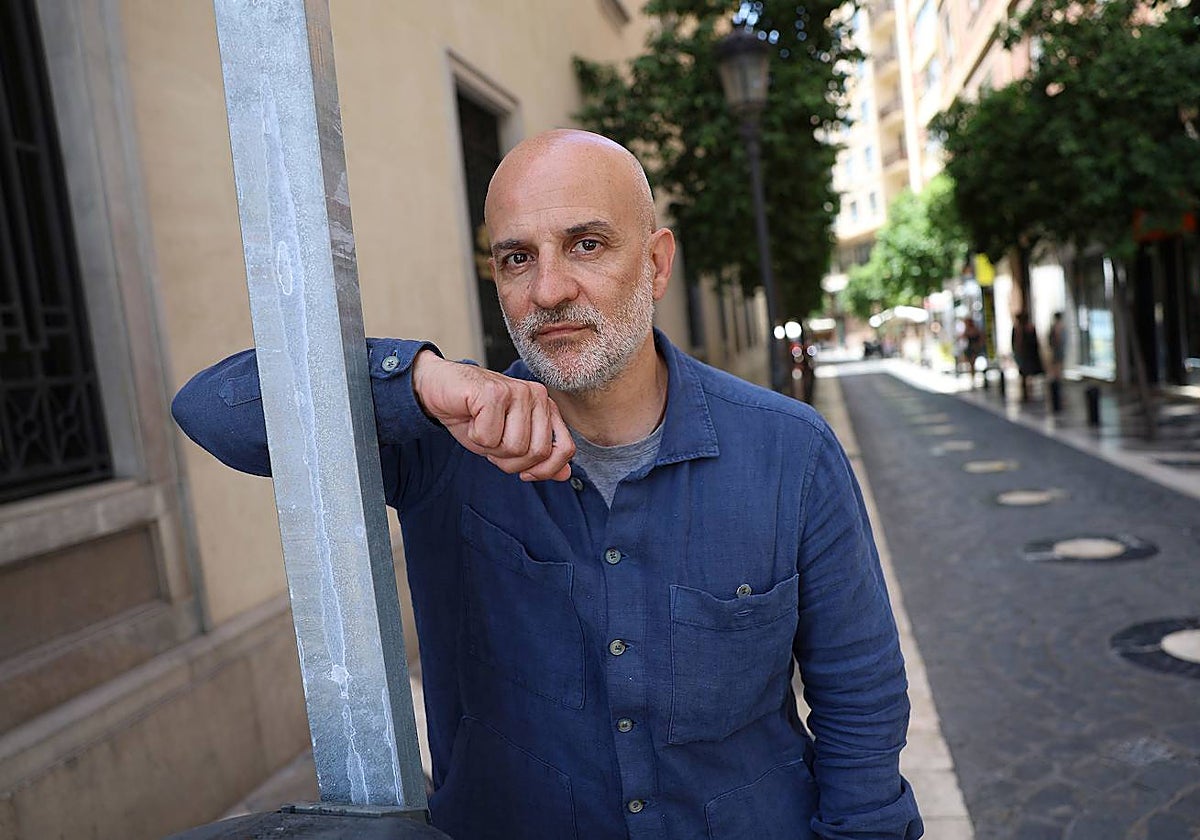
El Kanka, 'calm' in his best moment: "I find it hard to assimilate so much affection"
The singer-songwriter from Malaga makes a plea for serenity in his new album, a work with which he aims to fill the Teatro Cervantes for six nights.


El Kanka champions serenity in the emblematic song of his new work, but admits that it has been hard to find it for several days. He is in the midst of promoting the album, about to catch a plane to Colombia, and with the tour preparations already underway. A tour that has already sold out some dates and with which he aspires to set a record: six nights (from June 8 to 14) at the Teatro Cervantes. It's hard to stay calm. And yet, El Kanka manages to convey 'La calma'—the title of his sixth album—in a relaxed conversation, not watching the clock, with the same honesty and closeness as when only ten people listened to him in a tea house in Málaga.
–Do we underestimate the importance of serenity?
–Yes, I think it's not talked about enough. Antonio Gala championed serenity over happiness and joy. And it seemed very smart to me because what's more beautiful than being at peace with oneself. Not everyone can say that. I don't know if many people will achieve complete peace in their lives, but it is certainly a good goal.
–But this modern life doesn't leave us space for calm. Even interviews, for example, are now done without time.
–Well, and now I notice a lot of difference with the early years. In the end, you become more selective. One of my clear intentions is to get along with my work, that the interviews are cool, that they take their time and that we have a moment to eat between the morning interview and the afternoon one (laughs). My record was in Mexico City where I did 16 interviews in one day. My voice hurt. Not the throat. The voice!
–You appeal to calm in a tense world. How do you keep yourself apart from that? You are very present on social networks, the center of tension.
–I don't consider myself completely apart, far from it. I also belong to the tribe of the tense, but as much as possible, with my tools, I try to have a minimum balance. For my profession, for the creative part, it's interesting not to live all the time in that tension, I need to have a minimum of serenity to be able to sit down and write things. And therefore, even though I am present on networks, I don't look at them. I haven't had Instagram on my mobile for a year, for example.
"I try not to let ego take over me, but I know I don't fully succeed. How could I?"
–Anyway, you also don't have many 'haters'. You are one of the few lucky ones who aren't bashed on social networks.
–That's true, I get very little 'hate'. I think I'm generally liked, and I think that's also a very Malaga thing. People from Malaga are liked. But besides that, even though I'm super known within the 'underground', I'm not very media-focused, I don't appear much on TV. If someone doesn't want to listen to me, they don't have to listen to me by force. That doesn't happen with Bad Bunny. I've never in my life hit 'play' on one of his songs, but I know perfectly well who he is, I can't not know. So, Bad Bunny can be a kick in the balls to me and I have to put up with it. But if I'm a kick in the balls to someone, if they don't look for me, they don't listen to me. That's important.
–Do you still feel 'underground'?
–Yes. For me, Robe was 'underground' even though he sold 30,000 tickets. He wasn't played on the radio and his project in conception was artisanal. He was a guy from a vast minority. That's a bit what happens to me. Most people in this country don't know me. I go to the fishmonger in my neighborhood to buy salmon and no one knows me. But those who know me are super fans.
–At one of your last presentations, always crowded, a family dressed entirely as pandas (the symbol of the new work) and a girl with the titles of your albums tattooed attended. Do you ever get used to so much affection and praise?
–Not me, certainly. To this day, I still find it hard to assimilate. Also because I think there's a part of me that doesn't want to believe that. I've always been very afraid of being one of those artists who become assholes. I try to look the other way, think that I'm a normal person who makes my little songs, but it's true that often the impact of those little songs... Wow!
"Many artists of 50 years old compose as if they were 20, and I wouldn't want to be one of those"
–Are you worried that it might end?
–Yes. There's a very specific thing that happens to me, which is an inheritance from my father, that I have a terrible fear of being poor. And look, I've never been poor, my parents both worked and they've always been there to help me. But when I moved to Madrid I didn't want to be asking them for money. And I can assure you that my life was quite miserable economically. I lived in a completely lamentable house where the fridge didn't fit in the kitchen, it was in the living room. I've never wanted to be a millionaire, but a bit of economic dignity is fundamental. And I know that the vast majority of people, as things stand, don't have it. My father was tremendously poor in his childhood and he instilled that fear in me. To this day, I still think 'what if the next album doesn't work and people stop coming to see me?'
–It would also be a blow to the ego...
–Of course. I try not to let the ego take over the scene, but I'm convinced that I don't fully succeed. How could I? It's true that it's not the same when a project grows extremely fast, like the kids from 'OT' or Estopa, who went from zero to a hundred. That's harder to assimilate than what happens to me. I've gotten used to all the phases, I haven't skipped any steps. But in the end, there are a lot of people telling me I'm awesome and something surely permeates me. I try not to pay much attention and I work very hard on that humility. But I'm sure that if suddenly the next album doesn't like anything, it's not only going to be an economic blow.
–Do you still have insecurities?
–Yes, of course. I don't think any human being ever gets rid of feeling insecure. I've been making songs for many years. Right now, I have a number of resources that experience gives me, having made mistakes, having thrown many songs away, having believed that a song was going to work and it didn't... And all that gives security. But I still go to bed thinking that the song I made is going to the drawer."Most people in this country don't know me, but those who do are super fans"
–This is an album where you sing about domestic love and there's a touch of nostalgia in 'Los compadres'. You're getting older.
–Of course! And that has its bad things, the body is no longer the same and each time one is closer to meeting Chanquete. And, as you know, I'm terrified of death. But getting older has very beautiful things. I like to take advantage of some of this. Most songs are very similar and talk about love in the same way. And I've never liked that, I like to make a song that says things in a way that hasn't been said before. Like "if I have time I'll buy tomatoes" or "where have you put my slippers", I think few songs talk about a romantic situation in that way. And in 'Los compadres' I talk about friendship, but also about the passage of time and I couldn't do that at 20. There are artists who are 50 years old and compose as if they were 20. I wouldn't want to be one of those. Because I'm not 20, I'm 43. And that's beautiful, I want to have another perspective, I want to have matured, to have learned things and for that to show in the songs. I hope to compose songs at 70 and 80 years old and be able to talk about old age.–At 20 you also couldn't have talked about anxiety, as you do on this album.
–I hadn't suffered it, and now I have.
–Do you suffer it often?
–Yes. I've never had an anxiety attack or panic attack. Yes, I have had generalized anxiety disorders. It comes in phases. I've been in therapy for many years and I don't manage it now the same as when it first hit me, when I thought I was going to die. I'm calm by nature, but I'm an apprehensive person and a textbook neurotic, as I say in one of my songs (laughs).
–And you choose music, a very relaxed profession, with no exposure at all...
–I didn't think that through very well (laughs). Music is wonderful. What is music. I didn't start in this profession thinking that I had to get on stage to sing for 10,000 guys. I don't think that even now. I started because when I picked up the guitar and started making songs, it seemed like such a beautiful thing that I wanted to share it with people. When I'm at Sonorama and I know there are 40,000 people there, I can assure you that I'm not looking forward to going out. Then on stage I enjoy it, but my recurring phrase is 'what a strange profession'. No one is prepared for this.
–And we're seeing it with the number of dropouts there are in music. There may always have been, but now mental health is talked about more openly.
–Yes, it's several things. I think the world has changed a lot. Now we're all more stressed. As for music, 30 years ago not everyone carried a photo camera in their pocket. Now yes, and everyone wants to take a picture. And we have to be posting on networks all the time. I guess that influences cortisol levels. And, on the other hand, I'm glad it's not like 20 years ago, when the person who went to the psychologist seemed like a crazy person.
"I only have one aspiration: to be able to continue doing this comfortably"
–The song 'I said no', did you write it to remind yourself of that motto?
–But that and most of my songs. Most are things that I try to remind myself. I'm learning like anyone else to say no and set boundaries, and I claim it. But it's not something I've found, it's something I'm still looking for.
–And what about death? We all fear it, but yours is already pathological.
–It's that I've experienced it in a somewhat traumatic way and being young. Especially with my mother. She was 49 years old when she died of breast cancer and I was 19. She didn't smoke, didn't drink, took care of herself... It was very hard for my sister and me. Both of us are very aware that at any moment it's going to be our turn to hand in the spoon. That left me with some sequelae...–And yet, in 'It only happens to the rest' you add a note of humor to the drama.
–I'm very happy. The fact that I've been able to play with humor with something that gives me so much fear is a good sign.
–You've achieved a lot, and even more than you set out to. What do you aspire to now?
–It's been many years now that I only have one aspiration: to be able to continue doing this comfortably. I don't want much more, really.

Latest news





Upcoming events
12
Nov
El Desembarco, la traición de Viriato at La Caja Blanca
12
Nov
HOMER El Mero Mero at Sala Trinchera Málaga
13
Nov
Marbella Startup Lab – Innovate & Collaborate
13
Nov
Candlelight: Coldplay & Imagine Dragons at Sala Fundación Unicaja María Cristina
13
Nov
Candlelight: Tribute to Ludovico Einaudi at Anantara Villa Padierna