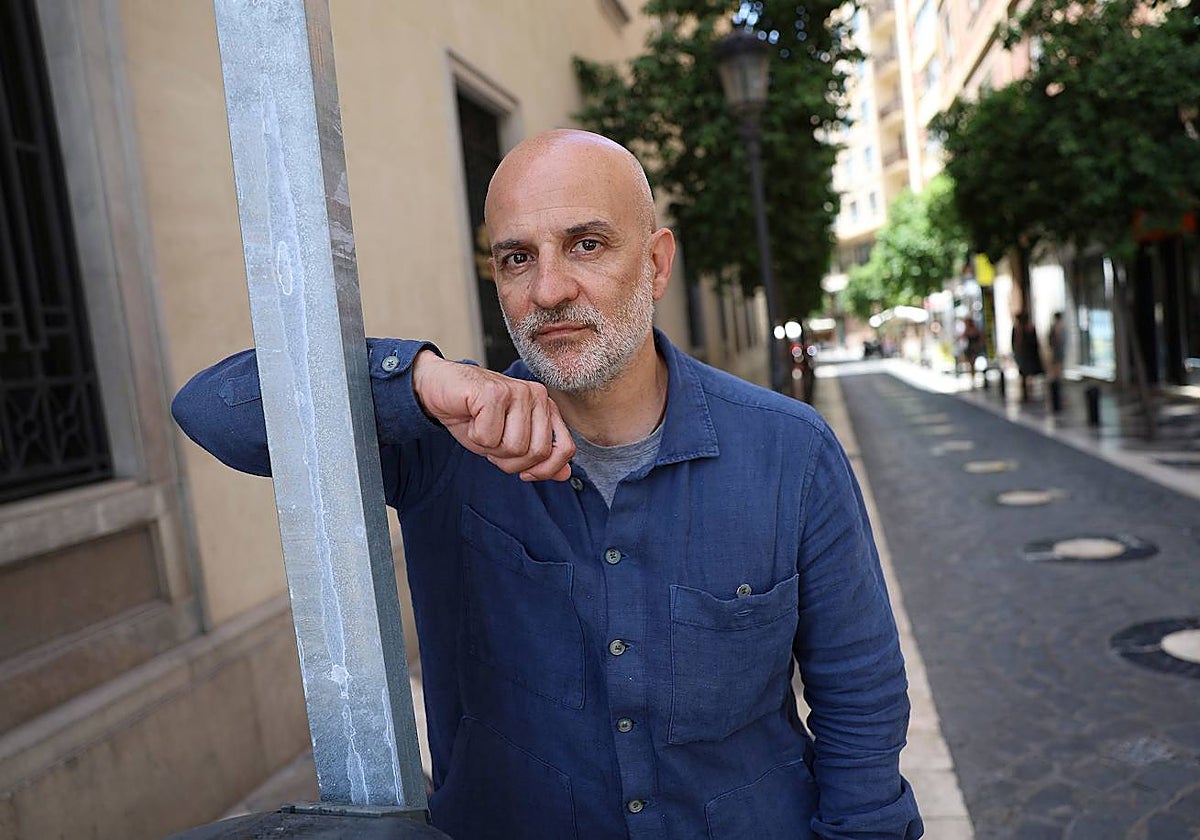
Pedro Bravo: "Picasso could not live now in the square where he was born in Málaga"

Málaga
14/06/2026 at 00:15h.The interview is at the Málaga Palacio. I have prepared questions, but walking to the hotel is the best preparation for what we are going to discuss: ... tourists that have to be dodged at every step, apartment buildings for foreigners that were once residences, and terraces everywhere reducing public space. This phenomenon is analyzed by essayist and researcher Pedro Bravo in 'Before All This Was City', reflecting on how the success of cities has become a failure for their inhabitants. In Málaga, a triumphant city of museums since the opening of the Picasso gallery over two decades ago, there lies the paradox that the very Malagan artist himself could not afford to live today due to the housing prices driven up largely by tourists who come precisely to seek the roots of the most revolutionary painter of the 20th century.
—Do you prefer city or countryside?
—Ha, ha, both actually. I love urban life. I have greatly enjoyed its virtues and suffered its defects. But lately, I like the mountains. I live split between one place and another, a winning combination.
—You could have titled this book 'The city is not for me', like the Martínez Soria film.
— Without a doubt, because it feels like cities are no longer thought of, managed, and planned for the people who live in them, but for visitors and investors. And, moreover, this is acknowledged without any shame. It's not bad to have tourists and investors, but when the city serves only them, the community loses its meaning.
—Is the city model in crisis?
—We are in a time of many crises. In the urban model, we have seen how places we felt belonged to us have become environments that expel us. Whether it's due to the housing problem or because you can no longer shop at local businesses. These are the physical symptoms, but there are also emotional ones, like a certain sense of feeling strange in your own home which is your city. Ultimately, it's a crisis of the economic model because profitability is a success of the city, but it's a huge problem that generates anger and frustration in the citizens, leading to polarization, housing crisis, loneliness, aging population...
—Have we citizens lost the battle?
—I hope not. There is an objective loss of quality of life. If you have to live far from your workplace, you are losing a lot of time in traffic jams or transport, and missing out on things you liked, such as leisure or doing nothing, which is also fantastic. But things can be changed, because the current evolution is proving to be a failure. Cities that boast of success... that success implies the failure of the community.
«Cities that boast of success... that success implies the failure of the community»
Pedro Bravo
Author of 'Before All This Was City'
—What other city is possible?
—One where housing fulfills its social function, as stated in the Constitution. Where there is free time, the possibility of having a family, and a sense of future for the youth, something increasingly difficult. This may sound simple, but these concepts are closest to what we want. More than the competition between cities and the city-brand, which seem like football league.
—It's a paradox that we who live here are also tourists elsewhere. Are we the new plague?
—In cities full of tourists, surveys conducted with these visitors indicate that what bothered them was that there were many tourists. It's not so much a problem of people traveling, but that tourist infrastructures are constantly expanding. For example, in Spain, it's paradoxical that the President of the Government, Pedro Sánchez, can say he is very concerned about housing while at the same time announcing the expansion of 17 airports. If we want to welcome more than 100 million visitors, they would have to stay not only in hotels, because there are not enough, but in tourist apartments that have a direct impact on home access. Tourism is neither good nor bad, but it depends on how and for what. And what we are seeing now is that in the most touristy territories, inequality is growing and complaints from neighbors are increasing.
The Book
-
'Before All This Was City'
-
Author: Pedro Bravo
-
Publisher: Debate, Essay, Spain, 2026, 304 pages
-
Price: 20.90 euros
-
—Here, we have not even managed to impose a tourist tax to compensate for the wear and tear caused by high occupancy.
—It's not just in Málaga, it's all over Spain, where very few territories have a tourist tax despite being the second world power in this sector. This tax makes perfect sense because, if for a few days visitors are neighbors of that territory —which, moreover, is the experience sold to them— and use its public services, it is normal that they contribute, as we all do. And then there is a clear demonstration: in places where the tax has been implemented, tourism has not decreased, but on the contrary.
—Another paradox: the Málaga of museums has transformed the cultural projection of the city, but it has also become a brand for foreigners, who are the ones who visit our museums the most.
—Málaga's strategy of being attractive has been very successful and franchised museums have been a fundamental part. But Malagans do not go to their museums because they are not designed for them, but to attract people from outside, since they are brands from outside. There should be a reflection on the role of public administrations in culture. I believe it is not just about creating attractive cultural centers, but also about creating spaces that give rise to a creative industry that would form a long-term identity for the city. Picasso could not live now in the square where he was born in Málaga. If you cannot live in the city, you have to leave. Distances are getting longer because public facilities are aimed at visitors.
«In places where the tourist tax has been implemented, tourism has not decreased, but on the contrary»
Pedro Bravo
Author
—Are we at risk of collapsing?
—We are close to a social collapse. In many territories, people already have to live in caravans. A country like Spain, which has always been welcoming to tourists, is realizing that the model is going in the wrong direction, not the tourists themselves. The aging of the population and the level of friction between one another are giving us signals. But there are also symptoms that things are changing. The issue of housing is being legislated again in Europe so that there isn't such terrible inequality. I have hope.
—In the book, you link the city crisis to the individualism of new technologies and far-right politics.
—We are experiencing a process of individualism and we should resist, although with technologies it is difficult because they are designed to hook us. The citizen accumulates anger, and if they are promised a return to the past, they cling to a burning nail. But where that nostalgic nationalism or populism is governing, life is not better either, because political powers have stayed below economic and technological powers. Therefore, it is time for the political class to realize that they need to be braver to put the citizen's interest above that of big capitals.
—Is the city, like democracy, the best system?
—I am not convinced that it is the best system, but it is the system. It is the way of living we have been developing for thousands of years, although the problem of housing has been discussed since Rome. But it has also brought very good things that are now lacking: the possibility of meeting people who don't think like you, but from that friction comes creativity, new culture, business projects, innovation, and life.
—Well, I'm remembering my last community meeting and agreeing was impossible.
—Ha, ha. Bad things also come out. Conflict is part of our human evolution, but so is coexistence. And it would be good if public administrators and companies realized that the path that will take us furthest is the one that goes a bit slower towards success, the one that thinks we all have to participate in this, not just a few. I know it sounds utopian, but there lies the real success.
- More topics
- Books
- Cities
- Málaga
- Pablo Picasso
Latest news

Upcoming events
17
Sep
La Pequeña Cuba Gastro-Cultural Festival in San Pedro Alcántara 2026
18
Sep
World Wellness Weekend Marbella 2026
18
Sep
Candlelight: Queen vs. ABBA in Málaga
18
Sep
Candlelight: Coldplay and Imagine Dragons in Málaga
18
Sep
3 de Corazones – Pancho Céspedes, Enrique Ramil and José Luis Jaén in Málaga
Similar News