Costa del Sol News
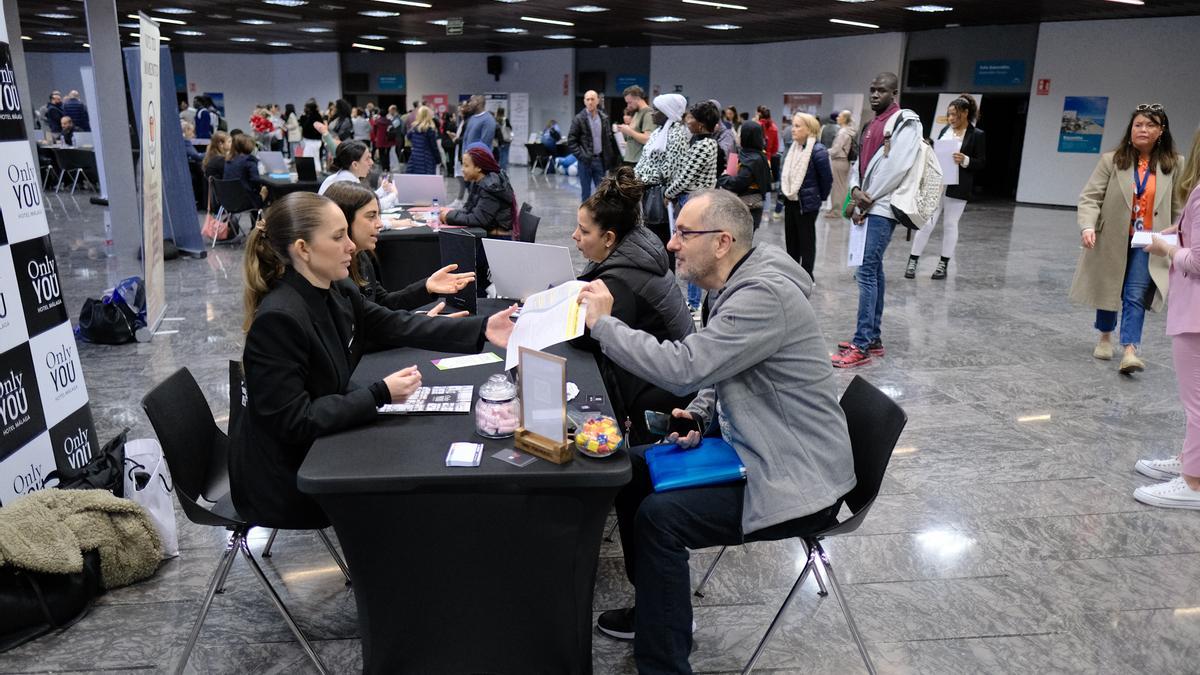
1,800 workers are being sought for hotels and restaurants on the Costa del Sol. That might sound like an old-fashioned classified ad, but it's not. It is actually the mission embarked upon by the main Málaga tourist sector business associations, which are "in great need of human resources," as some of the industry's leaders proclaimed at the Torremolinos Congress Palace. There, the third edition of the 'Emplea Turismo Málaga-Costa del Sol' event is being held this Thursday - until six in the evening. Hundreds of people are submitting their resumes and interviewing with representatives from 50 companies and nearly a hundred hotel and restaurant establishments, recruiting staff for almost 2,000 job positions on the eve of Easter Week.
The fair was organized by the Association of Hoteliers of the Costa del Sol (Aehcos), the Association of Restaurateurs of Málaga (Mahos), and the Association of Beach Business Owners (Aeplayas), with sponsorship from the Regional Government of Andalusia and the Provincial Council of Málaga, and collaboration from the Torremolinos City Council. At this initial contact with potential employers, primarily aimed at resume submission and a brief preliminary interview, people were eager to seize the opportunities also offered for "training." This was expressed by David, who, while waiting in line at a hotel chain's booth, said: "I would like to work as a waiter or in the kitchen, in hotels or in restaurants, and I am also looking for more training," referring to the presence of organizations and schools dedicated to this field at the fair.
Meanwhile, Mandiang was focused on finding a job in the hospitality industry, or even in hotels, as he distributed his resume, explaining while waiting to hand it over to a well-known tavern chain. The president of the Málaga Association of Restaurateurs (Mahos), Javier Frutos, noted that such a fair seeks "both young people and not so young because hospitality welcomes anyone who is eager to work." In his view, the fact that "around 1,800 jobs are being offered, mainly for the Easter season" is "a good opportunity for both parties," for employers and job seekers.
However, Frutos pointed out that, while employability in the sector continues to grow, "the main problem detected" is the lack of "qualified personnel." "We are mainly looking for qualified personnel; we continue to grow in hiring but, in the end, we lack that more solid base provided by trained staff," he said, while appreciating "the synergy" created by the participation of various hospitality schools in these employment days.
On his part, the president of the Association of Beach Business Owners (Aeplayas), Manuel Villafaina, defended that these employment days "are successful and always serve a purpose" for the sector. Villafaina also hoped that "this year, hospitality will shed the stigma that it has always been an irregular profession." "On the contrary, it is a very dignified profession, and I hope we can demonstrate that this year," emphasized the leader of the group that mainly includes beach bars.
Moreover, when José Luque, president of the Association of Hoteliers of the Costa del Sol (Aehcos), took the floor, it became evident that "each year about 5,000 workers are needed on the Costa del Sol." "Today we are looking for about 1,800, but there are also other fairs organized by municipalities or even companies; we ourselves at El Fuerte did one because we needed human resources before these dates," he added.
And at this point, Luque insisted that companies in the sector are "very eager for human resources" and, like other speakers, highlighted that "each year it is more difficult to find trained people." "The presence at this fair of even small companies denotes the need and lack of human resources we have in the hotel and restaurant industry," said Luque, while reiterating that "the lack of training" of the candidates continues to be the main obstacle when searching for workers: "There are people we hire without having a tool or a training contract and they directly enter the salary of a trained person, and then the companies have to act as trainers because they don't come trained."
Luque also lamented that "the problem is that tourism schools also do not attract many people for room and entry-level positions." "Everyone wants to be a chef or hotel manager, but fewer people want to start from the bottom, when there are great opportunities for training, and there are possibilities for promotion within the company or to go work around the world and learn languages; this profession has the most growth potential and can lead to other service sector professions, it is the profession of the future," he proclaimed.
In this regard, the Tourism Delegate of the Regional Government, Gemma del Corral, emphasized that one of the challenges ahead - for both public administrations and business owners in the tourism sector - is "to create an environment where people have the opportunity to grow in training and to offer that growth in service excellence."
However, the regional delegate of the sector reminded "that the tourism sector has magnificent professionals" and that one of the strengths of the Costa del Sol is "the attention paid to the customer." "But we are very competitive in that, and we believe we can continue to advance in that direction, we believe there is room: now we are going to make Artificial Intelligence training available to the sector," Del Corral stated.
And, following on, the Employment Delegate of the Regional Government, Carmen Sánchez, added that the Andalusian government has ten hospitality schools in the province and "there are also private ones." "Every year, we are bringing about 300 or 400 trained people into the sector, we are responding to that need, although it is true that it may not be enough because each year there are more hotels in the province and more people are needed," she emphasized.
At the opening of this tourism employment fair, the First Deputy Mayor and Councilor for Tourism of Torremolinos, Marta Huete, pointed out that with this type of initiative "the idea that tourism is the main engine of the economy in the province is consolidated."
Likewise, the deputy responsible for Employment at the Provincial Council of Málaga, Carmen Márquez, noted that "tourism is the main source of wealth in the province" and highlighted that "this is thanks to the work of business owners and trade associations present at this fair."