


The dangerous Portuguese man o' war jellyfish is already on the beaches of Málaga
The Aula del Mar has located the first specimens of this animal, notable for its "float" shaped like a sail, in Marbella, Fuengirola, and Benalmádena.
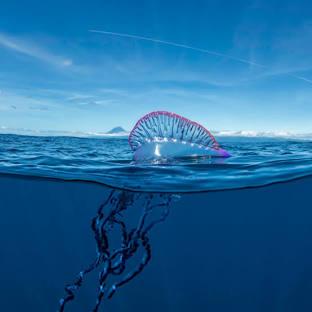

The Portuguese man o' war is now on the beaches of Málaga. This animal, notable for its upper "float" shaped like a sail, is among those considered most dangerous, since its tentacles are highly irritating upon contact with the skin. Therefore, if you see them, you must avoid touching them, even if they are dead.
This has been confirmed by members of the Aula del Mar Mediterráneo foundation, who have recently detected specimens of 'Physalia physalis' in the Alborán Sea, specifically on the beaches of Marbella (Puerto Banús), Fuengirola, and Benalmádena. These have been dragged to the coasts of Málaga from the Atlantic by the storm train that has been hitting the province since the beginning of March.
"The Portuguese man o' war is not a native species of the Mediterranean, but of the Atlantic Ocean, where it lives in temperate and tropical waters. However, under certain climatic conditions, it can be dragged through the Strait of Gibraltar and reach the Mediterranean coasts," explain sources from this institution.
Although it is generally known as a jellyfish, it is actually a siphonophore, that is, a colonial organism formed by several specialized individuals that act in a coordinated manner as if they were a single living being. Its most distinctive feature is its sail-shaped float, which allows it to move driven by the wind and ocean currents.
The presence of this species on the beaches generates concern due to its potent venom, which is found in its long tentacles and can cause intense pain, allergic reactions, and in some cases, medical complications. Although its sting is not fatal, it can cause significant discomfort and require medical assistance, warn the Aula del Mar.
Monitoring the Portuguese man o' war is essential to understand its distribution and predict in which areas it might appear in the coming days, especially with the upcoming Easter week, which will bring (if the weather permits) an increase in visitors to the beaches of the Costa del Sol. "Having up-to-date information will allow alerting coastal surveillance services and taking preventive measures."
For this reason, the Aula del Mar foundation has activated a monitoring plan through the environmental volunteer platform Red de Protección Marina and the Creamar groups of Málaga, Mijas, Rincón de la Victoria, and Nerja. Additionally, it has called on beachgoers to take precautions; but also to collaborate with information on the locations of specimens.
For this purpose, the email of the marine biologist Jesús Bellido (jesus.bellido@auladelmarmed.org) is made available to citizens so that, in case they find a Portuguese man o' war, they can provide the location (name of the beach or coordinates), date of sighting, and photos.

Latest news





Upcoming events
12
Nov
El Desembarco, la traición de Viriato at La Caja Blanca
12
Nov
HOMER El Mero Mero at Sala Trinchera Málaga
13
Nov
Marbella Startup Lab – Innovate & Collaborate
13
Nov
Candlelight: Coldplay & Imagine Dragons at Sala Fundación Unicaja María Cristina
13
Nov
Candlelight: Tribute to Ludovico Einaudi at Anantara Villa Padierna
Similar News

Marbella Launches ‘Summer Youth’ Programme with 2,500 Free Places
Marbella

Premium Tourism Drives Marbella’s Hotel Profitability to Record Levels as Overnight Stays Exceed 291,000
Marbella

‘Machos Alfa’ seeks extras in Marbella for filming of its sixth and final season
Marbella
