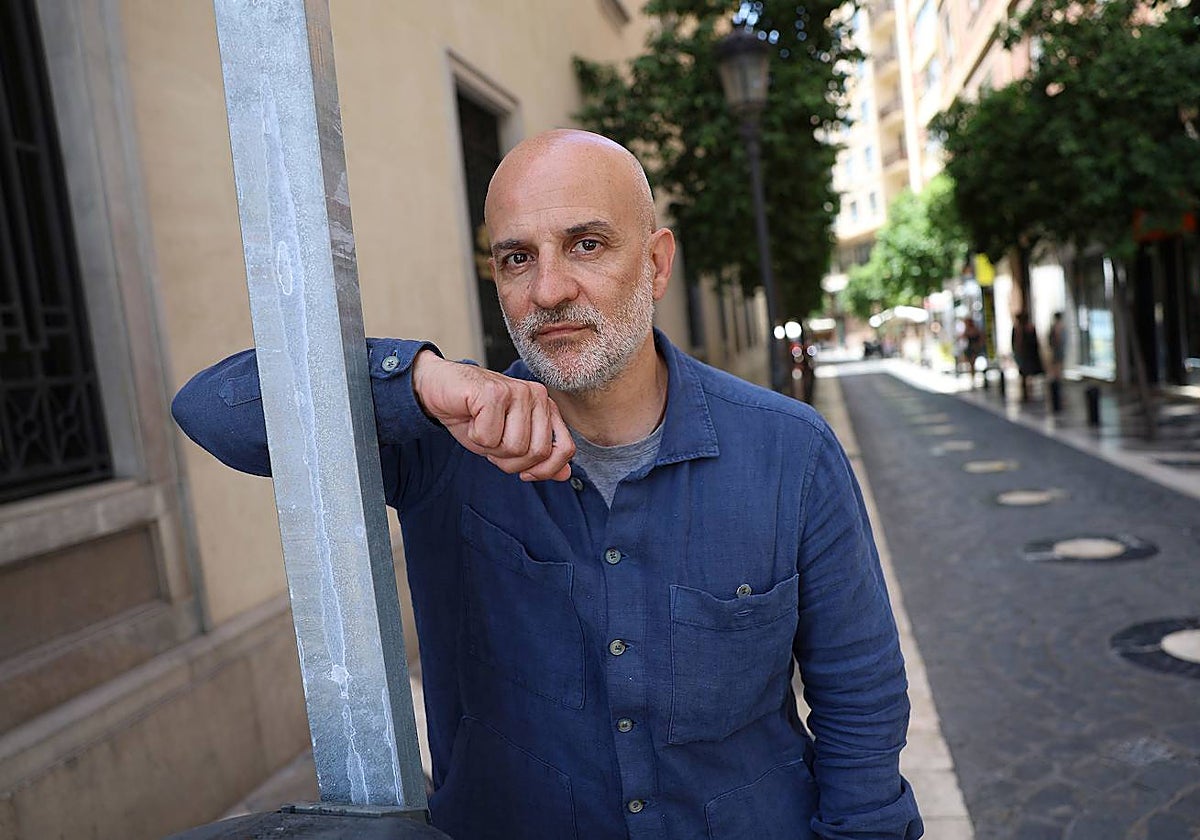
Charlie Sarria, the influencer who swims among sharks: "The Malaga native lives facing the sea but doesn't know it"
The marine biologist, promoter of an association dedicated to research, warns of how "threatened" the Mediterranean is.


Above his head, a white sky. At his feet, a rippled yet crystalline sea. The interview takes place on solid ground, on the unusual promenade of Rincón de la Victoria, built over the cliffs of El Cantal. The coast that accompanies us is not just any coast for Charlie Sarria, a 29-year-old marine biologist and influencer who swims among sharks. This irregular embroidery is bathed by the Mediterranean, the sea that has become a dogma for Sarria. Its shores have flooded his childhood from an early age. The beaches of the area raised him with a devotion to saltwater, instilling in him a passion and curiosity for what it hides within. The interview takes place with the sea keeping watch on the horizon, because for Sarria, "life away from the sea loses its meaning."
You're not a typical biologist, what would you say your job entails?
Promoting marine awareness and sparking people's curiosity about the sea. Making them want to know, respect, and take care of it.
Is it all through social media?
Mainly, yes. I also have a research component where, with my colleagues in Tenerife, we study sharks in the Canary Islands. Then there's a part of traveling outside Spain where I go to learn about these animals I want to see so I can later convey that. It's like a wheel that keeps turning. In the end, everything I can do and learn as a scientist allows me to share it with my followers.
I hear you have your own NGO
Yes, we created it in 2021, it's called Condrik. Sharks and rays belong to the chondrichthyans, hence the name (the NGO focuses on the research of elasmobranchs in the Canary Islands, especially sharks). We have achieved some very beautiful and interesting things. In 2025, we went down more than three hundred meters to look for deep-sea sharks with bait, something that had never been done in Spain before.
Has television done harm to sharks?
Unfortunately, there are movies that have demonized the role of the shark and have made people terrified of getting into the water. I also like to think that those movies created curious individuals who today are dedicated to researching them and wanting to preserve them.
What do you miss in the city?
I miss more proactivity in terms of marine-related research projects. We do many things that stay on land. There's a lack of fieldwork from my point of view. Many things are happening in our seas, in the Alboran Sea and in Malaga in particular, that we should study much more.
Are we lacking aquatic culture in the Mediterranean?
I was reflecting on this before the interview. The people of Malaga and the Mediterranean inhabitants in general live facing the sea, but they do not know the sea they live by. We don't know its species, the very important ecosystems we have, the rivers that the Mediterranean has. We have a great treasure and at the same time, it is very threatened, which is very important. If one does not know what they have, they do not preserve it and do not love it.
What are some of those threats?
Overfishing in the Mediterranean is brutal, more than 75 percent of the fish we consume comes frozen from outside because there isn't enough in our waters. Plastic pollution, habitat degradation... we are depleting the coast. The constant urban sprawl, with buildings on all the cliffs, without respecting the landscape itself, the natural scenic model. And then, of course, the lack of awareness on the part of citizens, which although it may be smaller regarding plastics, waste, leaving trash on the beaches. It's sad when you go to a beach in your city and you always find alcohol bottles, food remains... in the end, it costs nothing to pick things up and leave it as it was or better if possible.
Does coastal urban impact directly influence the sea?
Of course. Imagine we decide to build a pier, a dock, a breakwater and we change what is called the oceanic or coastal dynamics. By placing a structure where the wave will hit where it did not before, it can cause sand to sediment in one place and not in another, that beaches are lost or even species disappear due to the mobilization of land and mud. Depending on the type of impact, it will be during the construction phase or afterwards as well. There should be monitoring and a good environmental impact assessment to know what we are doing and it be a sustainable development, that does not compromise future generations.
In this sense, Malaga has taken a lot of land from the sea, what is its impact?
It's complicated. I always try to speak from knowledge and here I could not give you a clear answer. I know that in Malaga capital the only natural beach left is the one at the spa and now they want to do projects, which has been very controversial because there are sensitive species of soft corals, juvenile groupers. Even the rusty limpet, which was a critically endangered limpet. I don't know how the situation of the project is today to see if it happens or not, or if it would have a negative impact all the time or only during a phase of the project.
Do we have extinct species in the Mediterranean?
We have a very clear example that we are now trying to repopulate, such as the Monk seal. A wonderful seal. In Turkey, they are doing reintroduction of it, trying to get them to breed in different caves and some with success. There are very few left of an animal that was here. The great white shark is also very threatened here in the Mediterranean. There are very few left and it is extremely important. The same goes for the shortfin mako shark or the blue shark, in critical danger.
Are they protected enough?
In my opinion, there is a lack of protection. There is a lack of protection because their ecology makes it complex. They have very few offspring, take many years to reach sexual maturity, and the fishing moratoriums sometimes are not enough. But well, better than nothing.
The most fascinating thing you've seen in our waters...
Last year I was lucky to see a humpback whale in our area of Maro Cerro Gordo. An animal that does not usually inhabit our waters. It usually travels from the poles to tropical Africa. A solitary, subadult whale that apparently was healthy. It's like seeing a polar bear in the middle of Navarre. It was an incredible moment. I had the opportunity to see them in Mauritius, in the Indian Ocean. But to see them at home, in a place where they shouldn't be... I was moved to tears.
How long have you been studying the Mediterranean?
I like to say since I was a child. Since I was a boy, I was already passionate about the sea. I couldn't imagine myself anywhere else but being a marine biologist or at least dedicated to the sea in some way. From a young age with books on fauna and flora until understanding it at a much more technical level of how it works. And I am still fascinated and continue learning new things every day.
Have you noticed any changes since you've been studying it?
Well, I've seen unusual things that had never happened, like the whale or, for example, last year, many manta rays, a unique species that has existed in the Mediterranean (Mobula mobular) that is in critical danger of extinction. I talked with local fishermen from the area and they said this had never happened. Or the migrations of whales. We know that common fin whales inhabit the Mediterranean area and that it is a passage area, but we had never seen so much movement on the coasts of Granada and Malaga. Not just said by me, who am 29 years old, but by people who have been at sea for forty years.
Is everything negative?
There are always positive data, because otherwise I think we couldn't fight for anything. The sea has a unique regeneration capacity, species tend to adapt to the changes that occur. But they also need that space so that the animals can rebuild themselves, so to speak, and adapt. I think there is more and more awareness. The sea, for better or worse, is fashionable, and if that helps, blessed be it.
What is the sea for you?
Peace.
Positive or negative about your future?
I am positive. Obviously, where there is human intervention there tends to be ambition, ego, and destruction of ecosystems. But there are also good people, people with an infinite heart who do it selflessly. We can change many things and many things are being changed.
Can you imagine life away from the sea?
No. Unthinkable for me.

Latest news





Upcoming events
12
Nov
El Desembarco, la traición de Viriato at La Caja Blanca
12
Nov
HOMER El Mero Mero at Sala Trinchera Málaga
13
Nov
Marbella Startup Lab – Innovate & Collaborate
13
Nov
Candlelight: Coldplay & Imagine Dragons at Sala Fundación Unicaja María Cristina
13
Nov
Candlelight: Tribute to Ludovico Einaudi at Anantara Villa Padierna