


Cañeta and José Salazar, the Flamenco Couple Who Sang and Danced Until They Were 84 Years Old
The singer and dancer from El Perchel and the fandango singer, who have performed in New York, Japan, and Latin America, have owned two flamenco clubs in Puerto Banús, where Liza Minelli danced.Marianne Nilsen Nygaard: the muse of Antonio Flores
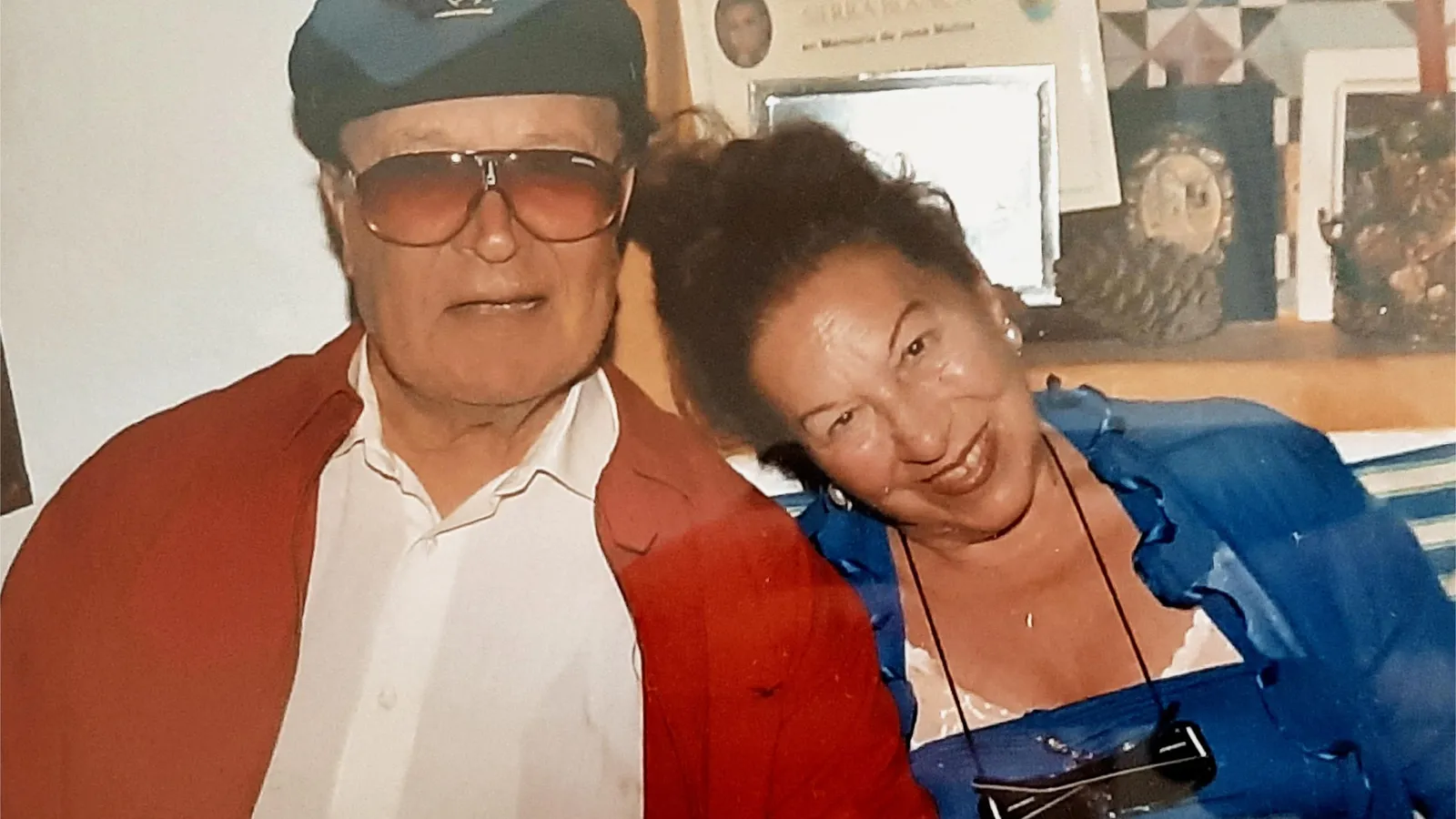

“La Cañeta and I got married in Malaga. The bullfighter Gitanillo de Triana lent us two thousand pesetas; I bought a bottle of wine, we went to a neighbor's house and started singing. I had a little shirt, which the gypsies tore when they heard me sing,” recalls José Salazar, husband and artistic partner of María Teresa Sánchez Campos, La Cañeta de Málaga. They are about to turn ninety. They performed together until six years ago. José climbs the stairs to the first floor of the apartment building, where his wife, who now spends most of her time in bed, is waiting for him.
The little I learned, I learned from life. My father was a gypsy dealer, he went to all the fairs and had children everywhere. I was born in Madrid, but when I was little they took me to Huelva. They didn't even register me at the civil registry. I did that when I was older, at the age of twenty, when I returned to Madrid. From the age of five, I was already singing in taverns because there was nothing to eat. We had nothing. We slept behind walls, laying down a blanket. There were five of us siblings, and I was the youngest. I couldn't go to school because if I did, there would be no food at home. We made a living from singing. My brother, Manuel, left with a troupe; my sister Margarita also sang, but not professionally. I stayed in Huelva, singing fandangos with Paco Isidro and Antonio Rengel.
La Cañeta and José Salazar, tribute in 2018 / MiguelónIn Madrid, I started working with Concha Piquer. I sent money to my mother for food and bought my friends raincoats and pants. In Huelva, they paid me three pesetas, while in Madrid I earned 25.
There was a kid who sang very well, and he told Gitanillo de Triana and Pastora Imperio, who owned the El Duende tablao in Madrid, about me. They listened to me and I stayed there. That's where I met La Cañeta. Her mother was La Pirula, a singer from El Perchel, where she grew up with La Repompa, La Quica, Pepito de Málaga, El Duende, and Carrete, who still dances, although he mostly talks.
La Cañeta only danced, I heard her flamenco voice, and when we were already dating, I said to her: why don't you take songs by Julio Iglesias, Los Brincos, and the Mexicans? She started singing and became indispensable at El Duende. Meanwhile, I sang to the dancer Maleni Loreto, who was married to the bullfighter Julio Aparicio.
La Cañeta, as an artist, was unlike anyone else. When her colleagues heard her sing, they trembled at the power of her flamenco voice and her legs. I used to get angry with her, asking her not to perform for so long, to save her energy. I knew how to cut it short, but she didn't; she gave it her all. Sometimes she would spend 45 minutes singing and dancing, which is the most difficult thing I've ever seen. When I reminded her, she would get angry with me. In front of the audience, she would say to me, “Sit down, you sissy.” I would sit down, and people would laugh.
I had an exclusive contract with the Zafiro record label and I wanted them to give La Cañeta a chance. I spoke to Marisol and Miguel de los Reyes, they took her on and she has recorded fourteen albums. I also recorded with Antonio Mairena. We have performed with Antonio Gades, Juanita Reina, and Lola Flores.
In Madrid, we got contracts for New York, France, Germany, Japan, Argentina, Colombia, and Ecuador. In New York, we were with Manuela Vargas, Naranjito, Fosforito, El Lebrijano, Juan Amaya, Juan Habichuela, the guitarist-poet, and we had a great time. After 55 days, Antonio Gades asked me to stay for six months. After that time, he said to me, “We're going to Puerto Rico.” I told him, “I'm going to Spain, I'm fed up with America.” I didn't like it because there were always lots of women who fell in love with us, and that was always dangerous. Once I was alone in the room I shared with Fosforito and El Habichuela, I turned on what I thought was the air conditioning, but it was the gas, and I fell asleep. Luckily, they came back in time and woke me up; I almost suffocated.
La Cañeta in Japan / Personal Archive In Japan, in the stalls, a Japanese man said to me: “You're José Chá, you're from such and such a place, you won a prize in Córdoba with Fosforito.” I was left wondering how he knew about my life.
“Do you want to record?” he asked me. So I recorded three albums in Japan. Mairena had already recorded there before, and we spent a year there.
La Cañeta would go to the plaza and the Japanese man would translate for us. We would invite him to eat and we would communicate as best we could.
On the tours of New York and Japan, we weren't paid much; my wife and I earned $700 between us. Money has never concerned me, only my singing and my work. I wasn't interested in fame, only in being a good person, doing well, and being happy. I never gave much importance to the prizes I won [in the National Flamenco Singing Competition in Córdoba in 1956], second prize for soleá, first prize went to Fosforito, and a special prize for singing fandangos from Lucena (Córdoba), which almost no one knew. I learned them from Paco Isidro.
In the 1960s, Spain was a fairground. Although we spent a lot of time singing, we were working in the tablaos of Madrid, we went with Gitanillo de Triana to the parties that Ignacio Coca gave in Madrid, which were attended by many artists such as Bambino, Terremoto, the Reyes brothers, and Rocío Jurado. At El Duende, the Catalan gypsies, including Peret, began to play rumba there. There were many parties for the aristocracy.
Inauguration of the Los Corales tablao in Puerto Banús / Personal ArchiveSometimes, the lords and marquises would fall in love with one of us. In Madrid, a marquis said to me: I'm not going to pay you now, I'll pay you tomorrow at the Wellington Hotel, where the bullfighters stayed to get dressed before the bullfights at Las Ventas.
“Go up to the room,” he said.
“I'm not going up to the room; you pay me here,” I replied.
We were always servants, but thanks to them we lived because they fed us. How they lived! Until freedom began, only they lived. They treated you well, as long as you spoke to them like a gentleman: Mr. So-and-so, Mr. Such-and-such. The same went for the servant, the horse keeper, and the cook. Everyone: yes, sir, as if he were a colonel.
The cocaine was brought in by the big shots. It wasn't brought in by the kids, the starving ones, which is why the parties lasted as long as they did. At eight in the morning, the young master was fresh, everyone was fresh, and we were there, exhausted, singing.
The main singers, Manolo Caracol and Antonio Mairena, didn't get along at all, they fought, they couldn't stand each other. Caracol said a lot of things to him, and Mairena ignored him, calling him a sissy. We didn't take sides. We went to French Morocco with Lola Flores, and I fell ill. Lola said to Pescaílla: “Give this boy a little less work. Send him to Madrid.” It was the temperature; when I came back, my illness was gone.
La Cañeta de Málaga with Lola Flores / Personal Archive I discovered Marbella when El Duende gave us permission because there was nothing there and here there were the parties of the nobility. Don Manuel Lapique threw many parties, as did Don José Banús and the Marquis of Saltillo. Here we opened the Los Monteros, Don Pepe, and other hotels. We opened a tablao in Puerto Banús. At first, I stood at the door, as if I were the doorman, so that no one could enter, because Don Juan, the father of King Juan Carlos, was coming with Don José Banús and his wife, Doña Pilar. All the important people passed through there: film directors, actors, politicians, and financiers. The tablao, which was on the ground floor of Puerto Banús, was built for me by Pepito Carleton. The same people who were at the tablao at night would later complain about the noise, and the police would come and threaten to shut us down. Father Don Rodrigo managed to keep them from closing the place down because of the noise, but when he died, they closed it.
In Puerto Banús, on a plot of land, we had a second tablao, where we even had a vegetable garden. Doña Pilar set up the tablaíto for me. Alfonso de Hohenlohe used to come to the house with his cousin, Count Rudi. There was a small kitchen and Cañeta would prepare some watercress for them to eat. They came to enjoy the atmosphere.
Doña Pilar always brought us all the big names, the biggest there were here. Even a press conference with Liza Minelli was held at my house, where she danced with Chano Lobato. Rainier, the Prince of Monaco, also stopped by.
When Lola Flores saw the success of the tablao, she asked Doña Pilar for a plot of land and set up another one near ours. She brought in the biggest names, but ours was very flamenco. It was more informal, where people could participate. One night Camarón and Paco de Lucía came, and the party lasted until two in the afternoon the next day.
Those were good years. When they sold the place, Doña Pilar thought I was going to ask them for money, but I told her I didn't want anything. We were among the first promoters of Puerto Banús.
We returned to Madrid. On Pintor Rosales, I set up a place with a basement, where all the great artists came, such as Paco de Lucía, Fosforito, Antonio Mairena, and Rafael Farina. Once again, the neighbors complained about the noise, and we had to close. I returned to Marbella, and we set up a tablao in the Guadalpín area until the Sevillanas craze died down. There were two large venues, and everyone in Marbella went there. We had two very good seasons, and then I got fed up. I formed a group with La Cañeta, a guitarist, a palmero, a bailaora, and me. We started doing galas in tablaos in Madrid, theaters, for a long time, until La Cañeta got sick and we slowed down. We returned to Marbella and sang together until we were 84. We got calls from Madrid and Barcelona, but our throats and legs were failing us. We don't go anywhere anymore.
With Rocío Jurado / Personal Archive When I saw that she was ill, I told her that I didn't want to sing anymore. My voice was worse than hers. The difference was that I could defend myself with the fandango from Huelva, because I did something different, pure gypsy. Antonio Mairena used to say: “Gypsy flamenco and Castilian singing”, which really annoyed Pepe Marchena and Juanito Valderrama. Because a gypsy sings differently from a Castilian, and vice versa. Because it has to hurt for a gypsy; he breaks his throat before a Castilian does. He sings for himself, so that it hurts; the Castilian does it with his mouth outwards, with a lot of force, but he doesn't have that feeling. That's why the gypsy, when he sings and hears good singing, cries. Have you ever seen a Castilian cry in flamenco? No, you haven't.
When I lost my voice, I dedicated myself to helping La Cañeta. They gave her tributes in Ojén and Málaga, and in Marbella, here without an audience. She has streets named after her in Málaga, Marbella, and Ojén. They haven't given me anything, because I'm from another land. I already have my awards for seguiriya and soleá. I'm not interested in being in the spotlight and being better than so-and-so. I'm humble. Let the people say it. I don't want to be number one.

Latest news





Upcoming events
12
Nov
El Desembarco, la traición de Viriato at La Caja Blanca
12
Nov
HOMER El Mero Mero at Sala Trinchera Málaga
13
Nov
Marbella Startup Lab – Innovate & Collaborate
13
Nov
Candlelight: Coldplay & Imagine Dragons at Sala Fundación Unicaja María Cristina
13
Nov
Candlelight: Tribute to Ludovico Einaudi at Anantara Villa Padierna
Similar News

Marbella Launches ‘Summer Youth’ Programme with 2,500 Free Places
Marbella

Premium Tourism Drives Marbella’s Hotel Profitability to Record Levels as Overnight Stays Exceed 291,000
Marbella

‘Machos Alfa’ seeks extras in Marbella for filming of its sixth and final season
Marbella
