


The 'Aida' Envisioned by Zeffirelli Arrives at the Cervantes
Verdi's iconic opera returns to the temple on Ramos Marín Street on March 7 and 9 with the stage design conceived by the Italian film director. A classic version that revives the eternal love triangle but also addresses universal issues, such as conflicts between peoples and religions.
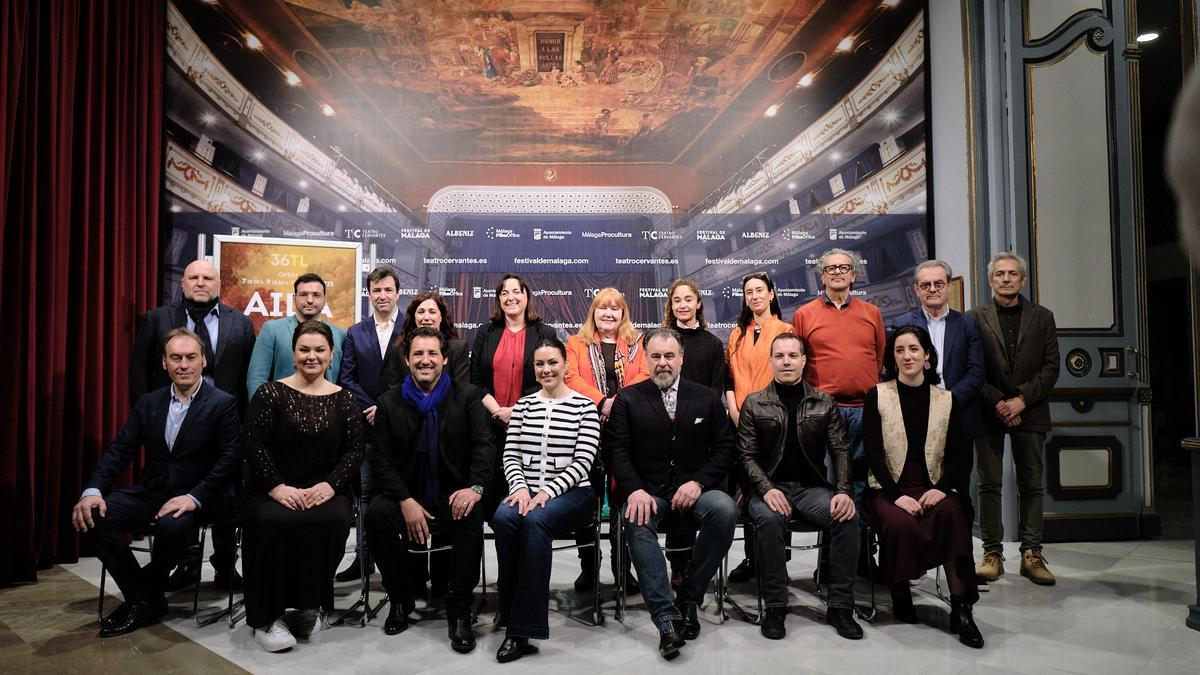

'Aida', the masterpiece by Giuseppe Verdi, an immortal piece of the operatic repertoire and bel canto, arrives at the Teatro Cervantes, as part of the XXXVI Lyrical Season, on the 7th and 9th of March. The work was presented today by its stage director, Vivien Hewitt, who relied on the scenography designed by Franco Zeffirelli, and its musical director, Óliver Díaz. The cast of soloists is led by Rocío Ignacio (Aida), Jorge de León (Radamés), Olesya Petrova (Amneris) and the baritone from Málaga Carlos Álvarez (Amonasro). Also participating in the production are Rubén Amoretti as Ramfis, Luis López as the king of Egypt, Laura Orueta as the priestess, and Francisco Arbó as the messenger. On stage, these voices will be accompanied by the Choir of the Teatro Cervantes de Málaga-Intermezzo, directed by Pablo Moras.
"It is the story of a love triangle that hides many other things, such as the clash of two peoples, two religions; a story from which one can draw their own conclusions," highlights Óliver Díaz. Hewitt, for her part, emphasizes the realistic quality of the work, both musically and scenographically. The scenic design on which this work is based was created by Zeffirelli in 2001. Vivien Hewitt assures that she has been as faithful as possible to the ideas of the film director, and she focuses on the costumes designed by Anna Anni for the author's production, which will also be used in this production, a work of "dazzling beauty and most realistic from a historical perspective."
Intimate
'Aida' is one of Verdi's most intimate works. A love story in which Aida, an Ethiopian princess, is torn between her forbidden love for Radamés, an Egyptian soldier, or loyalty to her people, defeated by Egypt. A love triangle, a strong political and social background, betrayal, or death, are some of the themes included in this story. "Can you imagine a Ukrainian girl falling in love with a Russian soldier? Well, this is the story of 'Aida'," reflects aloud Carlos Álvarez, bringing to the present the events narrated by Verdi. In the opinion of the baritone from Málaga, humans today, in the 21st century, still behave "as irrationally and incapable of resolving conflicts" as they did 154 years ago, when Verdi wrote this immortal piece of the bel canto repertoire.
As usual in the Lyrical Season, the public has responded and has sold out the tickets for the two performances of 'Aida'. However, the general rehearsals will be open to students from selected secondary schools, high schools, and vocational training centers, thanks to the blue theater's initiative to bring opera closer to the younger audience. "If you open the door, people come in, but you have to open it," reasons Vivien Hewitt in this regard.
Great Production
Experts define 'Aida' as a premonition of what would be the great Hollywood productions, because of its large sets, costumes, and scenography. The opera enjoyed great success when it finally premiered in Cairo on December 24, 1871, with the critics of the time highlighting the great scenic deployment (large choruses and scenes, special effects... Auguste Mariette, one of the essential figures of Egyptology, was behind the project designing its sets and costumes).
The viceroy Ismail Pasha, a Verdi enthusiast, thought of the Italian when he came up with the idea of an opera that would commemorate the future opening of the Suez Canal. Verdi initially hesitated, but eventually accepted the commission: he charged 150,000 gold francs, the highest fees in the history of music to date. Money well spent, indeed.

Latest news





Upcoming events
12
Nov
El Desembarco, la traición de Viriato at La Caja Blanca
12
Nov
HOMER El Mero Mero at Sala Trinchera Málaga
13
Nov
Marbella Startup Lab – Innovate & Collaborate
13
Nov
Candlelight: Coldplay & Imagine Dragons at Sala Fundación Unicaja María Cristina
13
Nov
Candlelight: Tribute to Ludovico Einaudi at Anantara Villa Padierna
Similar News

Málaga Airport Makes History with More Than Three Million Passengers in One Month
Málaga

Port of Málaga looks beyond its docks to support future growth
Málaga

Guide to the Virgen del Carmen Processions in Málaga and the Province
Málaga
