


Malaga, horses that rode on Kings Day

Three photos for a triangular view of the history of Málaga. Triangular refers to the topographic operation that allows mapping a place. ... In 'Estampas de Málaga. Memoria SUR', historian Javier Ramírez follows this concept to position some pieces of a possible photographic, and almost sentimental, map of Málaga. He does this through the three parameters of mechanical cameras: focus, depth of field, and time. The result: a personal focus that selects and comments on the layers that time sketches. Welcome to this visual story.
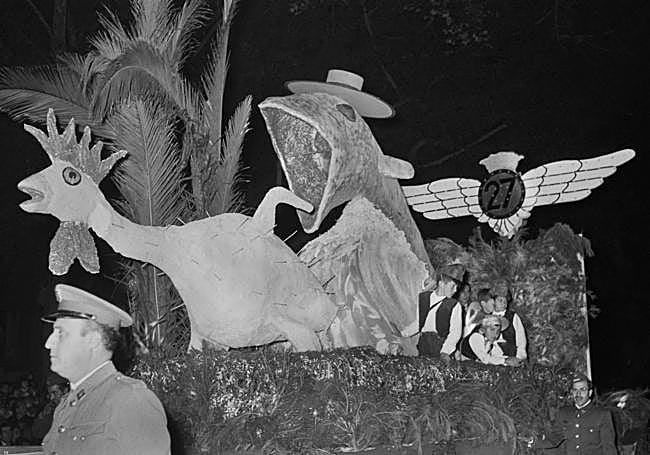
1960. Three Kings Parade
Enlarge
Fondo Bienvenido-Arenas. UMA Historical Photographic ArchiveIt could be mistaken for a carnival float. A plucked and terrified rooster seems to flee from a voracious fish that, leaping olympically over a wave, aims to swallow it. A palm tree, in contrast with the border of pine branches that edges the carriage, completes the scene. In the background, a circular shield with the number 27 in the center of two unfolded wings. But no, it is not carnival; its celebration has been banned throughout the national territory, with the exclusive exception of Cádiz and the Canary Islands. We are looking at one of the floats parading on the Alameda in the Three Kings Parade on January 5, 1960. Specifically, it is the one mounted by the Light Bombing Wing 27, a unit based at the Málaga Air Base. This is evidenced in this image by the escort of a corporal from "gurripatos" - as soldiers from the Base are affectionately called in Málaga - and, in other photos from that year with the same theme, the Air Force's Land Rover Santana pulling the device. The scene is completed by a group of shepherd boys and girls. The rear is closed with the 3 Wise Men drawn by a well-known painter.
1961. Three Kings Parade
Enlarge
Fondo Bienvenido-Arenas. UMA Historical Photographic ArchiveThe following year, the interpretation of the float from the Málaga Air Base is easier: a powerful winged horse pulls a sled announcing the arrival of the Three Kings. On the front panel, the legend 27 ALA Light Bombing and its shield, helps to decipher, from the current perspective, the loaded symbolism of the previous year's scene. The emblem, besides the wings that allude to military aviation, includes three very significant drawings: a rooster; another, of a fish (a boquerón, for some a chanquete), both wearing a flamenco hat, and a palm tree; a direct reference to the three locations that ALA 27 occupied up to that point. Two in Andalusia: Morón de la Frontera, 1957 (hence the rooster figure) and, 1959, Málaga (the boquerón). Between these two dates, a short stay at the Gando base (the Canarian palm). The unit was composed of B2I combat aircraft, a national copy of the famous German Heinkel 111. In 1968, with no other Heinkel 111s than the Spanish ones, they and their military pilots were used for the filming of the movie The Battle of Britain. But that is another story.
1961. Three Kings Parade
Enlarge
Fondo Bienvenido-Arenas. UMA Historical Photographic ArchiveFour seahorses, of which we see two here, ride the waves pulling a sea shell. From it emerges a mermaid with a unique figure and splendid black hair. It is the carriage that the charming Vespa Club has designed for that year. At the front, a large group of the same brand motorcycles led by barefoot sailors, including some with a sidecar, paves the way. Following the float, a double line of Vespa motorcycles, this time the heads of the pilots covered with a boquerón hood. The procession is accompanied by a school band playing their own music over the noise of the engines. Success is guaranteed. The organizers count on an unconditional audience: they are—or fervently wish to be—users of the most popular scooter of the moment. The large number of photographs showing our mermaid attests that it is one of the most valued motifs. What no one could imagine—nor, of course, she—was that the protagonist, Ketty Doblas, of this successful stage composition linked to the maritime tradition, would come to be distinguished as one of the great photographers that Málaga has produced.

Latest news





Upcoming events
12
Nov
El Desembarco, la traición de Viriato at La Caja Blanca
12
Nov
HOMER El Mero Mero at Sala Trinchera Málaga
13
Nov
Marbella Startup Lab – Innovate & Collaborate
13
Nov
Candlelight: Coldplay & Imagine Dragons at Sala Fundación Unicaja María Cristina
13
Nov
Candlelight: Tribute to Ludovico Einaudi at Anantara Villa Padierna
Similar News

Málaga Airport Makes History with More Than Three Million Passengers in One Month
Málaga

Port of Málaga looks beyond its docks to support future growth
Málaga

Guide to the Virgen del Carmen Processions in Málaga and the Province
Málaga
