


Hidden Gems of Andalusia
Andalusia is historical heritage and culture, but it also offers a more intimate and hidden legacy ready to surprise visitors.

The Andalusian community opens its doors to visitors with the allure of its rich historical heritage and a broad cultural offering, but also with a more intimate and sometimes hidden legacy ready to surprise even those who live here. These are small landscape, architectural, and ethnographic gems in each of the Andalusian provinces.
Sinagoga del Agua, in Úbeda (Jaén). / José Pedrosa / Efe
Sinagoga del Agua, Jaén
Although it is a challenging task to discover a gem within the treasure that is Úbeda, a relatively recent discovery in 2007 unveiled the existence of a synagogue hidden among the structures of several private homes. During the remodeling of a property, among other rooms of an ancient Jewish home, the one designated for the ritual purification bath or Mikveh was revealed. This room led to the naming of the space as Sinagoga del Agua, where visitors can peer into its wells and enjoy the underground water galleries.
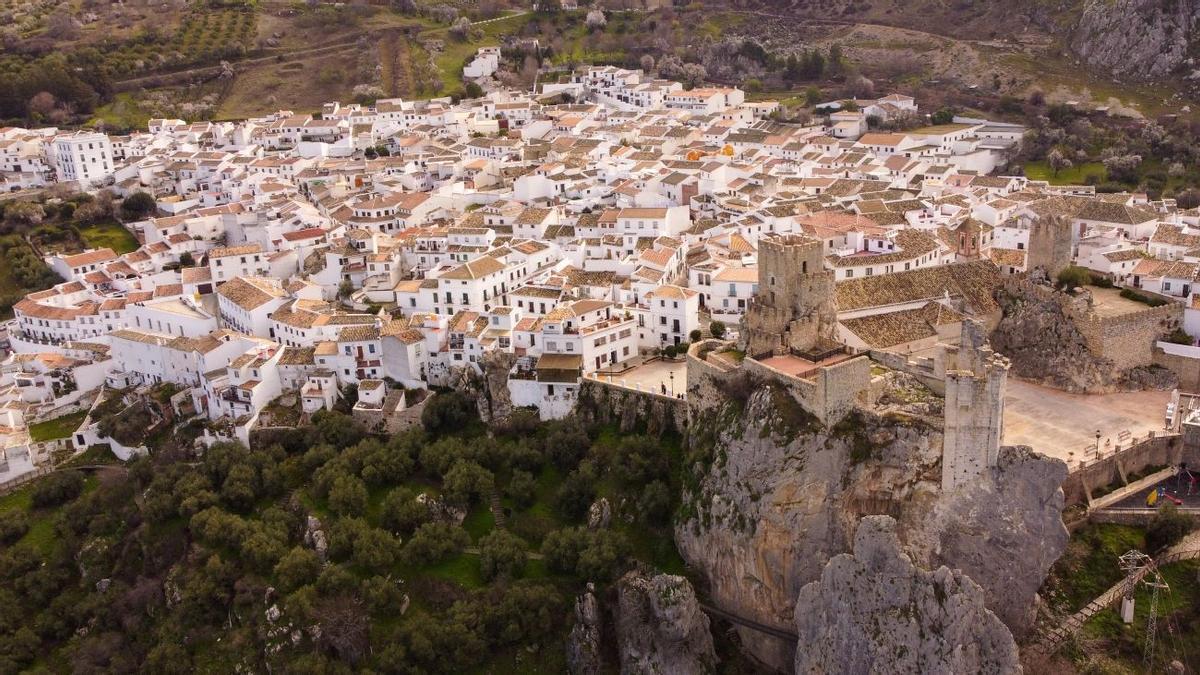
View of Zuheros, in Córdoba. / Manuel Murillo
Zuheros, Córdoba
Nestled in the Natural Park of the Sierras Subbéticas, Zuheros is one of the most beautiful and lesser-known villages in Andalusia. Declared a Site of Cultural Interest in its category of Historic-Artistic Group, thanks to its excellent state of conservation, the town – perched from the highest cliff with its castle – invites strolling and enjoyment of the senses. Its surroundings allow for various activities such as visiting the archaeological site of the Cave of the Bats or hiking routes along the Bailón river basin.
El Coto de las Canteras, in Sevilla. / James Narmer
Coto de las Canteras, Sevilla
El Coto de las Canteras is a quarrying site of marble and limestone from the ancient Urso, dating back to the 5th century BC and are in an excellent state of conservation, having had commercial activity until the 1960s. The town of Osuna houses this treasure of reliefs that recall the majesty of the city of Petra in Jordan and bear witness to the work of the stonecutters and their history, carved into the stone.
Corta Atalaya, in Huelva. / Julián Pérez / Efe
Corta Atalaya, Huelva
Among the tourist activities offered by the Riotinto Mining Park (from visiting the Mining Museum or the old English neighborhood of Bella Vista, to taking a train ride through lunar landscapes along the Tinto river basin), perhaps the visit to Corta Atalaya is one of the least known and most interesting. Included since 2012 as a Site of Cultural Interest, this mining location is considered the largest open-pit mining operation in Europe. Just the dimensions of the ellipse formed by the quarry's strata convey the spectacular nature of the landscape: 1,200 meters long, 900 meters wide, and 345 meters deep.
Fishing corrals, in Cádiz. / Rafael Avilés
Fishing corrals, Cádiz
The fishing corrals or fishery corrals are a set of constructions along the shores of Rota and Chipiona, linked to a traditional fishing art since at least Roman times, although it is unclear whether their origin is Phoenician or Arab. These man-made dykes, built in dry stone on abrasion platforms of ancient cliffs, take advantage of the tides and facilitate the capture of fish and shellfish that remain trapped between their stone walls. The boundary of the monument is defined by a polygonal line that includes a meadow of phanerogam plants and the eight corrals (five survive) that made up the complex protected as a Natural Monument since 2006 for its cultural, archaeological, and natural values. Visiting the corrals allows one to get close to a millenary fishing art and overlook one of the most beautiful beaches on the Cadiz coast like Punta Candor.
Casa Cueva de Ginés, Bobastro, in Málaga. / Pedro Cantalejo
Bobastro, Málaga
On the road from Álora to Ardales, near the famous Caminito del Rey, the enclave of the Natural Park Desfiladero de los Gaitanes leads to Bobastro, a ninth-century rock complex. This impregnable fortress for the troops of the Umayyads preserves the ruins of an ancient Mozarabic church. The Christians who lived under Islamic rule circumvented the prohibition against building temples by erecting rock churches like the one preserved here. The Bobastro church was destroyed by Abd al-Rahman III after the definitive capture of the enclave and the defeat of those who opposed the Umayyads of Damascus with Omar ibn Hafsún at the forefront.
Views of Capileira, in Granada. / City Council of Capileira
La Alpujarra, Granada
Although increasingly well-known, the Alpujarra remains one of the most uniquely beautiful mountainous areas in Andalusia, noted for its white villages, tradition, craftsmanship, and local products. They say that Pampaneira is the most beautiful village in the mountains, but one should not miss Capileira, Órgiva, Lanjarón, or Bubión. The cold winds from the summit of the Peninsula and the Moorish past make this corner, in the shadow of Veleta, one of the essentials of the province.
Sorbas, in Almería. / Andalusia Tourism
Sorbas, Almería
Known as the small basin for its houses hanging from a very unique rock formation. Sorbas (in Arabic, sand pot) is situated on a mountain 40 meters high surrounded by a ravine and the Aguas river. The houses overlook the cliff, as do the visitors who come close to the numerous viewpoints scattered around the village. At its feet opens a landscape that could well be the setting for a Jules Verne book, originated 6 million years ago when the sea waters receded from there.

Latest news





Upcoming events
12
Nov
El Desembarco, la traición de Viriato at La Caja Blanca
12
Nov
HOMER El Mero Mero at Sala Trinchera Málaga
13
Nov
Marbella Startup Lab – Innovate & Collaborate
13
Nov
Candlelight: Coldplay & Imagine Dragons at Sala Fundación Unicaja María Cristina
13
Nov
Candlelight: Tribute to Ludovico Einaudi at Anantara Villa Padierna
Similar News

Málaga Airport Makes History with More Than Three Million Passengers in One Month
Málaga

Port of Málaga looks beyond its docks to support future growth
Málaga

Guide to the Virgen del Carmen Processions in Málaga and the Province
Málaga
