


Malaga inaugurates its first virtual reality esports space
Four people from Malaga bet half a million euros on a competitive experience where the body is part of the controller
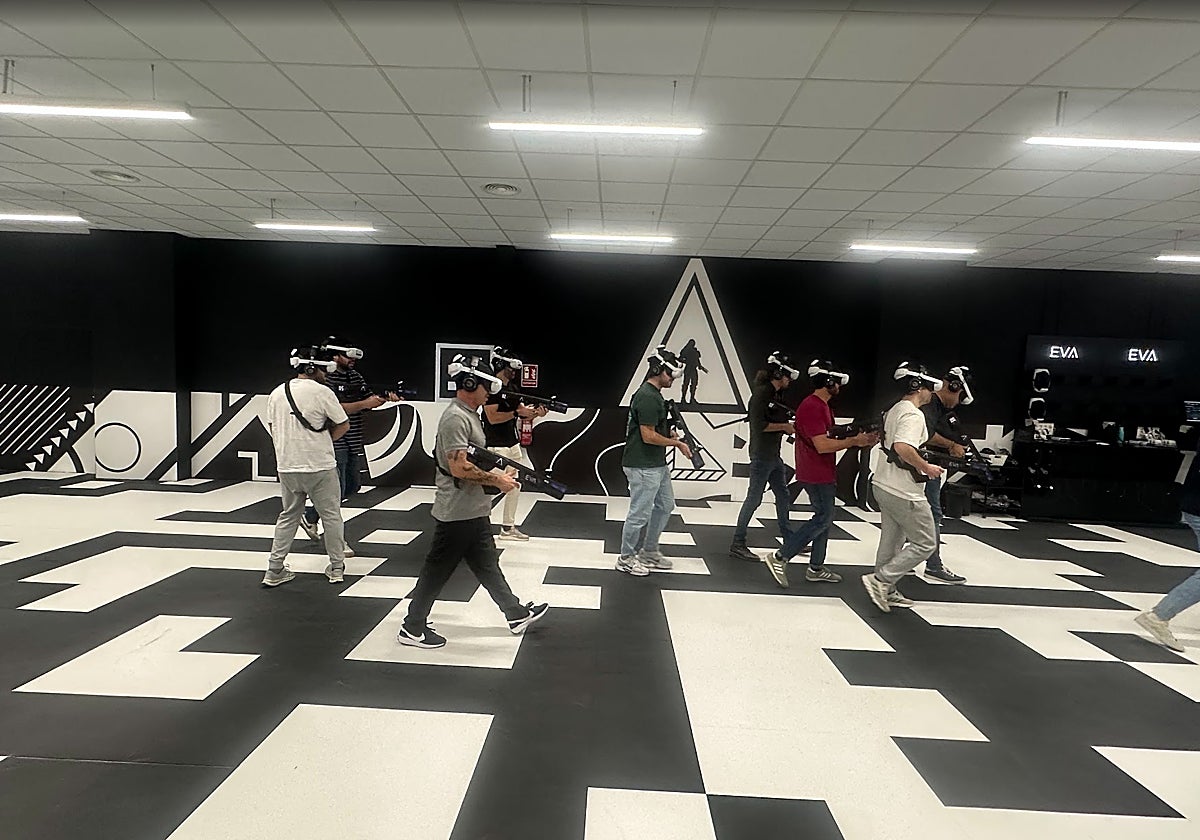

Do you remember the Oculus Rift? Those first virtual reality glasses that hit the market in 2012 and quickly became a global trend, envisioning what the future of the gaming and even film industry could become. Since that initial attempt (although the first attempt at virtual reality glasses actually dates back to 1962 with Morton Heilig and his Sensorama), many other brands have jumped on the virtual reality bandwagon, advancing the product by leaps and bounds and enhancing colors, resolution, clarity, and fluidity. What we are discussing today is the current pinnacle of virtual reality specifically and gaming in general. The result of all the advancements this technology has made over the years: EVA, a company specialized in virtual reality esports that has taken the art of gaming to its next level and has now arrived in Málaga thanks to four local entrepreneurs: Mario and Roberto Trelles, from Torcal; Augusto Sarmiento, from Parque Litoral; and David Muñoz, from Mollina.
An hour playing the various modes and games it offers, all developed internally, is more than enough to clarify several aspects: words, although we'll try here, do not do justice to the experience; there is no better advertisement than word of mouth; and you do not need to be a gaming enthusiast or a magician to enjoy a format that blends fantasy, technology, and sport.
The Experience
Before starting the game, Ángel and Philippe, the two 'game masters' who will accompany us during our immersion to ensure that nothing fails at any time and assist us if necessary, explain the basic concepts so we can navigate the virtual world created by Esports Virtual Arena (EVA). As soon as you put on the glasses, what was once a bland white room turns into an inhospitable, desert-like ochre planet, with some ships and small robots flying through space. This is where the adventure begins, where you start walking for the first time and get used to this new reality that now surrounds you. One of the most notable aspects is the development of the scenarios that, through levels, corridors, nooks, or infinite landscapes, manage to make the player forget not only that they are in a charmless white room but also deceive them into thinking that the playing space is much larger than it actually is.
The game masters give us a few minutes to get used to the new reality, something that happens easily and does not cause dizziness at any time. "The bulk of VR experiences on the market have a very large spatial limitation. Either you play in a small room where your character moves much faster than you do or you play sitting down. Not here, if you take a step, your character takes a step. If you run, your character runs, making everything much more organic and natural," explains Mario Trelles.
The first mode is player versus machine. The team, of up to ten people, faces different waves of zombies until reaching the final boss. As you overcome the waves, new weapons are unlocked to equip in the arsenal. In the other modes, where there are various maps that are updated with each season, teams are divided into two to fight each other to conquer and defend territories or simply to kill the opposing team. The level of immersion in all modes is even disconcerting. There comes a point where your brain ends up forgetting where it is in reality to fully enter into the game. It's most common to end up shouting and drenched in sweat. Seen from the outside, it looks comical and even ridiculous.
Pioneers in Spain
This group from Málaga brings the second franchise to open in Spain. Mario Trelles, who has been working for more than a year as a commercial director for Eva in various markets, assures that it will also reach Granada, Barcelona, Valencia, and a second one in Madrid. By the end of 2025, Eva will have 72 rooms spread around the world, although more than 50 are in France. There are also locations in places like Dubai, Malaysia, Germany, Belgium, Abu Dhabi, Colombia, or Chile.
We are facing a pioneering technology in the Peninsula, where the choice of Málaga is not a merit of the city and its landscape, but of four entrepreneurs who have decided to dive in to bring this technology to their province. In fact, three of them have had to go into debt to face an investment that amounts to around half a million euros. "It is a very important investment, it requires an effort," acknowledges Trelles, who firmly believes in the product. "The truth is, I have never been a gamer. But as soon as I saw what is done...". Virtual reality rooms already existed in Málaga, but there are very important differences with Eva that make this experience something very different from what the market offered until now.
The first of these are the video games that are offered: "everything here is games developed internally, which the rest of the competitors do not have," explains Trelles. Currently, there are two shooter video games, one with zombies and another more classic team duel, all against all, or capture of territories. In the future, new modalities will arrive, such as a paint shooter, designed for the youngest, and even a virtual reality arcade racing game, which will have physical Karts to race for real. These Karts not only have to move around the room, but also must be programmed to recognize the virtual terrain and react to the different options offered by the game. For example, if we go off the road and step on virtual gravel, the car will physically slow down. If an opponent throws an object to hit our kart, it will react, for example, by spinning on itself. We are on the threshold of the future of video games.
The second aspect is the game space. To open an Eva room, a minimum of 500 square meters of open space is required as a playing field. These measures are much larger than those offered by other VR rooms in the city. Additionally, everything is designed for competitive play, so all rooms must be standardized. "If you have a room of one square kilometer, your playing field will still be five hundred meters. In that case, you could open two rooms. But it wouldn't be fair for the rest of the users when competing if one team practices in a larger room than the rest," explains Trelles. Unlike other esports, VR requires a physical load unknown until now. "For all competitions, whether it's Lol, Clash of Clans, Counter, or any game, if you want your character to move, just use the mouse or press the keyboard. Here, if you want your character to run, you have to run. If you want your character to jump, you have to jump." Eva has its own esports leagues divided into territories. It's confidential, but just as there are esports teams for other games (see Giants, Koi, or Heretics, among many others) Eva will have its own competition teams.
The arrival of Eva to the city is a clear example of the technological ecosystem that Málaga lives transposed to leisure. An ecosystem that has consolidated the city as one of the main technological hubs in southern Europe. Eva is the response of four Malagueños who have seen an unfilled gap within this 'technological and digital Málaga', with a product that fits perfectly with the values that the city conveys: maintaining the pulse as a reference in trend and development, now also in the leisure sector.

Latest news





Upcoming events
12
Nov
El Desembarco, la traición de Viriato at La Caja Blanca
12
Nov
HOMER El Mero Mero at Sala Trinchera Málaga
13
Nov
Marbella Startup Lab – Innovate & Collaborate
13
Nov
Candlelight: Coldplay & Imagine Dragons at Sala Fundación Unicaja María Cristina
13
Nov
Candlelight: Tribute to Ludovico Einaudi at Anantara Villa Padierna
Similar News

Málaga Airport Makes History with More Than Three Million Passengers in One Month
Málaga

Port of Málaga looks beyond its docks to support future growth
Málaga

Guide to the Virgen del Carmen Processions in Málaga and the Province
Málaga
