


The hidden gorge of Ronda: not as famous, but dazzling
Known as El Abanico, this gorge, which is reached by an easy path, has served as a natural setting for 'Carmen' and the legendary series 'Curro Jiménez'.
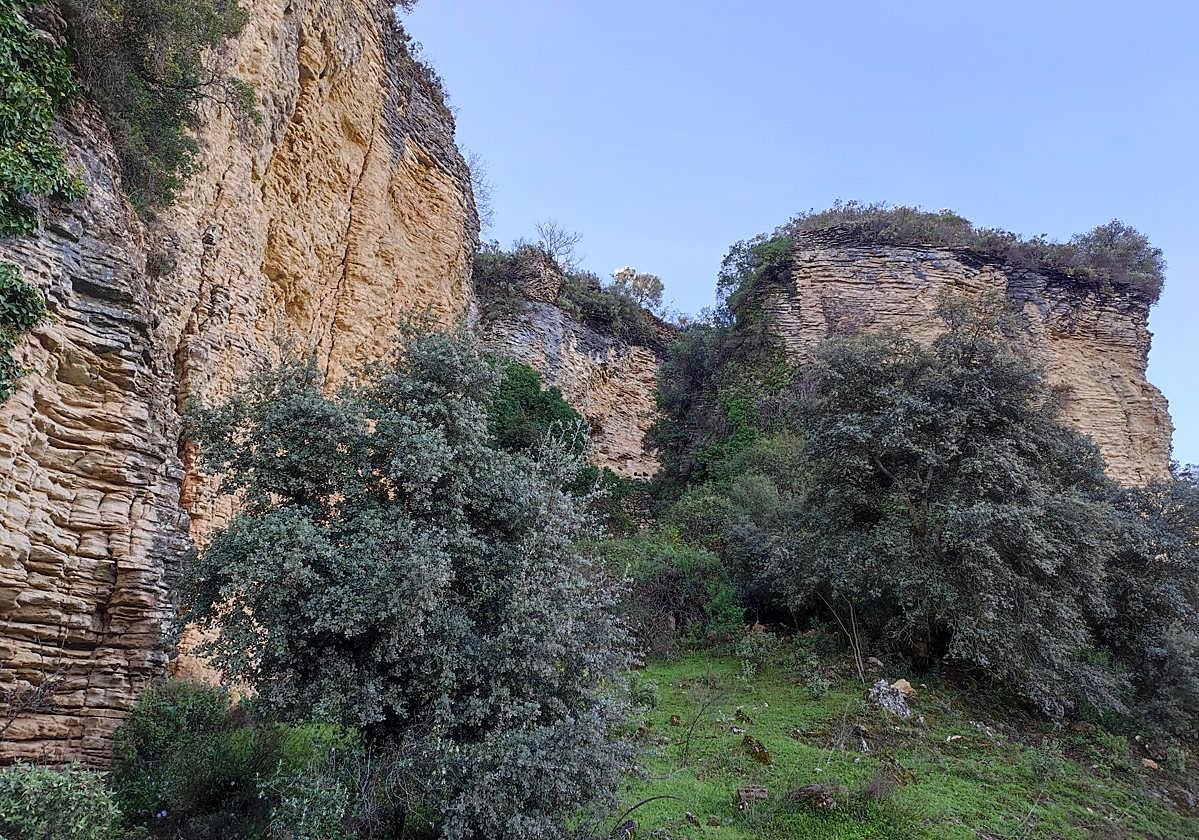

Just minutes away from Andalusia's most famous abyss lies another great rock cut that barely receives visitors. It is a rugged and quiet place, overshadowed for decades by the monumental icon that has brought worldwide fame to Ronda. There, there are no crowded viewpoints or railings, but there is a natural spectacle that surprises anyone who ventures into it through a winding path.
Its landscape strength has not gone unnoticed in the world of fiction. Long before it became a regular spot for hikers, this gorge had already captivated film and television with its spectacular nature. Among its walls, scenes from the film adaptation of the opera 'Carmen' were shot in the eighties, as well as episodes of the legendary series 'Curro Jiménez', which found there the perfect setting to recreate a rugged and legendary Andalusia.
Known as El Abanico, this geological complex is located south of the urban center of Ronda, next to the Sijuela stream. The continuous action of water on the Ronda molasse—a relatively soft sedimentary rock—has carved over thousands of years a narrow gorge with vertical walls and very striking eroded shapes.
The name comes from a unique rock formation that resembles an open fan, visible in one of the most spectacular sections of the route. It is one of the most valuable geological sites in the Serranía de Ronda, both for its morphology and the landscape that surrounds it.
Although it is further away from the historic center, El Abanico is perfectly accessible on foot. Thanks to the network of trails in the Serranía, it is possible to access this site without technical difficulty, following ancient traditional paths that have connected Ronda with other points in the region for centuries.
One of them starts from the end of the San Francisco neighborhood and coincides with an certified local trail (SL-A-40). The route first runs through wide and comfortable lanes and gradually descends towards the Sijuela valley, moving away from the urban environment and entering an increasingly natural landscape.
But this route is not just a hiking itinerary. It also includes one of the stages of the Great Serranía de Ronda, a major hiking project that connects the entire region on foot, and in this section, links the city with Alpandeire, the birthplace of Fray Leopoldo. This coincidence is not accidental: the route takes advantage of historical communication routes, used for centuries by muleteers, shepherds, and travelers.
The path was part of a traditional network that connected Ronda with the villages of the Genal and with the southern slope of the mountain range, and even with routes that eventually descended towards the coast. Even today, sections of cobblestone, dry stone walls, and features like gates and cattle grids remain, witnesses to its agricultural and livestock uses. Walking through this gorge is, therefore, to traverse not only a natural space but also an authentic historical route that has structured the territory for generations.
As you advance, the landscape changes. After leaving behind the first olive groves, holm oaks and gall oaks appear, until the path enters the shady area of the gorge, where steep rocks and riverside vegetation dominate.
The path passes by an old abandoned farmhouse that catches the eye with its slender stone tower, as well as remains of walls, threshing floors, and elements linked to traditional agricultural and livestock uses. Further ahead, the path narrows and follows the Sijuela stream, whose flow varies depending on the season.
It is in this final stretch where the geological complex of El Abanico is displayed in all its splendor, with eroded walls that inevitably remind one of the great natural symbol of Ronda, although here the atmosphere is much more solitary and wild.
One of the great attractions of this environment is its biological richness. The route crosses different landscapes, resulting in a notable diversity of flora. From the olive crops at the start, it moves to masses of holm oaks and gall oaks, culminating in riverside vegetation and that typical of limestone cliffs, where climbers and species adapted to rock appear.
Something similar happens with the fauna, especially with birds. In the initial sections, it is common to see sparrows, greenfinches, or finches, while in the gorge area, species linked to rock formations appear, such as the blue rock thrush, the red-billed chough, or the swifts. It is also not uncommon to spot raptors such as the kestrel or even the peregrine falcon soaring over the cliffs.
Like many unique corners of the Serranía de Ronda, El Abanico is surrounded by stories passed down from generation to generation. One of the most repeated places here a supposed ambush by the Lusitanian chieftain Viriato against Roman troops, a legend without historical basis but deeply rooted in oral tradition.
It is also said to have been used as a refuge for bandits and smugglers, attracted by the rugged terrain of the place and its proximity to ancient transit routes. Stories that, over time, have helped forge that romantic and mysterious aura that ended up seducing scriptwriters, filmmakers, and travelers.

Latest news





Upcoming events
12
Nov
El Desembarco, la traición de Viriato at La Caja Blanca
12
Nov
HOMER El Mero Mero at Sala Trinchera Málaga
13
Nov
Marbella Startup Lab – Innovate & Collaborate
13
Nov
Candlelight: Coldplay & Imagine Dragons at Sala Fundación Unicaja María Cristina
13
Nov
Candlelight: Tribute to Ludovico Einaudi at Anantara Villa Padierna
Similar News

Málaga Airport Makes History with More Than Three Million Passengers in One Month
Málaga

Port of Málaga looks beyond its docks to support future growth
Málaga

Guide to the Virgen del Carmen Processions in Málaga and the Province
Málaga
