


Picasso and Barceló Meet Through Ceramics
The Picasso Museum Málaga reinterprets the Picasso legacy from contemporary perspectives with a dialogue between both artists in Almería and Cádiz.
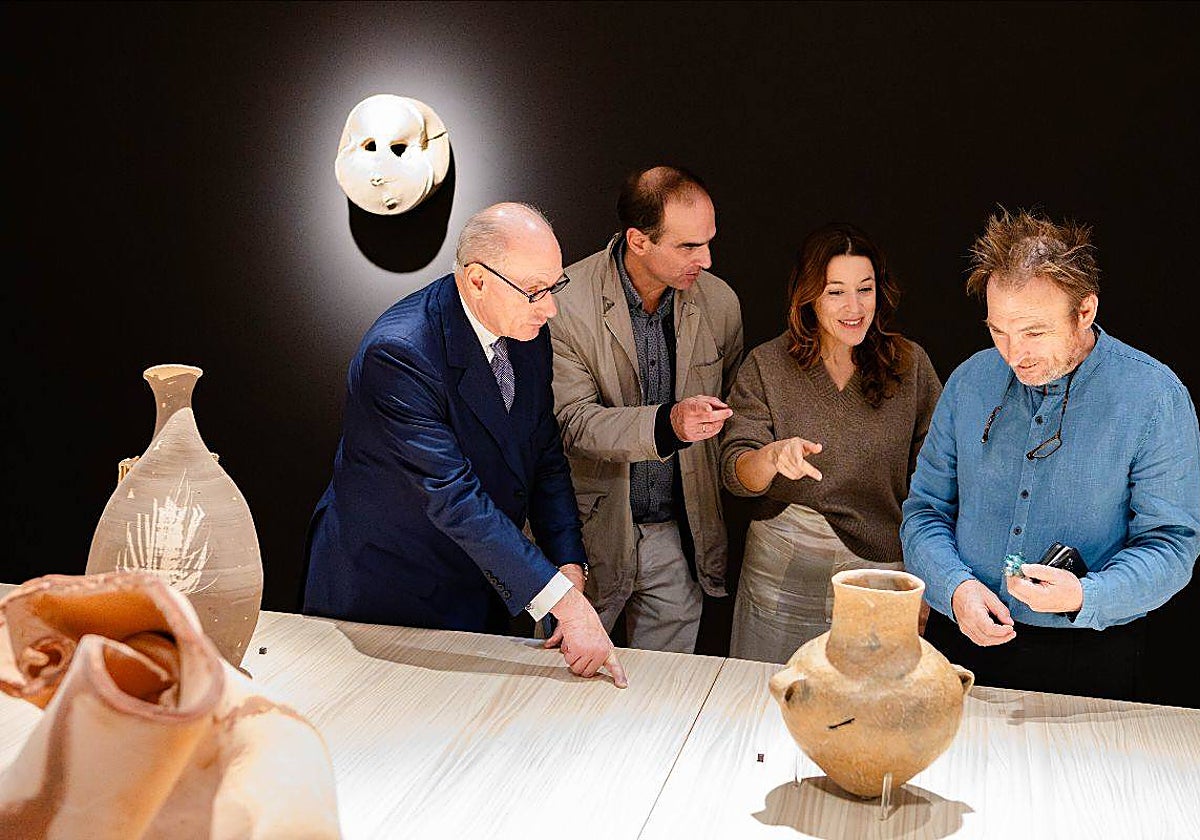

Pablo Picasso and Miquel Barceló connect through ceramics. The Picasso Museum Malaga extends the universe of the Malaga-born genius across Andalusia with ... a new chapter of 'Picasso Reflections', a line of work that seeks to reinterpret Picasso's work from contemporary perspectives in unique spaces of the community. Following 'Picasso x Koons', presented at the Alhambra and the Fine Arts Museum of Granada (December 2024 - March 2025), 'Picasso x Barceló' now reveals the connections between the work of the Majorcan artist and the Picasso legacy. The project was inaugurated this Tuesday at the Museum of Almería (December 16, 2025 – March 15, 2026) and will later travel to the Museum of Cádiz (March 25 – June 28, 2026).
Here, Pablo Picasso and Miquel Barceló converse through one of the oldest and most universal artistic mediums: ceramics. Their works are displayed alongside the archaeological collections of both museums, establishing a transhistorical intersection where prehistoric, ancient, medieval, and contemporary clay modeling practices find a common space. The exhibition also invites visitors to recognize in Barceló that constant echo of Picasso: an experimental attitude, a continuous reinvention from tradition, and a shared willingness to dialogue with ancient and modern art.
Expand
Chema Artero © Picasso Museum Malaga © Museum of AlmeríaSince the dawn of humanity, clay and fire have come together to shape ceramics, one of the oldest and most transcendent inventions. With the first vessels, humans found a way to preserve water, store grain, and cook food. Soon, these functional pieces also became bearers of symbols: they were decorated with geometric motifs, animals, or scenes of life, becoming witnesses to beliefs, rituals, and ways of imagining the world.
Clay, molded by hands, became a medium of memory. Trade spread ceramics along terrestrial and maritime routes, carrying jars, amphorae, and bowls from one end of the Mediterranean to the other. Each piece traveled loaded with oils, wines, or spices, but also with styles, techniques, and knowledge that mixed in ports and markets.
'Reflections. Picasso x Barceló' proposes understanding ceramics as a universal language that connects the useful and the transcendent, the everyday and the symbolic. The exhibition emphasizes the persistence of clay as a material of memory and experimentation, and places both artists within a Mediterranean genealogy of creators who, over millennia, have transformed clay into enduring art.
Expand
Chema Artero © Picasso Museum Malaga © Museum of AlmeríaFor Picasso, ceramics became an essential laboratory of ideas after World War II. In Vallauris, he discovered in clay a ductile medium that allowed him to unite painting, sculpture, and object, transforming plates, jugs, and vessels into human bodies, mythological beings, or everyday scenes, and connecting with the pottery traditions of Andalusia and the Mediterranean.
Barceló, for his part, came to ceramics in the 1990s, during his stay in Mali. There, he learned ancestral techniques from the Dogon community and turned an accident into a revelation: ceramics became a territory of exploration where the ritual, the bodily, and the experimental converge. His pieces bear the marks of the physical process, becoming living surfaces that retain the energy of the moment.
This exhibition, sponsored by the Unicaja Foundation, is curated by Miguel López-Remiro, artistic director of the Picasso Museum Malaga; Tania Fábrega, director of the Museum of Almeria; and Laura Esparragosa, director of the Museum of Cádiz.
Miguel López-Remiro states that while for Picasso "ceramics constitute not only a way to multiply his message, but also a privileged means of articulating tradition and innovation, memory and modernity"; for Barceló, ceramics constitute "a territory of exploration where the ancestral, the bodily, and the experimental converge." The curator also considers that "these two cities, Almería in the Mediterranean and Cádiz in the Atlantic, are key to understanding the evolution of this artistic medium and thus, thanks to Picasso and Barceló, creating a game of reflections between past, present, and possible futures."
Neolithic vessels, Phoenician amphorae, and Islamic pottery connect with the art of both creators
Situated in the archaeological contexts of Almería and Cádiz, the works of Picasso and Barceló dialogue with Neolithic vessels, Phoenician and Roman amphorae, Islamic pottery, and fragments of millennia of history. Thematic resonances that traverse time emerge: the human and animal figure as archetypes, fire as a transformative force, fragility as resistance, and the processes of fragmentation and reassembly as testimonies of time. And the sea, a shared soul of these two cities, which thanks to trade has been a channel of memory, mixing, and artistic creation among several civilizations.
The Museum of Almería, founded in 1933 and reopened in 2006 in a contemporary building, houses one of the most significant ceramic collections, with pieces spanning more than five thousand years, from the Neolithic to current productions. Its exhibition proposal, articulated around the stratigraphic column, allows understanding the cultural evolution of the southeastern peninsula through materials from sites like Los Millares or El Argar.
The Museum of Cádiz, located in Plaza de Mina since 1935 and declared a Site of Cultural Interest, is key to understanding the history and art of the city. Its collection is organized into three areas: Archaeology, Fine Arts, and Ethnography. Highlights include Phoenician sarcophagi, Roman sculptures, Baroque paintings by Zurbarán and Murillo, as well as the unique collection of puppets from Tía Norica. The museum offers a diverse tour that reflects the cultural identity of Cádiz from antiquity to the present.
'Reflections. Picasso x Barceló' is a project conceived and carried out in collaboration with Miquel Barceló, the Picasso Museum Malaga, and the Almine and Bernard Ruiz-Picasso Foundation, sponsored by the Unicaja Foundation and with the collaboration of the Ministry of Culture and Sports.

Latest news





Upcoming events
12
Nov
El Desembarco, la traición de Viriato at La Caja Blanca
12
Nov
HOMER El Mero Mero at Sala Trinchera Málaga
13
Nov
Marbella Startup Lab – Innovate & Collaborate
13
Nov
Candlelight: Coldplay & Imagine Dragons at Sala Fundación Unicaja María Cristina
13
Nov
Candlelight: Tribute to Ludovico Einaudi at Anantara Villa Padierna
Similar News

Málaga Airport Makes History with More Than Three Million Passengers in One Month
Málaga

Port of Málaga looks beyond its docks to support future growth
Málaga

Guide to the Virgen del Carmen Processions in Málaga and the Province
Málaga
