Costa del Sol News
There is evidence of numerous Christmas campaigns to practice charity for the poor in Marbella, spanning decades, since at least the 19th century. Poverty was a chronic issue in the city, and charitable acts, promoted by wealthy families, the church, and official bodies, occurred throughout the year, but were especially prominent during the Christmas season.
We go back to December 1949. That year, three events marked the Christmas charity campaign. The initiative kicked off mid-month at the Francisco Franco youth hostel, which had been provided by the provincial delegate of the Frente de Juventudes, Francisco Valverde. Two thousand food rations were distributed to those in need.
Significant ladies from the locality cooked from early in the morning. At two-thirty in the afternoon, the distribution began, initiated by María del Carmen Casanueva, wife of the Minister of Justice, Raimundo Fernández Cuesta. It took two hours to complete the distribution. It was noted that such a distinguished lady "spent the entire afternoon giving a lesson in Christian charity that was warmly applauded."
As in the twenties and thirties, public aid to the poor had a significant component of spectacle. The event was supported by the City Council and the Parish of Santa María de la Encarnación, where the archpriest Rodrigo Bocanegra had debuted a few months earlier.
A second charitable act was the distribution of clothing to needy children at the Maritime Orientation School of the Virgen del Carmen Fishermen's Guild. The school and the school wardrobe were headed by teacher Juan Belón Lima. Sixty-three sweaters and the same number of pairs of espadrilles were handed out. The Ministry of National Education subsidized the school wardrobe with two thousand pesetas. The event, held at the school premises, was attended by civil, military, and religious authorities. Naturally, there were speeches in which praise for the 'Caudillo' and his 'generosity' were not lacking.
The centerpiece of the campaign took place on Christmas Eve. It was noted that it was "difficult to express the spectacle of an entire town united in a magnificent example of charity and love for one's neighbor, without social differences, without prejudices, in short, that put into practice the words of Our Lord Jesus Christ, love your neighbor as yourself."
At twelve noon, 450 bed blankets and 520 food bags were handed out to needy families. Each bag contained one kilo of beans, half a kilo of rice, one liter of oil, and half a kilo of fig bread. Also, two thousand five hundred portions of bread were distributed according to the number of family members. The distribution took place at the Teatro Cine El Rodeo, owned by Ricardo Soriano, Marqués de Ivanrey, and managed at that time by Saturnino Cid Rodríguez, who provided the venue for the occasion.
Ladies and young ladies from Catholic Action were in charge of the distribution. During the time the activity took place, the rondalla of the artistic group of the Most Holy Christ of Love, a Passion brotherhood in its early stages, performed several Christmas carols and songs from their repertoire.
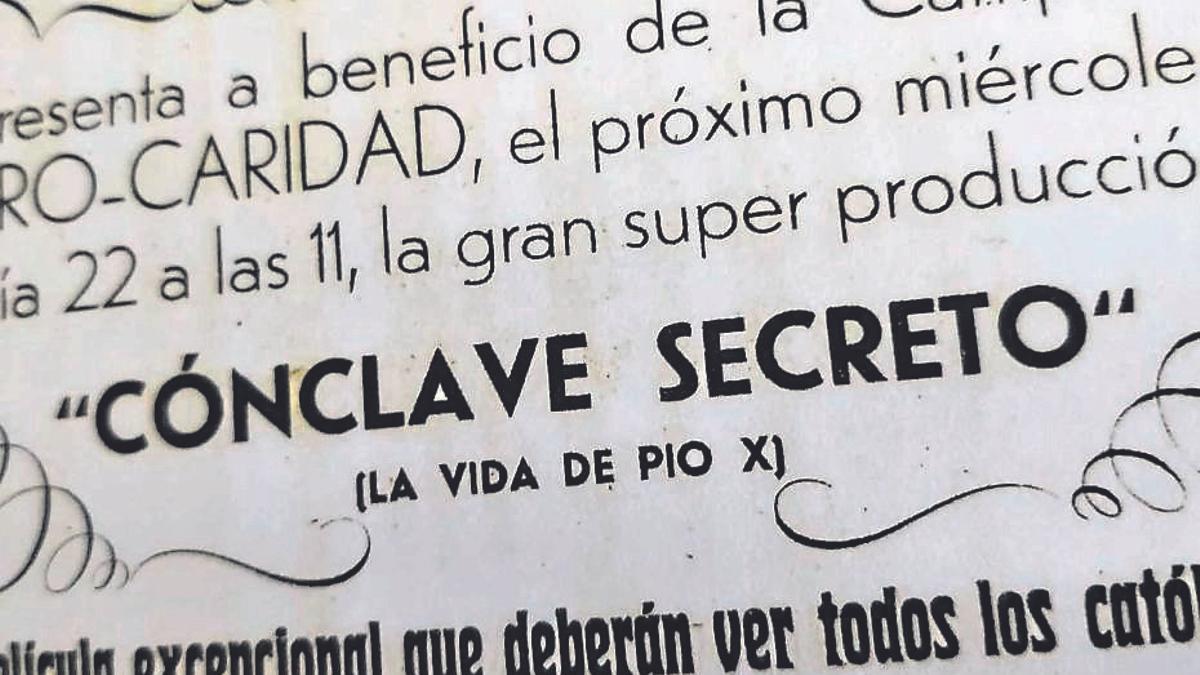
At six in the evening, also for the benefit of the poor, a film about Saint Francis of Assisi was shown, filling the cinema. Throughout that day, on three occasions, the parish priest Bocanegra spoke: before the distribution of blankets and food parcels, after the film screening, and at night, during the Midnight Mass, which saw a massive attendance.
The new priest, since his arrival, began to receive support from the officials: "Marbella has found the shepherd of souls it needed, as it was hungry for spiritual affection and our beloved parish priest gives it abundantly." This praiseworthy comment towards the new parish priest necessarily came to discredit the work carried out by the previous parish priest, Manuel Ballesteros Jiménez, who had been transferred to Málaga.
The Christmas campaign, diversified into different acts, would be a constant for many years. A change in the methods and possibly the effectiveness occurred when radio arrived in Marbella at the end of the fifties.
On Radio Marbella, help for the needy was promoted throughout the year, through the program 'El prójimo eres tú', which would be the origin of 'Cáritas' in the city. At Christmas, the focus was especially on collecting food and toys. In the success of those campaigns in the sixties and seventies, radio amateurs, a form of volunteering when that term was not used, were indispensable.