


The treasures of the Malaga metro: Culture orders the preservation and relocation of several Roman tombs from an unknown cemetery
The discovery has added value: it was not based on documentary records or previous historical references of settlements in the area.
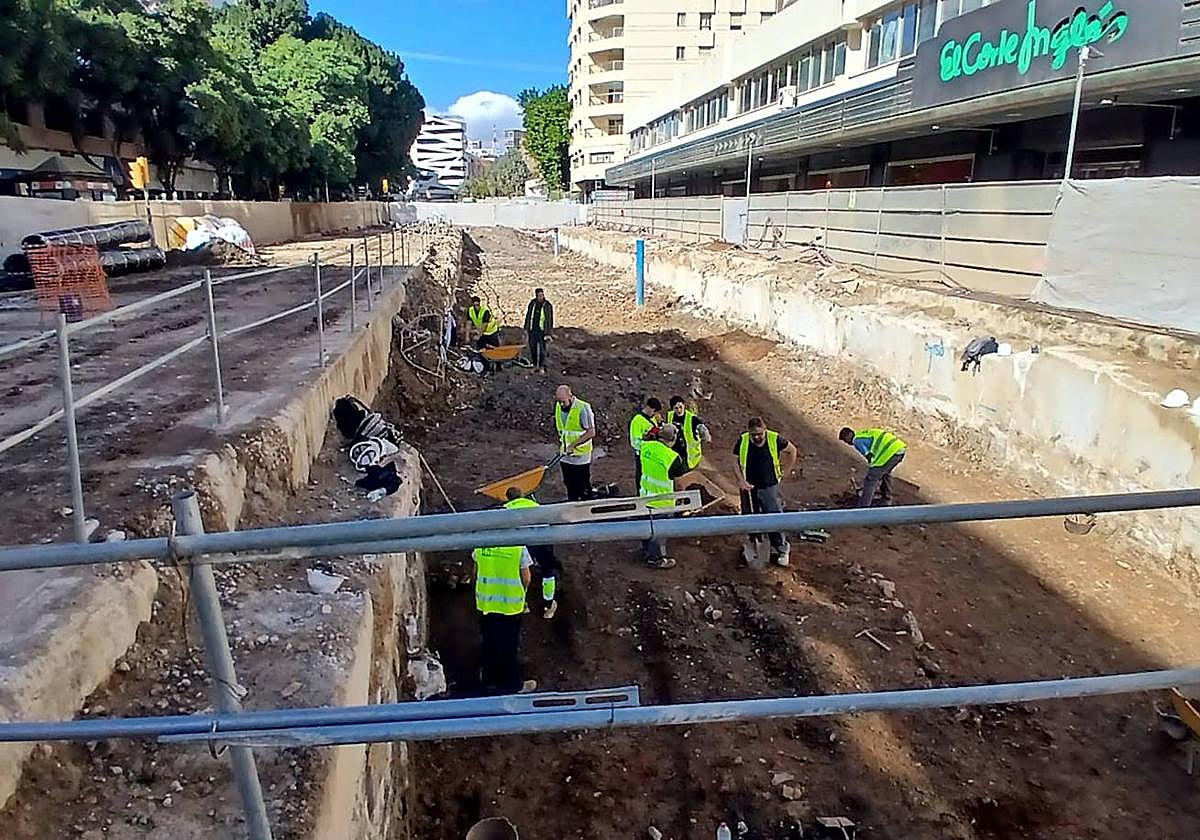

Archaeological findings in any excavation carried out in the city are not a surprise. Some are more valuable than others according to experts. ... On this occasion, once again, the extension works of metro line 2 towards the future third hospital have revealed an underground treasure: a Roman necropolis dating from the 2nd to the 4th centuries AD. For this reason, the works are delayed until the archaeological tasks are completed.
A team of archaeologists has been working on the site for some time, next to the new building of El Corte Inglés. Now, the Ministry of Culture has issued a resolution on the matter. Sometimes, the instruction is to catalog, preserve, and rebury. In this case, the verdict is to conserve and relocate those tombs that are more valuable and monumental.
"The resolution establishes extensive archaeological excavation, action on all tombs, and the relocation and enhancement of the most unique ones," the Ministry of Development assures in a statement to the media.
Expand
Some tombs must be moved. SURThe discovery spans 400 linear meters on Hilera Street and work has been ongoing since May. Moreover, it is a discovery that was not based on any documented evidence or historical references prior.
The possible existence of a Roman era occupation was only identified in the area of Perchel Norte. In fact, according to research conducted to date and the literature consulted, the sector encompassed by Calvo Street, Hilera, and Andalucía Avenue was reclaimed from the sea starting from the Muslim era, which explained the absence of Roman funerary remains in the area.
Historical Value
The investigation carried out in the mentioned sector confirms the discovery of a Roman necropolis, from both the early and late imperial periods, near Hilera Street, opening a new avenue for research, and which could illustrate the possible existence of a suburban area from the imperial era connected with the city, and consequently, a sepulchral route or exit route from the city of Málaga.
During the extensive archaeological excavation works, carried out between May, August, and the last months of the year, 274 burials have been found where the type of ritual corresponds to inhumation and which are characterized by the presence of scant grave goods. A stratigraphic sequence has been developed to reach a lower layer of the ground where the tombs are inserted.
A high percentage of the corpses are buried in pits with horizontal tegulas (flat tiles placed over the body as a funeral cover). By type of burial, frame tombs covered with tegulas; mensas with pits and boundaries made with mortar; simple pit tombs, ossuary tombs, perinatal burials in whole or selected amphorae, or in pits delimited with bricks, among other types, have been found. Funeral enclosures have also been found, some built with masonry and foundations of rounded stones, in various states of preservation.
296
tombs have been found in this necropolis.
Given the scope of the discovery, the resolution of the Ministry of Culture determines the need to expand the investigation, applying new excavation techniques related to anthropological perspective and obtaining additional information for the heritage valuation of the entire property. This greater methodological effort must be specified with the excavation of each funerary complex and individual space with interdisciplinary methodology, from archaeology to physical anthropology. Specific machinery will also be used in the opening of the sedimentation.
Furthermore, the excavation, protection, and enhancement of those tombs and anatomical remains that are in better condition, and are distinguished by their monumentality, will be prioritized and will be transferred to the future museum space of the metro works at Guadalmedina Station.
Attabanim
The implementation of these corrective measures, which are focused between the points kilometers 0+110 and 0+500 of the Guadalmedina-Hilera section, will condition the work program in the execution of the metro. The next phase corresponded to the extension of the tunnel roof slab in this section, which will now have to wait for the implementation of the measures contemplated in the resolution.
The Málaga Metro works, promoted by the Ministry of Development, Territorial Coordination, and Housing, thus confirm their commitment to the preservation of the heritage richness found in the city's subsoil, as evidenced by precedents such as the protection, transfer, and storage of remains found during the extension works of the subway to the historic center, where vestiges of the old Muslim suburb of Attabanim, among other historical remains, surfaced.

Latest news





Upcoming events
12
Nov
El Desembarco, la traición de Viriato at La Caja Blanca
12
Nov
HOMER El Mero Mero at Sala Trinchera Málaga
13
Nov
Marbella Startup Lab – Innovate & Collaborate
13
Nov
Candlelight: Coldplay & Imagine Dragons at Sala Fundación Unicaja María Cristina
13
Nov
Candlelight: Tribute to Ludovico Einaudi at Anantara Villa Padierna
Similar News

Málaga Airport Makes History with More Than Three Million Passengers in One Month
Málaga

Port of Málaga looks beyond its docks to support future growth
Málaga

Guide to the Virgen del Carmen Processions in Málaga and the Province
Málaga
