


Albéniz, the last cinema in Málaga, turns 80 years old
The theater that grew famous with the exclusive showing of 'Gone with the Wind' is the sole survivor from the golden age of film exhibition in the capital. Transformed into a box office success with original version screenings, and far from disappearing, it is finalizing its expansion.
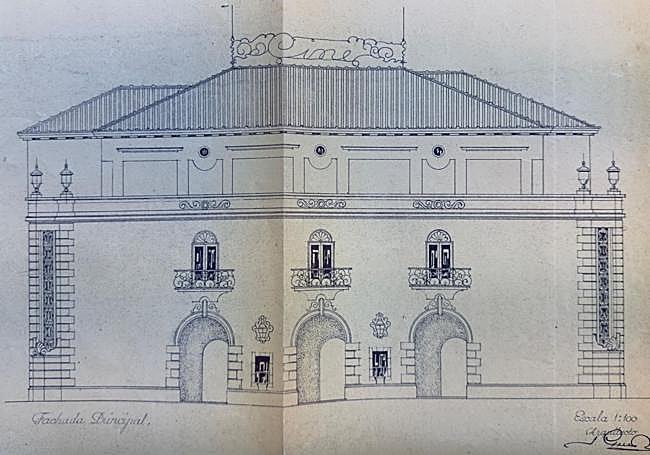

If it were a movie, it would be titled 'Mission Impossible'. That's how one feels walking down Alcazabilla on the way to the Albéniz box office, having to dodge pedestrians, tourists, and various delivery people on the busy walk. The feeling of not making it to the screening on time contrasts with the same scene 80 years ago. Back then, the street was more of an unpaved lot and, although the city's most modern cinema-theater opened there, nobody went because it was too far away. Hard to believe. In that post-war Málaga, the kilometer 0 of the billboards was in Uncibay square, where the gigantic Málaga Cinema, the exquisite Goya, and the pretentious Echegaray competed. Reaching the outskirts of the center where the new hall was located was then another 'Mission Impossible'. But because it was inhospitable. The solution was given by the roar of the Metro Goldwyn Mayer lion, which the people of Málaga eventually heard when the Hollywood studio signed the exclusive rights to premiere its films at the Albéniz. Eight decades later, the legendary hall is the last survivor of the golden age of the big screen and, moreover, with as much future as it has past: its recent expansion by the City Council.
"It was a cinema that was in no man's land, and also isolated," recalls critic and journalist Guillermo Jiménez Smerdou, about that large exhibition venue that opened its curtain in 1945, with a project by architect José González Edo, whose original plans and first photos were donated by his descendants to the Provincial Historical Archive of Málaga of the Ministry of Culture. Promoted by the company Constructora Inmobiliaria Malagueña, the cinema would end up becoming the engine for the urban transformation of Alcazabilla, which would still have to wait until 1951 to (re)discover by chance the Roman Theater, during the construction of the House of Culture.
But attracting the public to the foothills of the Alcazaba required an extra dose of seduction and marketing. "For the people of Málaga back then, the center ended at Uncibay square," explains Jiménez Smerdou, whose diagnosis is shared by historian and archivist María Pepa Lara who describes the photo of the era around the cinema: "There were no houses, only plots of land, and it was not paved." "It's hard to believe today, but the Albéniz was considered to be on the outskirts and for the spectators, it was an odyssey," adds Lara, who before becoming a chronicler of Málaga's memory, was a spectator of that hall, once it managed to attract the large public in the 50s and 60s.
The author of 'History of Cinema in Málaga' picks up a handbill from the era when it was called "Gran Albéniz" with the announcement of the 1960 premiere of the religious film 'Molokai' and exclaims: "Oh, how I cried with this movie." In that post-war Spain of scarcity, where television was still science fiction, the great leisure of the people of Málaga was cinema. "Premieres arrived twice a week, on Mondays and Thursdays, and the movies lasted about three days except for the most box-office hits that could be on the billboard for a week," recalls Jiménez Smerdou, who broadcast movies on his radio program 'Invisible Cinema' and does not forget the resounding success of the film that consecrated that new hall: the legendary 'Gone with the Wind' premiered on March 24, 1951, and was on the billboard for a month. "Something unheard of in those years," he emphasizes.
Like its protagonist, the Albéniz could shout what Scarlett O'Hara said at the end of the first part of this superproduction – "As God is my witness, I'll never be hungry again" – because the exclusive acquisition of this Hollywood superproduction gave it fame and box office. And moreover, it re-premiered it in the following years to the delight of the people of Málaga. María Pepa Lara did not miss it, despite the fare at its premiere: 15 pesetas, the cheapest seat. "As they were the only ones and the film was very famous, the price was high," confirms the historian, who remembers with a laugh the play on words of the people of Málaga to refer to the cost and the excessive length – four hours – of this serial of Vivien Leigh and Clark Gable: "People said they had gone to see 'What the money cost me and my ass hurt'."
The takeoff of this cinema coincided with the contract that the Albéniz signed with MGM and Warner to acquire their catalogs. Also with the change in management when the owners who built it sold it to Braulio Murciano and Juan Herrera. "They turned it into the most important in Málaga, despite the initial problems," states Jiménez Smerdou who adds that "Don Braulio was the only businessman who respected my work and never pursued me to speak well of his movies."
With its new owners, the cinema experienced one of its most prosperous times. Owners also of Avenida and managers of Moderno and Cervantes, Murciano & Herrera made the Albéniz their great showcase with the premiere of legendary films, such as 'Spartacus', 'Ben-Hur', 'Samson and Delilah', 'Seven Brides for Seven Brothers', 'Doctor Zhivago' or the Fordian 'Sergeant Rutledge'. In the seventies, the hall was 'infected' - like everyone - by the cinema of the destape and accused the competition of the nearby Astoria. However, both venues managed, with the support in their environment of Andalucía and Victoria, to move the 'Gran Vía' of Málaga and the favor of the public from Uncibay square to the Merced-Alcazabilla axis, where the main capacities of the capital were concentrated.
With democracy and the expansion of color television, changes were looming. And the Albéniz paid the price in the form of a sanction. The largest of a Málaga cinema. The screen quota legislated by the Government in 1980 to protect Spanish cinema had an implacable application and the inspector of the Ministry of Culture noted that the Alcazabilla hall was missing six days of exhibition of national films in the first quarter. The company appealed and argued that it had also projected special passes of the national 'blockbuster', 'Rocky Carambola', from the television idol Torrebruno and that "perhaps we lack one day", which it attributed to a "calculation error". The plea of discharge helped reduce the penalty, but the authority was resolute: the minister Íñigo Cavero signed a fine of 324,500 pesetas from 1981. At 200 pesetas per ticket, the revenue of more than 1,600 spectators to pay for the 'slip'.
That served to set an example for the rest of the cinemas, but also to further discourage the owners who no longer saw the business. The following year, they transferred the emblematic screen to Francisco Gómez Reyes, the great entrepreneur of exhibition in Málaga, who created the 'Albéniz Circuit', along with the rest of his group's halls in the capital: Regio, Aleixandre, and Palacio del Cine – former Capitol –. But the arrival of América Multicines days before its premiere in 1980 changed everything. The complexes with several screens and smaller capacities imposed themselves over the old megahalls and many cinemas closed. The Albéniz also succumbed, but to be converted into four halls at the end of the 80s. However, the reform was complicated. The property removed the amphitheater and the boxes, the City Council paralyzed the work, a court authorized to continue with the rehabilitation and, in 1991, the hall reopened without an opening license. The local police did not take long to seal the cinema that had to wait several months to resume projections until it made peace with the City Council.
As a result of the new understanding, in 1993, the Municipal Cinematheque began to operate, which every Thursday projected films in the original version. That would be the germ of the acquisition of the legendary cinema by the City Council. Under the formula of expropriation, the Culture Area acquired its property in 2008 after disbursing 6.1 million euros, with plans to spend as much to convert it into a theater/cinema. But the plans changed. The Málaga Festival finally assumed its management and, after an express rehabilitation of 40 days and a reduced budget of one million euros, it reopened in April 2010 as a cinema with four screens. A year earlier, the Echegaray had been rehabilitated to become a theater, while a decade later the Alameda followed in its footsteps under the hand of Antonio Banderas.
"We started with the idea of a billboard for all audiences, with special attention to Spanish and auteur production, but we also welcomed commercial films in V.O. In fact, we inaugurated with Tim Burton's new version of 'Alice in Wonderland', but the audience told us they wanted another type of cinema, the one that made us different from the rest of Málaga's billboard," explains Juan Luis Artacho, head of programming at the municipal company Málaga Procultura, which today integrates the Albéniz. The premiere of the Hollywood 'Fantastic Mr. Fox' resulted in just 13 spectators in its first weekend, while the auditorium filled up with the French 'Villa Amalia' or the New Zealand 'Mao's Last Dancer'."
"We doubled down on the bet and dedicated all the halls to alternative cinema to the commercial circuit," recalls Artacho who cites as an example the recent premiere of one of the films that points to the next edition of the Goya Awards, 'Sundays', by Alauda Ruiz de Azúa, with the story of a young woman who feels the call of the habits and religion. "The revenue we have made with that film can compete with any cinema in Spain, even Madrid or Barcelona," argues the programmer who, although he confesses that the beginnings were not easy, the municipal hall has a very loyal audience, particularly older adults over 40, who do not give up movies on the big screen. "I still go to the cinema and my favorite is the Albéniz, because it has the best billboard and is in the center of Málaga; it is the most comfortable to get to by walking," assures historian María Pepa Lara, giving reason to Artacho.
There is no premiere, cycle, or exhibition – Fancine, German Film Festival, French, Italian... – that is celebrated in Málaga without having Alcazabilla as its headquarters, which has made the octogenarian hall look to the future with its expansion project, the Neoalbéniz. This December the work should have been finished, but the works in the nearby square of Jesús el Rico make it clear that there are still a few bricks to be laid to finish those two new halls that will increase the billboard to six of the last surviving cinema in the center. It is not its only record. It is also the only hall in Spain with public management by a City Council and with weekly premieres. A model that they are trying to imitate in other parts of the country. "The most beautiful thing is when you see a father who brings his children to see 'Singing in the Rain' and, at the same time, those young people come alone," concludes Artacho. With that quarry, the Albéniz movie still has footage to project. To the hundred.

Latest news





Upcoming events
12
Nov
El Desembarco, la traición de Viriato at La Caja Blanca
12
Nov
HOMER El Mero Mero at Sala Trinchera Málaga
13
Nov
Marbella Startup Lab – Innovate & Collaborate
13
Nov
Candlelight: Coldplay & Imagine Dragons at Sala Fundación Unicaja María Cristina
13
Nov
Candlelight: Tribute to Ludovico Einaudi at Anantara Villa Padierna
Similar News

Málaga Airport Makes History with More Than Three Million Passengers in One Month
Málaga

Port of Málaga looks beyond its docks to support future growth
Málaga

Guide to the Virgen del Carmen Processions in Málaga and the Province
Málaga
